Partition numbers to 1,000Quick View
ayanm21

Partition numbers to 1,000

(0)
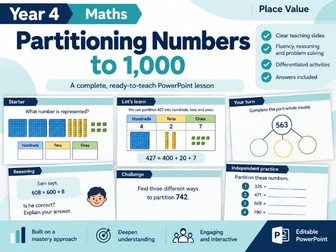
A ready-to-use Year 4 maths lesson on partitioning numbers to 1,000, designed around the White Rose Maths approach to Place Value. This lesson helps pupils develop a secure understanding of 3-digit numbers, place value and partitioning, using a progression from concrete and pictorial representations to abstract calculations and reasoning. The resource includes: Clear learning objective and success criteria Starter activity to recap place value Teacher input and worked examples Hundreds, tens and ones place-value activities Part-whole models Numbers containing zeroes Guided practice Fluency questions Reasoning and explanation questions Challenge activities for higher-attaining pupils Independent practice Learning objective: To partition 3-digit numbers into hundreds, tens and ones. Key vocabulary: partition, place value, digit, hundreds, tens, ones, value, part-whole model Suitable for Year 4, classroom teaching, intervention, revision, consolidation or maths mastery sessions. Please note: This is an independently created resource inspired by the teaching approach and progression used in White Rose Maths. It is not an official White Rose Maths resource.
Place Value- Year 4 White rose styleQuick View
ayanm21

Place Value- Year 4 White rose style

(0)
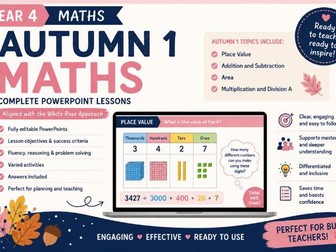
Year 4 Maths – Autumn 1: Place Value to 1,000,000 A complete, engaging Year 4 Place Value PowerPoint lesson designed to support pupils in developing a strong understanding of numbers and place value, following the White Rose Maths-style progression. This resource is ideal for whole-class teaching, maths mastery, revision, intervention or independent learning. What’s included: Clear learning objective and success criteria Place value up to 1,000,000 Reading and writing numbers Understanding the value of each digit Partitioning numbers into place-value parts Comparing and ordering numbers Number representations and place-value charts Numbers with zeroes Fluency activities Reasoning and problem-solving questions Challenge activities Think-Pair-Share opportunities Independent practice Perfect for: ✔ Year 4 Autumn 1 ✔ Whole-class maths lessons ✔ White Rose-style teaching ✔ Maths mastery and deeper understanding ✔ Intervention and consolidation ✔ Teachers looking for a ready-to-use resource Please note: This is an independently created resource inspired by the teaching approach and progression commonly used by White Rose Maths. It is not an official White Rose Maths resource.
What is a solid?Quick View
ayanm21

What is a solid?

(0)
This lesson introduces Year 4 pupils to the properties of solids, helping them understand that solids keep their shape because their particles are packed closely together. To explore this idea in a practical way, the class carries out a simple experiment in which they shake a jar of cream until it turns into butter. During the activity, pupils observe how the liquid cream gradually thickens and eventually becomes a solid that holds its shape. This hands-on investigation helps them see how a material can change state and reinforces their understanding of what makes a solid different from a liquid.
Exploring AmplitudeQuick View
ayanm21

Exploring Amplitude

(0)
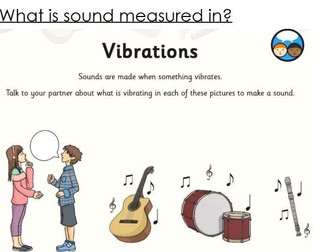
What is sound measured in? This science lessons explores the amplitude of sounds. This lesson includes a practical activity that will engage the students and give them a better understanding of sound and amplitude.
Electricity- Components of a circuit lessonQuick View
ayanm21

Electricity- Components of a circuit lesson

(0)
This lesson focuses on understanding the key components that make up a circuit and aims to answer the following questions: What is electricity? How is it made? what is a circuit? How does a circuit work? what are components of a circuit?
Conductors and insulators lesson - investigationQuick View
ayanm21

Conductors and insulators lesson - investigation

(0)
This lesson focuses on understanding the difference between conductors and insulators and how they impact electricity. The task is a hands on group work investigation to find out which materials block the flow of electricity and which do not. Key questions: What are conductors? What are insulators? What is the difference? How do they effect the flow of electricity?