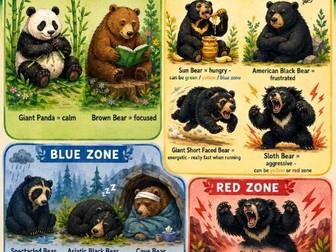
Bears Zones of Regulation Visual PosterQuick View
noblek123

Bears Zones of Regulation Visual Poster

(0)
A child-friendly Zones of Regulation bear poster co-designed with a Year 5 student to support emotional literacy and self-regulation. This colourful visual resource uses different bear species as memorable metaphors for emotions and regulation states. I designed it with one of my Year 5 students as part of a discussion about feelings, focus, energy levels and the Zones of Regulation. The poster links each bear to a feeling or state, helping pupils use concrete, engaging animal metaphors to recognise and name what they are experiencing. The Sun Bear is shown as a flexible example because hunger may appear differently for different children — sometimes as low energy, sometimes as irritability, and sometimes as feeling mostly okay but needing food. The Polar Bear is included as an “unclassified” example to show that physical states such as feeling cold do not always fit neatly into one emotional zone. This resource may be useful for: Zones of Regulation displays PSHE and emotional literacy lessons SEN / SEND support Visual teaching 1:1 tutoring, mentoring or intervention work Calm corners or regulation stations Helping pupils discuss feelings through metaphor Supporting children to notice, name and understand body states It is designed to be warm, visual and memorable, especially for pupils who respond well to animals, humour, visual metaphor and concrete examples. It can be used as a classroom poster, a discussion prompt, or a starting point for children to create their own regulation metaphors.

AQA English Language Paper 1 Question 2 GuideQuick View
noblek123

AQA English Language Paper 1 Question 2 Guide

(0)
Step-by-step guide to AQA GCSE English Language Paper 1 Question 2 (8 marks): how to analyse language with model answers, worked example and planning grid. This 10-page Word guide takes students through Question 2 of the AQA GCSE English Language Paper 1 (8700/1), using the November 2024 exam: “How does the writer use language here to describe Foxcote Manor?” It breaks language analysis into five clear steps that students can take into any Question 2: Read the extract Select your evidence Annotate your evidence Brainstorm ideas and make three claims Plan and write your answer What’s included: What Question 2 is looking for: the what / how / why of language analysis, plus a “do this, not that” table of common mistakes (such as feature-spotting and generic effects). Model answers: the Level 3 and Level 4 indicative standards from the AQA mark scheme, colour-coded for meaning, method and explanation of method, with notes on what lifts the Level 4 response. A worked example for every step: annotating a quotation, grouping evidence into three claims (“intimidating”, “dilapidated” and “a haven for nature”), and a completed paragraph plan. The planning grid: Claim → Evidence → Analysis → Zoom → Analysis of zoom, which helps students move from spotting a technique to in-depth, word-level analysis. From Level 3 to Level 4: a first draft and a redrafted paragraph side by side, with notes explaining exactly what changed and why. It’s ideal for modelling redrafting and self-assessment. A blank planning grid for students’ own three paragraphs. A one-page quick-reference sheet for students to keep in their folders. How to use it: the guide works for whole-class teaching, intervention groups, one-to-one tuition, homework or revision. Use it alongside the AQA November 2024 Paper 1 question paper and mark scheme, which are free to download from the AQA website. The extract itself isn’t reproduced in this resource. Suitable for GCSE English Language students in Years 10 and 11, including those aiming to move from a Level 3 (5–6 marks) to a Level 4 (7–8 marks) answer.