Three sets of resources to support the AQA Medieval England: Edward I topic at GCSE.
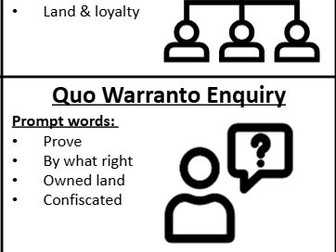
Dual coded card deck for vocabulary grouping/recall games.
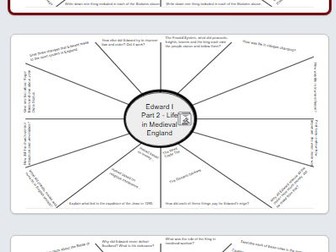
Set of revision clocks for structured revision lessons or homework.
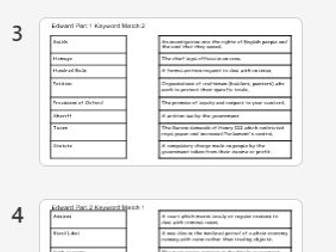
Keyword matching tasks for starter activities, gives students a complete medieval glossary.
Set of 48 cards broken down into 3 parts for GCSE AQA History students studying the Edward I topic. Each card has prompt words and icons to dual code.
Could be used for any word based revision games to build confidence with challenging key terms, e.g:
Articulate: students describe key historical terms first using the prompt words or for extra challenge treating these as ‘Taboo’ words.
Categories: Students are challenged to group the cards into categories (e.g social, political, economic) and then have to turn pages over and list as many key terms in that category as they can.
All images credited from Noun Project creators in notes of each slide.
5-6 Lesson Scheme on the focus “Were the Suffragettes the main reason why women got the vote in 1918?” aimed at middle Key Stage 3 groups with a skill focus on historical interpretations.
Bundle includes:
Powerpoint 1, “Why did some women in Britain want the vote?” with keyword diagram and source analysis tasks included to unpack the idea of class.
Card sorting activity for lesson 1 with arguments for and against womens’ suffrage.
Powerpoint 2, “Did the tactics of the Suffragists make any difference?” with historical interpretation analysis tasks included.
Reading sheet and worksheet for structured comprehension on the Suffragists.
Powerpoint 3, “Who were the Suffragettes and what did they do?” with keyword diagram on ‘Direct Action’, table worksheet, Suffragette Case studies profiles (Emily Wilding Davison, Leonora Cohen, Annie Kenney, Mary Richardson) and source analysis tasks included.
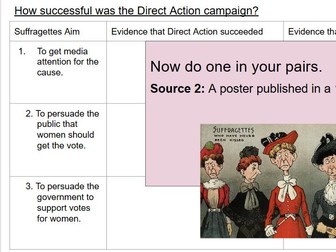
Powerpoint 4, “How successful was Direct Action?” with video task and structured source analysis task included, focusing on different aims of Direct Action and their success - versions with more or fewer sources for different class groups.
Powerpoint 5, “Was World War 1 the tipping point in the womens’ suffrage campaign?” with historical interpretation analysis tasks included.
Reading sheet for lesson 5 to support structured note taking on World War 1.
Powerpoint 6 with a debate question and suggestions on structure.
Comprehensive knowledge organiser to support students in revising for the debate activity or other assessments.
All powerpoints and sheets should be editable and dual coded.
Vocabulary match activity aimed at mixed ability year 10 and 11 classes studying King Edward I and medieval England for their AQA British Depth Study.
Each slide is could be a starter activity, revision starter or glossary for an exam practice task to support extended writing.
Broken down into sections of the course.
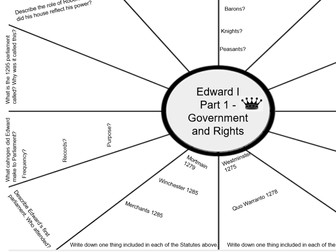
Three revision clocks aimed to support mixed ability year 10 and 11 classes studying King Edward I and medieval England for their AQA British Depth Study.
Each slide is a revision clock on one part of the course and could be completed in class or as homework to activate student retrieval from their memory and then filling in detail from one of the AQA approved revision guides or their classwork.
Each should be printed A3 if possible to allow space for writing.
‘Talk like a historian’ set of 12 simple, colourful posters to display in secondary history classroom with accessible definitions and dual coded.
Terms included: Cause, Consequence, Chronological, Continuity, Change, Evidence, Factor, Interpretation, Inference, Provenance, Significance, Source.


 Quick View