The Big Christmas Quiz 2025Quick View
jillbeckwith

The Big Christmas Quiz 2025

(0)
Here it is! The one you’ve all been waiting for! Bigger and better than last year! Save yourself energy and time at the end of term by downloading this topical and Christmassy class quiz! A pub-style quiz with twelve rounds of 10 questions in each. Created in PowerPoint so that it is easy to use in any classroom. (Answers for teachers are in the notes frame of each slide. This can also be printed off in advance). Suitable for 6th formers or those in upper secondary years. Ideally played in teams of about 4, although in smaller classes, students can play in pairs. Question categories are selected by teams and hyperlinks on the PPT take you to the 10 specific questions for each round. A final slide in each set takes you back to the round selection slide ready for the next team. The quiz contains rounds with a Christmas or topical flavour as follows: 1 Christmas crackers 2 Books and Art 3 History 4 Music 5 What happened in 2025? 6 Over the Rainbow (colour-themed questions) 7 TV and Film 8 Science 9 Name that Tune! 10 Find the connection! 11 Nature 12 Where on Earth? (geography themed questions) …and a Tie break question in the event of a tie between teams. NB - the quiz was initially designed for A Level Language students so round 9 asks them to guess the titles of Christmas songs written in the IPA (International Phonetic Alphabet). However, this is guessable and decodable with a bit of imagination and so need not be avoided by non-linguists. Preparation • teams of about 4 (for smaller classes - aim for no fewer than 3 teams) • paper and pens - for the ‘whole class’ rounds • white board - for teacher to keep running score • festive music, food and prizes are optional! How to Play First round: (used to decide which team selects their individual round first) As a class - use the ‘Christmas Crackers’ round. For this, teams write down their answers, the teacher gives the answers at the end of the round and then records each team’s score on the white board. Next rounds: Teams then take it in turns (order chosen by teacher, e.g., highest or lowest scoring team from Round 1) to select their preferred category from the round selection slide. Students confer in their teams and then give answers verbally and score themselves. Any wrong answer can be offered to other team to score bonus marks (e.g., quickest to raise hand when asked.) Teacher records teams score and any bonus points on white board. Tie-break In the event of 2 teams on the same score at the end - use the ‘tie-break’ question. Depending on time and number of teams • Either more whole class rounds where students write answers on paper • OR another set of team rounds (chosen from category selection slide) which they answer verbally
OCR A Level English Language Exam Prep Booklet Paper 1 Section C -Comparing and Contrasting TextsQuick View
jillbeckwith

OCR A Level English Language Exam Prep Booklet Paper 1 Section C -Comparing and Contrasting Texts

(1)
This booklet prepares students for the Section C 'Comparing and Contrasting Texts’ section on Paper 1 of the A Level exam OCR H470/01. It is the third in a series of 6 revision booklets which prepare students for each of the different exam questions in turn. The booklet describes this exam task in detail, outlining how students can do well on this task. It offers practical suggestions about how students can revise their understanding of mode and terminology which describes spoken, written and hybrid mode language. The tasks encourage students to make distinctions between spontaneous and planned speech and standard and nonstandard English and revise all their prior learning of material related to spoken language. The booklet suggests strategies and techniques for writing a comparison of texts in an exam (with models) and a suggested essay structure. It contains a principal examiner’s tips for success and signals how students can achieve well on all three assessment objectives. The booklet is accompanied by a series of videos (not professionally made) that can be used by teachers new to teaching the specification to help them prepare for lessons in advance as they contain suggested solutions to exercises. The videos showing recall practice of spoken language knowledge (offered both in real time and 2x) useful for the task can be shown to students and shared with them as part of their independent revision. Included, also, is a video that models the process of analysing 2 exam texts for comparison in real time. The playlist of these videos is included in the resource bundle. NB: Specifications do change from time to time so please ensure that specification information, detail and guidance is relevant at the time of teaching.
OCR A Level English Language Year 1 - Course Booklet 10: Language & Power 1 (Power in Discourse)Quick View
jillbeckwith

OCR A Level English Language Year 1 - Course Booklet 10: Language & Power 1 (Power in Discourse)

(1)
OCR A Level English Language Year 1 - Course Booklet 10: Language & Power 1 (Power in Discourse) This resource is Number 10 in a series of course booklets for OCR A Level English Language which are designed to be used by students in class. This booklet focuses on language and power which is one of the specific topics examined at AS and is a fundamental focus at A Level. This introduces the more conceptual aspects of the English language course. The booklet covers instrumental and influential power in language both in speech and writing. It covers persuasive language and the rhetoric appeals (ethos, pathos and logos). The booklet covers spoken language examples from advertising, politics, the classroom, and television interviews. It also focuses on instrumental power in written texts such as notices, wills, and official documents. The booklet contains both subject content and language examples for students to analyse. Exercises can be worked on by students individually or collaboratively and in class or at home. If used in order, the Year 1 booklets prepare students for the OCR AS in English Language qualification at the end of the first year of study. If your students are preparing only for the OCR A Level English Language qualification at the end of two years of study, the booklets can theoretically be used in any order, although the Year 2 booklets do contain content that builds on Year 1 (AS) knowledge and skills. The booklet is accompanied by a series of videos (not professionally made) that can be used by teachers new to teaching the specification to help them prepare for lessons in advance as they contain suggested solutions to exercises. The playlist of these videos is included in the resource bundle. NB: Specifications do change from time to time so please ensure that specification information, detail and guidance is relevant at the time of teaching.
OCR A Level English Language Year 2: Language in the Media BookletQuick View
jillbeckwith

OCR A Level English Language Year 2: Language in the Media Booklet

(0)
This resource is a course booklet for the Language in the Media unit for OCR A Level English Language designed to be used by students in class. This unit is best delivered as a final module in Year 2 as it revises first and second year conceptual work. [Also available from my shop is a series of 4 booklets for Child Language Acquisition and Language Change as well as a series of 15 booklets for Year 1 of the A level on which this work builds.] This booklet prepares your students for the exam question on Language in the Media which relies on them having studied how gender and power is represented in language (in Year 1) as well as how technology is a key contextual influence on language change. As such, this is a revision module which stresses the importance of the concept of representation which is reiterated in the exam question itself. Contemporary media texts and students’ responses to them are offered for analysis and key contextual aspects of audience, and purpose are revised. The booklet encourages students to examine representations in language systematically through lexical, semantic, grammatical and graphological choices offered by producers. Texts enable students to focus their analysis on representations of gender, power and technology in turn. Concepts encountered in their study of language change (informalisation, marketisation, deference, synthetic personalisation) are also revised and students are shown how these can be marshalled in support of their textual analysis on this exam question. Students are offered structured tasks and exam style questions to help prepare them for the language in the media task in the A Level exam. The booklet contains both subject content and language examples for students to analyse. Exercises can be worked on by students individually or collaboratively and in class or at home. The booklet is accompanied by a series of videos (not professionally made) that can be used by teachers new to teaching the specification to help them prepare for lessons in advance as they contain suggested solutions to exercises. The playlist of these videos is included in the resource bundle. NB: Specifications do change from time to time so please ensure that specification information, detail and guidance is relevant at the time of teaching.
OCR A Level English Language Exam Prep Booklet Paper 1 Section A - Language under the MicroscopeQuick View
jillbeckwith

OCR A Level English Language Exam Prep Booklet Paper 1 Section A - Language under the Microscope

(0)
This booklet prepares students for the Section A ‘Language under the microscope’ section on Paper 1 of the A Level exam OCR H470/01. It is the first in a series of 6 revision booklets which prepare students for each of the different exam questions in turn. The booklet describes this exam task in detail, outlining how students can do well on this task. It encourages them to review all the terminology they know and how to apply it efficiently to meet the assessment objectives. It contains a principal examiner’s tips for success and offers practice exercises which model top band answers. The booklet is accompanied by a series of videos (not professionally made) that can be used by teachers new to teaching the specification to help them prepare for lessons in advance as they contain suggested solutions to exercises. Videos showing recall practice (both in real time and 2x) of the terminology useful for the task can be shown to students and shared with them as part of their independent revision. The playlist of these videos is included in the resource bundle. NB: Specifications do change from time to time so please ensure that specification information, detail and guidance is relevant at the time of teaching.
OCR A Level English Language Exam Prep Booklet Paper 1 Sect B-Writing about topical language issuesQuick View
jillbeckwith

OCR A Level English Language Exam Prep Booklet Paper 1 Sect B-Writing about topical language issues

(0)
This booklet prepares students for the Section B ‘Writing about topical language issues’ section on Paper 1 of the A Level exam OCR H470/01. It is the second in a series of 6 revision booklets which prepare students for each of the different exam questions in turn. The booklet describes this exam task in detail, breaking down the wording of the question and offering concrete suggestions for how students can meet the assessment objectives and achieve marks in the top bands and contains a principal examiner’s tips for success. It models good examples of polemical journalism and includes a link to a Padlet full of style models as well as to several websites that are full of the type of journalistic writing about language issues that the examiners are looking for. The booklet offers examples of topics the exam board has set in the past and suggests possible topical issues that may crop up in the future. The booklet is accompanied by a series of videos (not professionally made) that can be used by teachers new to teaching the specification to help them prepare for lessons in advance or can be shown to students and shared with them as part of their independent revision. The playlist of these videos is included in the resource bundle. [NB: I have also included in this bundle, the exam preparation booklet for the same task on the** AS paper**. There are many similarities but there may be extra information in it which teachers may wish to add to the A Level booklet I offer. NB: Specifications do change from time to time so please ensure that specification information, detail and guidance is relevant at the time of teaching.
OCR A Level English Language Exam Preparation Booklet Paper 2 Section C - Language ChangeQuick View
jillbeckwith

OCR A Level English Language Exam Preparation Booklet Paper 2 Section C - Language Change

(0)
This booklet prepares students for the Section C 'Language Change’ section on Paper 2 of the A Level exam OCR H470/01. It is the sixth in a series of 6 revision booklets which prepare students for each of the different exam questions in turn. The booklet describes this exam task in detail, explaining how students can do well on this task and achieve top band answers for each assessment objective, using a principal examiner’s tips for success. It includes useful concepts for evaluating language change and explores the ongoing process of standardisation. It includes contextual revision from 1600 onwards as well as a summary of suggested language change indicators. The booklet suggests a systematic way to compare texts from different eras using the language levels as well as a suggested essay structure that studentc can use in the exam and includes some short mini texts for comparison practice. The package also contains a ‘British Contexts’ grid (mentioned in the booklet) designed to be printed in A3 which outlines very broad historical periods from 1600-2000 using headings such as: gender and sexuality, class, formality, education etc. [This booklet makes reference to the exam preparation booklet for Paper 1 Section C ‘Comparing and Contrasting Texts’ because it, too, contains strategies for writing a comparison essay. However, this booklet can be used alone for the purpose of preparing for the Language Change question.] The booklet is accompanied by a series of videos (not professionally made) that can be used by teachers new to teaching the specification to help them prepare for lessons in advance as they contain suggested solutions to exercises. Some can also be shown to students as part of their revision in class or independently. The videos include instructions about how to write a language change essay, and the real time (and 2x speed) annotation and essay planning of the past paper question (Shipwrecks). NB: Specifications do change from time to time so please ensure that specification information, detail and guidance is relevant at the time of teaching.
OCR A Level English Language Revision - Paper 1 Section C - Comparing and contrasting textsQuick View
jillbeckwith

OCR A Level English Language Revision - Paper 1 Section C - Comparing and contrasting texts

(0)
This is a package of materials to help the teacher support students in their preparation for Question 3 on Paper 1 of the OCR A Level English Language A Level; Comparing and contrasting texts (36 marks) IMPORTANT: These resources were devised for the OCR AS English Language Exam Paper 1 Question 2 which is also called Comparing and contrasting texts.This task is basically the same at both AS and A Level but the question wording, timing and marks available are different. Therefore the PPT should be amended with question wording, marks available and timings before use with A Level students to avoid confusion At A Level, students will be set a more diverse range of texts for comparison in the exam than in AS and it is also not guaranteed that one of the texts will be spontaneous spoken English. Therefore, during the exam preparation period, students should be presented with a wide variety of texts for comparison taken from past OCR exam papers and should compare their answers with the indicative content for these questions supplied by OCR and available on their website. This package consists of the following: PowerPoint outlining exam technique for the comparing and contrasting exam task Three spoken language revision sheets (map, recall practice and mode differences) (pdfs) Comparison practice of 2 texts linked by topic of ‘riots’ (pdf) Indicative content for these texts (Word doc). Exam essay plan suggestion (Word doc) Links to 5 videos connected the previous resources to help teachers to prepare for lessons or to share with students during their independent study time: Comparing and contrasting exam technique 15m13s Spoken language recall practice (normal speed with sound) 23m51s Spoken language recall practice (sped up x 4, no sound) 5m57s Comparing and contrasting 2 texts on topic of riots (normal speed with sound) 24m55s Comparing and contrasting 2 texts on topic of riots (sped up, no sound) 6m05s
OCR A Level English Language Exam Preparation Booklet - General Overview for H/470 01&02Quick View
jillbeckwith

OCR A Level English Language Exam Preparation Booklet - General Overview for H/470 01&02

(0)
This booklet offers students a clear overview of what is expected in all 6 questions of the OCR A level English Language examination: H470 01 and 02. It is designed to be given to students before Easter to help them plan and structure their revision systematically before the A level examinations in June. It also covers fundamental principles of how to revise based on scientific evidence. Included in the booklet are links to a Padlet containing many more tried and tested revision tips, and to tools for students’ independent revision including Quizlets especially made for this specification. The booklet is designed as an introduction to the other 6 exam preparation booklets for this specification available in my TES shop which are designed to support students with their exam revision for each of the 6 exam questions on the A Level paper. NB: Specifications do change from time to time so please ensure that specification information, detail and guidance is relevant at the time of teaching.
OCR A Level English Language Year 2: Change Booklet 1: Attitudes to Language ChangeQuick View
jillbeckwith

OCR A Level English Language Year 2: Change Booklet 1: Attitudes to Language Change

(0)
This resource is Number 1 in a series of course booklets for the Language Change unit for OCR A Level English Language designed to be used by students in class. This is a unit normally covered in Year 2 of the A level. [Also available from my shop is a series of 4 booklets for Child Language Acquisition as well as a series of 15 booklets for Year 1 of the A level on which this work builds.] This booklet explores the issue of attitudes to language. It covers the central concepts of prescriptivism and descriptivism focusing on a case study of popular and linguistic attitudes to Americanisms and offering an opportunity for students to write about this topical language issue. The booklet defines diachronic and synchronic change and covers the functional and social reasons why language changes. Synchronic change is explored by using a case study of CBBC’s Rastamouse and the linguistic controversy it generated as well as a brief description of Jamaican Creole and its characteristics. LePage & Tabouret-Keller’s idea of acts of identity is covered as is the emerging dialect of Multicultural London English (MLE) and language debates around it. Finally the idea of language use as a form of cultural capital (Bourdieu) is explored as are the competing forces at work in language (Bahktin’s centripetal and centrifugal forces). The booklet also contains a ‘Language in the Media’ style text for analysis on the topic of MLE. The booklet contains both subject content and language examples for students to analyse. Exercises can be worked on by students individually or collaboratively and in class or at home. The booklet also contains a revision glossary for theories and terminology covered in the booklet with a link to Quizlet flashcards. The booklet is accompanied by a sheet of teacher’s notes and a series of videos (not professionally made) that can be used by teachers new to teaching the specification to help them prepare for lessons in advance as they contain suggested solutions to exercises. The playlist of these videos is included in the resource bundle. NB: Specifications do change from time to time so please ensure that specification information, detail and guidance is relevant at the time of teaching.
OCR A Level English Language Exam Preparation Booklet Paper 2 Section B - Language in the MediaQuick View
jillbeckwith

OCR A Level English Language Exam Preparation Booklet Paper 2 Section B - Language in the Media

(0)
This booklet prepares students for the Section B - ‘Language in the Media’ section on Paper 2 of the A Level exam OCR H470/01. It is the fifth in a series of 6 revision booklets which prepare students for each of the different exam questions in turn. The booklet describes this exam task in detail, explaining how students can do well on this task and achieve top band answers for each assessment objective, using a principal examiner’s tips for success. It focuses on the key word in the question (representation) and offers students a series of questions that students should ask themselves about representations of gender and power in language as well as how technology might have shaped the language of the text when looking at the text presented to them in the exam. [This booklet makes mention of other booklets in my shop (the two language and power booklets, the two language and gender booklets and the two language and technology booklets as well as the language and the media course booklet). The concepts contained in those booklets are relevant revision for this exam question. However, this booklet can be used on its own as part of students’ revision for this question.] The booklet is accompanied by a series of videos (not professionally made) that can be used by teachers new to teaching the specification to help them prepare for lessons in advance. These can also be shared with students for their class or independent revision. The videos contain recall practice of power concepts, gender concepts and technological influences on language (both in real time and sped up for efficiency of showing/viewing), and demonstrations of annotations and essay planning for 2 past questions (Spyware and House of the Future) as well as a Ford Car advert from the Language in the Media booklet). The playlist of these videos is included in the resource bundle. NB: Specifications do change from time to time so please ensure that specification information, detail and guidance is relevant at the time of teaching.
OCR A Level English Language Exam Preparation Booklet Paper 2 Section A - Child language acquisitionQuick View
jillbeckwith

OCR A Level English Language Exam Preparation Booklet Paper 2 Section A - Child language acquisition

(0)
This booklet prepares students for the Section A ‘Child Language Acquisition’ section on Paper 2 of the A Level exam OCR H470/01. It is the fourth in a series of 6 revision booklets which prepare students for each of the different exam questions in turn. The booklet describes this exam task in detail, explaining how students can do well on this task and achieve top band answers for each assessment objective, using a principal examiner’s tips for success. The booklet offers students strategies for reviewing all the CLA terminology and theories they know and how to apply them efficiently to meet the assessment objectives. It encourages students to watch the famous documentary about Genie Wiley as a way of prompting their revision of significant CLA theories that can be used in their analytical answer. The booklet also offers a suggested structure for their exam answer as well as mini texts for analysis and student responses to improve. The booklet is accompanied by a series of videos (not professionally made) that can be used by teachers new to teaching the specification to help them prepare for lessons in advance as they contain suggested solutions to exercises. Videos showing recall practice (both in real time and 2x) of CLA theories useful for the task can be shown to students and shared with them as part of their independent revision. The video playlist also includes real-time approaches to 3 past CLA exam questions showing what can be used in their exam answer. The playlist of these videos is included in the resource bundle. NB: Specifications do change from time to time so please ensure that specification information, detail and guidance is relevant at the time of teaching.
OCR A Level English Language Investigation (NEA) Academic Poster Resource PackageQuick View
jillbeckwith

OCR A Level English Language Investigation (NEA) Academic Poster Resource Package

(0)
This is a package of resources designed to be used with students to help them navigate the academic poster component of their language investigation NEA (coursework). It consists of: 1 A PowerPoint which introduces the students to this component in detail with tips about how they can maximise their marks in this component 2 A PowerPoint containing three students posters, the marks they received and the Principal Moderator’s feedback on each one. This is accompanied by a Word document of the PM’s feedback. 3 A Powerpoint which gives instructions to students about completing the first draft of their poster. It includes links to resources that can help them further. 4 A Word document instructing students how to use ready-made templates (to be used in extremis!) 5 A peer feedback sheet in Word that students can use to review each others’ second drafts before final submission In addition, a link is included to a playlist of videos (not professionally made) that can help teachers new to the specification before delivering this component in class). NB: Specifications do change from time to time so please ensure that specification information, detail and guidance is relevant at the time of teaching.
OCR A Level English Language Investigation (NEA) Student Booklets 1 & 2Quick View
jillbeckwith

OCR A Level English Language Investigation (NEA) Student Booklets 1 & 2

(0)
In this package, there are 2 student booklets which guide your students through the NEA (Coursework): Booklet 1: Finding a Topic Booklet 2: Starting Your Investigation Booklet 1 introduces the NEA, outlines what the investigation is and what your students are aiming to produce. It then offers structured guidance to help students find a language topic that interests them, how they should gather data to investigate and what are the guiding principles to making their investigation manageable and successful. Booklet 2 is designed to be used once the students have settled on their chosen area of investigation. It guides them through the detail of the specification and how to do well on each assessment objective, the complexities of primary and secondary research, how to structure their report, how to write each section and how to put the document together for submission. Also included is an exercise which guides students through different research methodologies and the pros and cons of each. NB: Specifications do change from time to time so please ensure that specification information, detail and guidance is relevant at the time of teaching.
OCR A Level English Language (NEA) Quantitative Analysis Booklet for the InvestigationQuick View
jillbeckwith

OCR A Level English Language (NEA) Quantitative Analysis Booklet for the Investigation

(0)
This booklet is designed to give to students to help them explore all the different ways that they can incorporate quantitative analysis to help make their OCR A Level NEA language investigation more scientific. [The specification states that students must include quantitative as well as qualitative analysis in their report. ] This booklet includes revision of some key GCSE maths concepts (percentages and charts, mean, median, mode and range) that students have often forgotten by the time they come to undertake their language investigation. It also includes a range of online tools that students will find helpful when analysing blocks of text such as ones for creating visual and mathematical representations of word frequency, mapping language change over time and calculating reading ease. The booklet is accompanied by a playlist of videos (not professionally made) which outline and demonstrate some of these quantitative methods. The videos can be used by teachers to prepare for class delivery or can be shared with students. [Please check weblinks mentioned in the videos are up to date before shaing with students.] NB: Specifications do change from time to time so please ensure that specification information, detail and guidance is relevant at the time of teaching.
OCR A Level English Language Year 2 - CLA Booklet 1: Theories and Pre-verbal stagesQuick View
jillbeckwith

OCR A Level English Language Year 2 - CLA Booklet 1: Theories and Pre-verbal stages

(0)
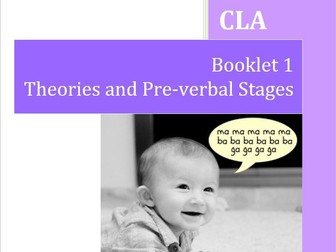
This resource is Number 1 in a series of course booklets for the Child Language Acquisition Unit (CLA) in OCR A Level English Language designed to be used by students in class. This is a unit normally covered in Year 2 of the A level. [Also available is a series of 15 booklets for Year 1 of the A level on which this work builds.] This booklet focuses on the ways that babies first use sounds to communicate and starts the exploration into how and why humans develop speech. It covers significant theories of child language acquisition: behaviourism (Skinner), nativism (Chomsky), cognitive theory (Piaget) and social interactionism Bruner and Vygotsky). The booklet contains both subject content and language examples for students to analyse. Exercises can be worked on by students individually or collaboratively and in class or at home. The booklet also contains a revision glossary for the theories and terminology which links to Quizlet flashcards. The resource also contains a worksheet with hyperlinks and an audio file for use alongside this booklet. The booklet is also accompanied by a series of videos (not professionally made) that can be used by teachers new to teaching the specification to help them prepare for lessons in advance as they contain suggested solutions to exercises. The playlist of these videos is included in the resource bundle. NB: Specifications do change from time to time so please ensure that specification information, detail and guidance is relevant at the time of teaching.
OCR A Level English Language Year 2: Change Booklet 2: The Development of Standard EnglishQuick View
jillbeckwith

OCR A Level English Language Year 2: Change Booklet 2: The Development of Standard English

(0)
This resource is Number 2 in a series of course booklets for the Language Change unit for OCR A Level English Language designed to be used by students in class. This is a unit normally covered in Year 2 of the A level. [Also available from my shop is a series of 4 booklets for Child Language Acquisition as well as a series of 15 booklets for Year 1 of the A level on which this work builds.] This booklet focuses on diachronic change and explores the origins of the English language and reasons for its varied lexis, grammar and phonology. Characteristics of Anglo-Saxon and Latinate roots of English words and a brief chronology of English is covered. The booklet also explores the importance of printing in the development of Standard English. The booklet also focuses on aspects of internal change: lexical change (Algeo’s classification of word formation) semantic change processes graphological change (letter and text formation) The booklet then covers some aspects of Early Modern English: the lexical explosion of the 1600s, the inkhorn controversy and two influential texts (King James’ Bible and Shakespeare). It revisits the topical issue of resistance to language change and also offers students an opportunity to practice a Language Change exam style comparison of texts. The booklet contains both subject content and language examples for students to analyse. Exercises can be worked on by students individually or collaboratively and in class or at home. The booklet also contains revision glossaries for theories, key figures and terminology covered in the booklet with a link to Quizlet flashcards. The booklet is accompanied by a sheet of teacher’s notes and a series of videos (not professionally made) that can be used by teachers new to teaching the specification to help them prepare for lessons in advance as they contain suggested solutions to exercises. The playlist of these videos is included in the resource bundle. NB: Specifications do change from time to time so please ensure that specification information, detail and guidance is relevant at the time of teaching.
OCR A Level English Language Year 2: Change Booklet 4: 1800 to present dayQuick View
jillbeckwith

OCR A Level English Language Year 2: Change Booklet 4: 1800 to present day

(0)
This resource is Number 4 in a series of course booklets for the Language Change unit for OCR A Level English Language designed to be used by students in class. This is a unit normally covered in Year 2 of the A level. [Also available from my shop is a series of 4 booklets for Child Language Acquisition as well as a series of 15 booklets for Year 1 of the A level on which this work builds.] This booklet focuses on how rapidly changing social context in the 19th and 20th centuries affected language change, including key developments in education that promoted literacy as well as the development of other Englishes throughout the world instigated by colonialism. It explores changes in deference in language and examines examples of Victorian texts: lonely hearts, newspapers and adverts. The booklet outlines key events in the 20th century and explores how technological, social and political change have affected language change. Concepts such as Fairclough’s infomalisation and marketisation are explored and texts that reveal changing attitudes to gender and social identity are explored. Stuart Hall’s audience reception theory is explored in order to emphasise that all texts can be read oppositionally and this is a key aspect of how social change occurs. Students are offered several texts from earlier eras to analyse as well as opportunities for exam practice comparison which mirrors the format of the language change question in the A Level exam. The booklet contains both subject content and language examples for students to analyse. Exercises can be worked on by students individually or collaboratively and in class or at home. The booklet also contains revision glossaries for theories, key figures and terminology covered in the booklet with a link to Quizlet flashcards. The booklet is accompanied by a series of videos (not professionally made) that can be used by teachers new to teaching the specification to help them prepare for lessons in advance as they contain suggested solutions to exercises. The playlist of these videos is included in the resource bundle. NB: Specifications do change from time to time so please ensure that specification information, detail and guidance is relevant at the time of teaching.
OCR A Level English Language Year 2: Change Booklet 3: Fixing the Language (c18th &19th)Quick View
jillbeckwith

OCR A Level English Language Year 2: Change Booklet 3: Fixing the Language (c18th &19th)

(0)
This resource is Number 3 in a series of course booklets for the Language Change unit for OCR A Level English Language designed to be used by students in class. This is a unit normally covered in Year 2 of the A level. [Also available from my shop is a series of 4 booklets for Child Language Acquisition as well as a series of 15 booklets for Year 1 of the A level on which this work builds.] This booklet explores concepts such as language decay and evolution and covers the efforts in the 18th century to ‘fix’ the language as an attempt to eradicate language change. It outlines the interventions of Jonathan Swift, Samuel Johnson, Robert Lowth and James Walker to stem lexical, grammatical and phonological change in the English Language. It also covers how the Oxford English Dictionary in Britain and Webster’s dictionary in America were developed later (in the 19th century) to improve the work completed by Johnson in 1755. The booklet also explores modern prescriptivism and its new embodiment. The booklet examines grammatical change in detail and offers students useful terminology to describe and account for the grammatical differences they see in examination texts from different eras. It revisits the important concept of standardisation as an ongoing continuum. Finally, students are offered structured tasks and an exam style question to help prepare students for the comparison task in the language change question in the A Level exam. The booklet contains both subject content and language examples for students to analyse. Exercises can be worked on by students individually or collaboratively and in class or at home. The booklet also contains revision glossaries for theories, key figures and terminology covered in the booklet with a link to Quizlet flashcards. The booklet is accompanied by a series of videos (not professionally made) that can be used by teachers new to teaching the specification to help them prepare for lessons in advance as they contain suggested solutions to exercises. The playlist of these videos is included in the resource bundle. NB: Specifications do change from time to time so please ensure that specification information, detail and guidance is relevant at the time of teaching.
OCR A Level English Language Year 1 - Course Booklet 12 - Language & Gender 1: representationQuick View
jillbeckwith

OCR A Level English Language Year 1 - Course Booklet 12 - Language & Gender 1: representation

(0)
OCR A Level English Language Year 1 - Course Booklet 12 - Language & Gender 1: representation of gender in language This resource is Number 12 in a series of course booklets for OCR A Level English Language which are designed to be used by students in class. This booklet is one of two which helps students prepare for the specific Language and Gender question on Paper 2 of the AS. This topic is also central to students’ preparation for the Language in the Media question at A Level. The material in the booklet builds on work covered by Booklet 11 (Language and Power 2: power behind discourse) and here focuses specifically on how gender is represented in language. It covers the difference between sex and gender, and explores the question of whether English is a sexist language, giving several opportunities for writing about this perennial topical language issue. Representation of gender in language is very conceptual and the booklet explores: semantic over-representation, objectification, binary opposition, lexical asymmetry and marking, negative semtanic space, pejoration, and dominating and muted groups. It highlights the work of researchers and theorists in the field such as Julia Stanley, Janet Holmes, Sara Mills, Saussure, Derrida, Muriel Schulz, Norman Fairclough, Shirley and Edward Ardener, Dale Spender, Sapir-Whorf, Steven Pinker, Stacy Smith, Theo Van Leeuwen, Kate Clark and Michael Halliday, The booklet contains both subject content and language examples for students to analyse. The language texts are longer than in earlier booklets since this topic is designed to build on earlier fundamental analytical work. Exercises can be worked on by students individually or collaboratively and in class or at home. The booklet also contains a revision glossary which links to Quizlet flashcards. If used in order, the Year 1 booklets prepare students for the OCR AS in English Language qualification at the end of the first year of study. If your students are preparing only for the OCR A Level English Language qualification at the end of two years of study, the booklets can theoretically be used in any order, although the Year 2 booklets do contain content that builds on Year 1 (AS) knowledge and skills. The booklet is accompanied by a series of videos (not professionally made) that can be used by teachers new to teaching the specification to help them prepare for lessons in advance as they contain suggested solutions to exercises. The playlist of these videos is included in the resource bundle. NB: Specifications do change from time to time so please ensure that specification information, detail and guidance is relevant at the time of teaching.
OCR A Level English Language Year 1 - Course Booklet 14: Language and TechnologyQuick View
jillbeckwith

OCR A Level English Language Year 1 - Course Booklet 14: Language and Technology

(0)
This resource is Number 14 in a series of course booklets for OCR A Level English Language which are designed to be used by students in class. This booklet contains material that is NOT examined as AS level but which IS part of the focus for the Language in the Media question on the A level exam paper. It is also important for the Language Change topic at A level. If your students are taking the AS exam at the end of year 1, this content can therefore be covered after the summer exams. The booklet focuses on how the context of production (technology) shapes language use. It starts with a definition of CMC (computer mediated communication) and revises Halliday’s functional theory and Algeo’s classification of neology covered in earlier booklets. The material covers how landline telephones changed conversation patterns and then looks briefly at a few varieties of early CMC: original text messaging, chatrooms (synchronous and non-synchronous), blogs, emails and social networking sites. Concepts relevant to technology are explored: affordances and constraints, interactivity, plasticity, non-linearity and synchronicity - all of which affect language use. The useful notion of vernacular literacy practices and is outlined and there are opportunities for writing about topical language issues related to technology. The booklet also suggests several ideas for investigations into CMC language that they could undertake for their A level NEA coursework. Booklet 15 suggests more CMC NEA ideas for individuals or for groups to work on as mini practice investigations in the summer term. The booklet contains both subject content and language examples for students to analyse. The language texts are longer than in earlier booklets since this topic is designed to build on earlier fundamental analytical work. Exercises can be worked on by students individually or collaboratively and in class or at home. If used in order, the Year 1 booklets prepare students for the OCR AS in English Language qualification at the end of the first year of study. If your students are preparing only for the OCR A Level English Language qualification at the end of two years of study, the booklets can theoretically be used in any order, although the Year 2 booklets do contain content that builds on Year 1 (AS) knowledge and skills. The booklet is accompanied by a series of videos (not professionally made) that can be used by teachers new to teaching the specification to help them prepare for lessons in advance as they contain suggested solutions to exercises. The playlist of these videos is included in the resource bundle. NB: Specifications do change from time to time so please ensure that specification information, detail and guidance is relevant at the time of teaching.