ESL Connect 4 set - Pres. Simple, Past Simple, Pres. PerfectQuick View
Virgoletta

ESL Connect 4 set - Pres. Simple, Past Simple, Pres. Perfect

(0)
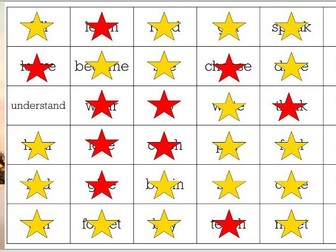
A set of five games of Connect 4 for ESL students to practise building the affirmative, negative and question forms of verbs in various tenses: Basic verbs: 36 of the most common verbs in English, for beginners to practise Present Simple; Past Simple: I’ve included a game which only uses regular verbs and two games with only irregular verbs; Present Perfect: both action and non-action verbs. Each game comes both as a PowerPoint, to play in teams, and as a pdf, to be printed out for pairwork. I’ve included a short list of tips to make the game easier or more difficult, and alternative ways to play. How to play Students choose a symbol - I have included a yellow star and a red star in the PowerPoint slides - and try to place their symbol on 4 consecutive cells (horizontally, vertically, or diagonally). In order to be allowed to place a symbol, students must make a correct sentence with the verb in the cell they choose. The first student / team who manages to do so is the winner. If they make mistakes, they lose their chance to place their symbol and it’s the other team’s turn. This means strategy is not enough: even a team with three symbols in a row could make a mistake and give the other team a chance to block them.

Making Scones ESL lesson plan (2 lessons)Quick View
Virgoletta

Making Scones ESL lesson plan (2 lessons)

(0)
Students learn some words used in a recipe to make scones. They match verbs and phrases to form the sentences which they then order to build the recipe. A video allows them to check if they were right. After this, they can use the vocabulary they’ve learned to write their own recipe. In the end, a memory game: a pelmanism activity with the words and pictures from the lesson. Includes: 1 lesson plan; 1 PowerPoint presentation introducing the target vocabulary by means of photos; 1 printable worksheet with a word grid; 1 PowerPoint presentation with the tasks linked to the video recipe; 1 printable worksheet with the verb cards and the phrases, to be cut out and matched (if the teacher has no time to cut up the cards beforehand, students can be given the worksheets to cut up, as both verbs and phrases are in alphabetical order); 1 PowerPoint presentation with the memory game; 1 printable worksheet with cards with the target vocab and photos, to play the memory game without the PowerPoint.
Puss in Boots word problems (no division)Quick View
Virgoletta

Puss in Boots word problems (no division)

(0)
The story of Puss in Boots as word problems. There are two very similar versions: one only uses addition and subtraction; the other, multiplication too. Each version is available in two layouts: 1 problem on each page, or 4 on each page. In both cases, at the end of the story, the pages can be stapled together for students to end up with a booklet. (Drawings could be added, too.) Addition and subtraction: 20 problems. Addition, subtraction and multiplication: 21 problems. All answers included. No decimals nor fractions. Recommended for Year 6 students, also suitable for Year 7. More “story problems” to follow
Summer pelmanism game - Kids and ESL beginnersQuick View
Virgoletta

Summer pelmanism game - Kids and ESL beginners

(0)
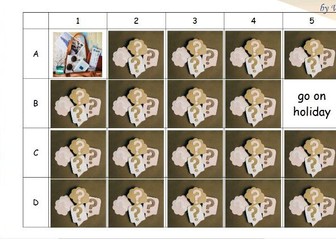
A pelmanism game for ESL: 12 summer-related words are introduced, then students uncover two cards at a time to find the matching pairs of photo and word. For this game, you need to use the PowerPoint editing mode, instead of starting the presentation. Students give the coordinates of the two cards they wish to uncover (“B6 and D1!”). The teacher selects and deletes the two question mark pictures covering those. If it’s a match, no need to do anything. If it isn’t, the teacher just clicks on the Undo icon, and the two question marks re-appear. The game goes on until all pairs have been found. If time allows and students might benefit from some extra practice, the teacher can then Undo their last action, so one question mark is back, and duplicate that several times to cover the cells with words. Then, the teacher asks students to name the pictures: “What’s A2? C4?”, to revise the target vocabulary one last time. The same images and words are also provided as worksheets to print and cut up. I recommend printing on card stock, if you wish to use them as cards to play. Otherwise, you can use standard paper and have young students match them and glue them into their notebooks.
Spring pelmanism game - Kids & ESL beginnersQuick View
Virgoletta

Spring pelmanism game - Kids & ESL beginners

(0)
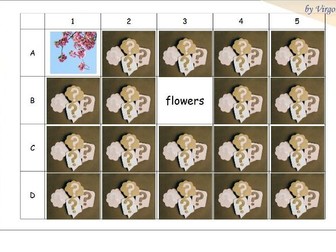
A pelmanism game for ESL: 10 spring-related words are introduced, then students uncover two cards at a time to find the matching pairs of photo and word. For this game, you need to use the PowerPoint editing mode, instead of starting the presentation. Students give the coordinates of the two cards they wish to uncover (“B6 and D1!”). The teacher selects and deletes the two question mark pictures covering those. If it’s a match, no need to do anything. If it isn’t, the teacher just clicks on the Undo icon, and the two question marks re-appear. The game goes on until all pairs have been found. If time allows and students might benefit from some extra practice, the teacher can then Undo their last action, so one question mark is back, and duplicate that several times to cover the cells with words. Then, the teacher asks students to name the pictures: “What’s A2? C4?”, to revise the target vocabulary one last time. The same images and words are also provided as worksheets to print and cut up. I recommend printing on card stock, if you wish to use them as cards to play. Otherwise, you can use standard paper and have young students match them and glue them into their notebooks.
Autumn pelmanism game - Kids and ESL beginnersQuick View
Virgoletta

Autumn pelmanism game - Kids and ESL beginners

(0)
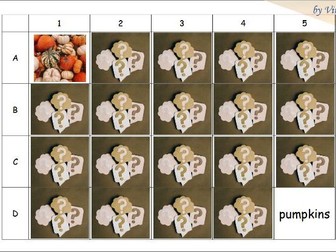
A pelmanism game for ESL: 10 autumn-related words are introduced, then students uncover two cards at a time to find the matching pairs of photo and word. For this game, you need to use the PowerPoint editing mode, instead of starting the presentation. Students give the coordinates of the two cards they wish to uncover (“B6 and D1!”). The teacher selects and deletes the two question mark pictures covering those. If it’s a match, no need to do anything. If it isn’t, the teacher just clicks on the Undo icon, and the two question marks re-appear. The game goes on until all pairs have been found. If time allows and students might benefit from some extra practice, the teacher can then Undo their last action, so one question mark is back, and duplicate that several times to cover the cells with words. Then, the teacher asks students to name the pictures: “What’s A2? C4?”, to revise the target vocabulary one last time. The same images and words are also provided as worksheets to print and cut up. I recommend printing on card stock, if you wish to use them as cards to play. Otherwise, you can use standard paper and have young students match them and glue them into their notebooks.
Kids & ESL beginners: the four seasonsQuick View
Virgoletta

Kids & ESL beginners: the four seasons

4 Resources
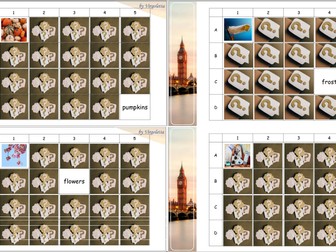
Four vocabulary games for children and ESL beginners. In each case, words related to a season are introduced by pictures, then they’re used to play a memory game - you get both printable cards and a Power Point version, usable in class as well as for online lessons.
Winter pelmanism game for ESL beginnersQuick View
Virgoletta

Winter pelmanism game for ESL beginners

(0)
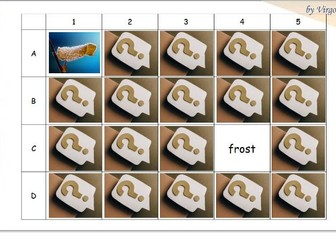
A pelmanism game for ESL: 10 winter-related words are introduced, then students uncover two cards at a time to find the matching pairs of photo and word. For this game, you need to use the PowerPoint editing mode, instead of starting the presentation. Students will give the coordinates of the two cards they wish to uncover (“B6 and D1!”). The teacher will select and delete the two question marks covering those. If it’s a match, no need to do anything. If it isn’t, the teacher just clicks on the Undo icon, and the two question marks re-appear. The game goes on until all pairs have been found. If time allows and students might benefit from some extra practice, the teacher can then Undo their last action, so one question mark is back, and then duplicate that several times to cover the cells with words. Then, the teacher asks students to name the pictures: “What’s A2? C4?”, to revise the target vocabulary one last time. The same images and words are also provided as worksheets to print and cut up. I recommend printing on card stock, if you wish to use them as cards to play. Otherwise, you can use standard paper and have young students match them and glue them into their notebook.