Henry VIII - Full Homework ProjectQuick View
Eldritch2

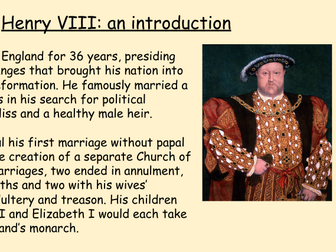
Henry VIII - Full Homework Project

(1)
A homework project aimed at year 7 pupils to cover the course of six weeks approx. They should complete 1-2 tasks per week. Focusing on a general introductory overview of King Henry VIII, his life, six wives, and some of his political decisions.
Thomas Wolsey Fun Multiple Choice Game [Henry VIII & His Ministers]Quick View
Eldritch2

Thomas Wolsey Fun Multiple Choice Game [Henry VIII & His Ministers]

(0)
This is a fun multiple choice game task for a class new to the topic of Henry VIII & His Ministers, specifically the life, tenure, and times of Thomas Wolsey, who was High Chancellor, Legate, and Cardinal to King Henry. Also known as ‘Alter Rex’ (Other King) due to his significant power in office. How does the game work? The game is based on Thomas Wolsey, the player or players are expected to roleplay Wolsey’s decisions and choose the best decision for each scenario. There are seven scenarios. Detailed and interesting questions: The game has seven detailed questions which are to be printed on a worksheet (one each or one between two) for pupils/students to circle the number corresponding with their chosen answers. Fun intro to the topic in history: The game is intended to be a fun introduction for those unaware of Thomas Wolsey’s life events. It mixes fictional and non-fictional elements, all of which are kept in the context of his officiation under Henry VIII. Will build curiosity and interest in the subject: The aim of the activity is, as a primer, to build interest and curiosity about the historical subject material and be an effective solo, pair, or group task. ‘Gamifying’ learning can yield benefits in how a class connects with the subject material. What’s included? Full PowerPoint: A full colourful and detailed PowerPoint to display the questions at the front of the class. Detailed questions that are in the context of the period: All the questions have been designed to be based on the types of challenges Wolsey faced whilst in office - with an average of three possible solutions to choose from, some ‘solutions’ are better than others, in terms of points! Full detailed answers: Answers are included with detailed explanations for each possible decision - with a points tally at the end and points ranges denoting how successful the player has been. The task would best suit those in Secondary Level education in England at KS3 level with little to no prior knowledge of Thomas Wolsey, particularly his time serving under Henry VIII (1509-1530).
The Bayeux TapestryQuick View
Eldritch2

The Bayeux Tapestry

(0)
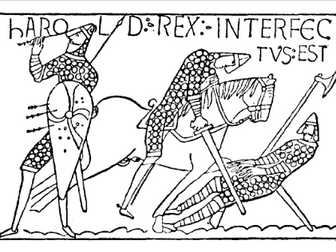
The Bayeux Tapestry, designed for Year 7 History, but could be used across other age groups in KS3 if adapted. This is a full lesson for 55 minutes, the slideshow comprehensively examines the Bayeux Tapestry as a Norman account of the 1066 Norman Conquest and Battle of Hastings at a KS3-level of ability. An animated video of the tapestry is linked with questions to accompany. The lesson also includes a colouring-in activity with provided annotations of the scene of Harold’s death at the Battle of Hastings. A critical reflection exercise follows where students are challenged to objectively scrutinise the validity and reliability of the tapestry as a historical source; a collation of evidence over two slides is provided for print or digital view for them to consider and then write an informed response to as a way to conclude the lesson. Crossword activity also included, can be printed out.
The Crucifixion: Why was Jesus crucified?Quick View
Eldritch2

The Crucifixion: Why was Jesus crucified?

(0)
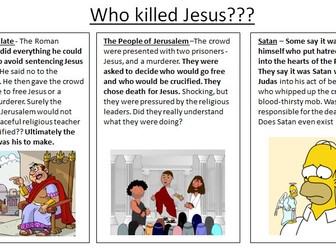
A full lesson covering 55 minutes that explores Jesus’ trial and crucifixion in terms of the historical events and the spiritual importance of these events that are symbolically central in the Christian faith and its beliefs. The lesson pack includes: **Starter **- naming the four main events of Jesus’ life - incarnation, crucifixion, resurrection and the ascension. An overview of the context of Jesus’ death - the Jewish leaders (Pharisees) and the Roman governor, Pontius Pilate who controlled Judea. A New Testament reading exercise, the class should have access to New Testaments, one between two, or one each. If not, a laptop or access to a computer will be fine if the Bible chapters and verses are found online for group reading. Briefly exploring why Pilate allowed Christ to be executed if he didn’t think Jesus was guilty of anything. A video with overview of the crucifixion. A worksheet with accompanying information sheet for the class to work on in the second part of the lesson. Exploring the people that may be responsible for Jesus’ death and evaluating each of their involvement - Judas, Pharisees, Jesus himself, Pontius Pilate, The People of Jerusalem, and Satan. Quick plenary task for feedback.
History: WW1 Trench Warfare (Full Lesson & Worksheets)Quick View
Eldritch2

History: WW1 Trench Warfare (Full Lesson & Worksheets)

(0)
This is a package designed for a year 8 History lesson on the topic of WW1 trench warfare. The lesson examines the features, purposes and strategies behind trench warfare on the Western Front. It gives pupils a chance to engage with the conditions and lifestyle undertaken by men conscripted to live, fight, and likely perish in this perilous environment. 16 slides of content Intro recall quiz Fill in the gap activity Diary entry activity Sketch a cross-section of a trench activity Accompanying worksheets
Year 7 History: Skeletons in the Field, Mystery/InvestigationQuick View
Eldritch2

Year 7 History: Skeletons in the Field, Mystery/Investigation

(0)
This full lesson is designed as a history investigation/mystery for a year 7 class to solve. They are tasked with reviewing a range of evidence and coming to a conclusion about an archaeological find. This will help them develop skills essential to the task of being a historian. How did these people die? Who were these people? Why are there so many skeletons in one place? Were they murdered, or did they die naturally? 13 slides total, plus worksheet.
The 10 Commandments [Mosaic Covenant]Quick View
Eldritch2

The 10 Commandments [Mosaic Covenant]

(0)
A lesson designed for a 50-60 mins typical length lesson for a Year 9 class. This resource includes an overview of the influence of the 10 commandments in Judaism, the importance of the ten commandments in significantly changing Jewish society, defining the Kingdom of Israel, the sabbath, and an exploration of each commandment in detail. The Golden Calf is explored too as a symbol and story of disobedience towards God before the commandments came into effect. Follows on nicely from the Story of Exodus detailing Moses’ role in leading the Hebrews out of slavery in Egypt with God’s (YHWH’s) assistance. Includes a 5-mark exam-style question: “Why is the Covenant with Moses important to Jewish people?” (5 marks) Includes a “who, what, when, where, why” task for arranging information about the covenant into these categories. Includes a ‘motives’ task where students can place information into each column to determine the benefits for God/Israelites in the covenant (agreement). An interpretative art task, where students are asked to list the events circled in the painting of Moses on mount Sinai, with the Israelites in the foreground. Has an exploration of ‘Ethical monotheism,’ with accompanying video.
Year 7 Geography: Would you survive in the desert? (Fun Lesson)Quick View
Eldritch2

Year 7 Geography: Would you survive in the desert? (Fun Lesson)

(0)
This is a lesson aimed at year 7 pupils, it would work well as a fun lesson in a Geography biomes module. The pupils are tasked with selecting a range of items to take with them into a survival scenario, pupils are challenged with using their prior knowledge about desert climates, fauna and flora, in order to maximise their chances of survival. 19 slides Multiple survival scenarios and item selection task Activity sheet to be filled in during the activity
Understanding Humanism (Full Lesson)Quick View
Eldritch2

Understanding Humanism (Full Lesson)

(0)
This full lesson (20 slides) is aimed at year 8 students in secondary education. These materials can be adapted for other year groups. The lesson is an introduction to the worldview and ideas of humanism, and would work well as part of an ‘alternative faiths’ unit of lessons. I have taken some resources and adapted them from the freely available educational resources on the humanists website. The lessons slides include a range of tasks and activities, including: Fill in the gaps Multiple choice Interpretative response statements Two-sided table activity Videos ‘Design a humanist building’ activity Enquiry question plenary
Christianity: The Nature of GodQuick View
Eldritch2

Christianity: The Nature of God

(0)
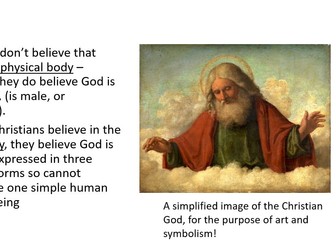
Lesson is for Year 9 designed for 55 minutes, examining the nature of the Abrahamic God in the Christian religious tradition. Can be adapted as you see fit for other year groups and abilities. The lesson is an introduction to God’s qualities and attributes, entering the topic via an interpretative activity focusing on a famous art piece, "The Creation of Adam ", a fresco painting by Italian artist Michelangelo, which forms part of the Sistine Chapel’s ceiling. This allows the pupils to interpret for themselves what a famous Christian artist was trying to show about God’s qualities in art form. Later in the lesson, a critical lens is introduced allowing students to consider the (arguable) shift in God’s character that apparently takes place between the Old and New Testaments of the Bible; a meaner, less forgiving God in the Old, and a more forgiving and patient God in the New. An agnostic and atheist account of this change is included. A key words sheet for print is included, as is a worksheet that looks at scripture; matching the keywords to each piece of scripture. Optional video with link included. Rounded off with a quick plenary.
God as omnipotent, loving, and justQuick View
Eldritch2

God as omnipotent, loving, and just

(0)
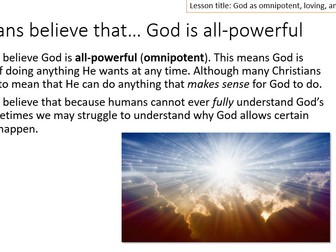
A 55-minute lesson planned for year 9 on the AQA spec. The lesson engages with three central qualities of God’s divine nature in the Christian faith. The first approach is from the popular topic of superheroes - students are asked to consider the subject in light of God’s similar extraordinary abilities and what superheroes mean to most people, the reasons for their popularity, and how this could parallel the security and authority that is also seen in the Christian God, owing to such capabilities. A brief discussion on the different classifications of love, as created by the ancient Greeks looks at the type of omnibenevolence that is possessed and expressed by God’s all-loving nature. A worksheet looking at Bible stories from scripture that exhibit different aspects of God’s divine nature enables students to engage with scripture (paraphrased/reworded for suitable ability). This has 4 interrogative questions for each example giving the potential for this activity to take up a good portion of the lesson time if needed. A plenary and exam-style question to finish.
Crime & Punishment (Y9 Full Homework Project, RE)Quick View
Eldritch2

Crime & Punishment (Y9 Full Homework Project, RE)

(0)
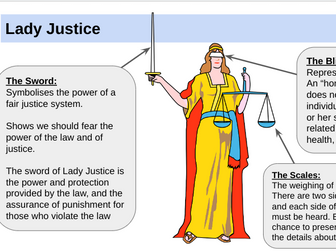
This is a Religious Studies homework project designed to be completed over the course of a term, 1-2 tasks per week. Intended for Y9 KS3, but can be adapted for other year groups if required. The homework project package includes key term definitions, written activities, etc. 34 slides in total covering topics such as the James Bulgur case, the abolition of capital punishment in Britain, the early history and development of the British legal system and common law, engagement with key subject topic terms.
Thomas Aquinas: The Cosmological ArgumentQuick View
Eldritch2

Thomas Aquinas: The Cosmological Argument

(0)
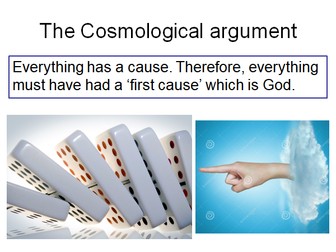
A lesson on Aquinas’ Cosmological Argument, designed to cover 55 minutes lesson time. Brief overview of motion and causation with pictured examples, including a domino-falling video which I only advise you show 2-3 minutes of to illustrate the point. Terms are defined and simplified for students to copy down into books. Following this is a 5 minute activity on tracing motion or causations in a chain. The lesson then presents a research task on the criticisms of the Cosmological Argument, this is designed for use with a computer room, school laptops, or students own devices. Some engaging finishing/extension tasks are then in place to use if needed. Also a quiz on Quizziz is linked for potential use. Followed by a brief 3-5 min plenary to recap lesson.
William Paley: The Design ArgumentQuick View
Eldritch2

William Paley: The Design Argument

(0)
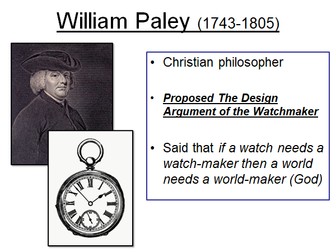
A full lesson that covers Paley’s Design Argument, the lesson covers strengths and weaknesses of this argument for God, with a computer-based activity along with accompanying optional videos that you can visit during the lesson to add depth to commentary on Paley’s famous ‘argument from design’. Numerous pictures are included to clearly illustrate examples of possible alleged design in the universe and world. You can also adapt and print out materials based on the PowerPoint slides if you want to produce physical worksheets. The topics that are included and that you can cover in the lesson The Heat Death of the universe and how it could affect beliefs about a designer. The Cambrian Explosion (life suddenly appearing in the fossil record) and how it could affect belief about a designer vis a vis Paley’s Design Argument. The Big Bang and the Cosmic Lottery (how the universe appears to be perfectly tuned to life) and how this could affect views of the Design Argument. Some points about ‘lack of design’ highlighted by Darwin and Attenborough are also included for brief discussion. A latter activity using computers or own devices involves a data-sorting activity to encompass other critiques or supporting points for the argument. A Design Argument quiz link via Quizziz is also included for potential use. All rounded off with a plenary to recap.
GCSE Islam Practices: Salah (Prayer)Quick View
Eldritch2

GCSE Islam Practices: Salah (Prayer)

(0)
This is a full lesson covering the topic of prayer (Salah/Salat or Namaz). The lesson includes a variety of activities, from image/picture-board enquiry tasks to exam-style question tasks including a review/analysis of three model answers for a 12-mark question (AQA Religious Studies). The lesson includes a recall task/mini plenary for the middle of the lesson looking at key terms. There is a video alongside with accompanying questions to be answered.
Festival of Passover Full LessonQuick View
Eldritch2

Festival of Passover Full Lesson

(0)
This is a full lesson on the topic of Passover aimed at a Year 7 class. It is an introduction to the topic and its connections to the Story of Exodus in the Hebrew Bible. It would work well as part of a festivals, rites, and celebrations module in RE: Comic strip activity Seder dish activity Comparison of Passover and Easter Letter-writing task
Buddhism: Beliefs & Practices - AQA GCSE Religious Studies Revision Full Knowledge OrganiserQuick View
Eldritch2

Buddhism: Beliefs & Practices - AQA GCSE Religious Studies Revision Full Knowledge Organiser

(0)
This is a handy knowledge organiser that focuses mainly on listing all the ‘lists’ of beliefs that students need to know when studying Buddhism. It also has some content on Buddhist practices included; meditation, malas, retreats, and other events such as a description of Buddhist festivals e.g. Wesak & Parinirvana. It sorts out the lists by numbers in ascending order. Please note: While there is a lot of content contained in this document, it is not an exhaustive revision resource and should be used alongside other resources for best results. Geared towards the AQA GCSE Religious Studies Spec A programme. Please edit the cover links and description as required.
The Road to Easter: Lent (Full Lesson Slides)Quick View
Eldritch2

The Road to Easter: Lent (Full Lesson Slides)

(0)
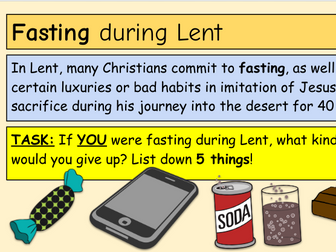
This is a PowerPoint full lesson (14 slides) for year 7 ability focusing on the Christian period and season of spring-time annual religious observance, Lent. There are a range of tasks included in the lesson - a crossword, fill in the gap, several brief summary YouTube videos, and a Lent timeline activity. You can adapt these resources as you wish to suit your class/school requirements.
Who was Mother Teresa? Empire of Charity (Full Lesson)Quick View
Eldritch2

Who was Mother Teresa? Empire of Charity (Full Lesson)

(0)
This is a lesson aimed at year 8 pupils to be potentially used in a study of religion, charity, and wealth. The lesson examines the work of famous Catholic nun and missionary, Saint Mother Teresa of Calcutta. The lesson is designed to raise awareness and critical thinking about the legitimacy of charitable work; and to encourage pupils to clearly examine and scrutinise the premises and claims of humanitarian agencies that may hold considerable influence and gravitas. The lesson includes: An overview of Mother Theresa. A four-column table information sorting activity. A summary activity for the 1994 documentary, “Hell’s Angel”. A written task asking pupils to consider what ulterior motives may have driven ‘Missionaries for Charity’ organisation. Question regarding whether Mother Teresa was a religious fundamentalist.
RE: Design Your Own Festival (Full Lesson)Quick View
Eldritch2

RE: Design Your Own Festival (Full Lesson)

(0)
This is a simple lesson designed to help an RE Year 7 class engage with the components that make up and constitute a festival celebration whether solemn or joyful in tone. The lesson asks pupils to design their own festival and think about what different things a festival needs to function, have meaning, and work well as an event. 14 slides Starter questions and picture identification task Analysing what makes up a ‘festival’ Example festival group feedback task: Aspects, themes and values