 Quick View
IGCSE Global Perspectives Team Project
A step by step IGCSE Global Perspectives (0457) Team Project toolkit: local issue, research, action, Explanation, Evidence of Action and the Reflective Paper.
Take the stress out of the Team Project, for your students and for you.
This toolkit walks students through every stage of the IGCSE Global Perspectives (0457) Team Project: choosing a local issue, dividing research, planning a measurable action, writing the Explanation of Research and Planning, collecting Evidence of Action, collaborating well and writing the Reflective Paper. A running fictional case study, Team Refill, shows what good work looks like at each step.
What’s inside
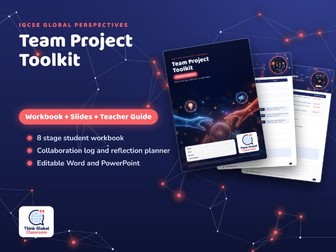
Student Workbook (19 pages, Word and PDF): nine units with team and personal planning pages.
Unit 0: Know the Team Project (project map, key rules, suggested ten week timeline)
Unit 1: Team agreement and choosing a local issue (the issue test)
Unit 2: Researching perspectives and dividing the work
Unit 3: Planning an action with an aim and success measures
Unit 4: Writing the Explanation, with a word budget and a full model
Unit 5: Carrying out the action, collecting evidence and measuring success
Unit 6: Collaborating well (meeting log, contribution tracker, scenarios)
Unit 7: Writing the Reflective Paper (describe less, reflect more; sentence starters)
Unit 8: Final submission checklist
Teaching Slides (33 slides, PowerPoint and PDF): with speaker notes. All text is 25pt or larger.
Teacher Guide (8 pages, Word and PDF): a ten session plan mapped to the slides, expected answers, a teacher observation log template and formative success criteria.
Why teachers like it
Clear, accurate summary of what each part of the project asks for, with word limits and common pitfalls
A model Explanation of Research and Planning under 400 words that students can dissect, not copy
Side by side examples of describing and reflecting for the Reflective Paper
Editable Word and PowerPoint files, so you can add your own deadlines
Please note: This is an independent resource from Think Global Classroom. It is not produced, endorsed or checked by Cambridge University Press and Assessment. Assessment facts are summarized from the published syllabus; please check the current syllabus and coursework guidance. The success criteria are our own and do not reproduce Cambridge mark schemes or level descriptors. American spelling is used throughout.