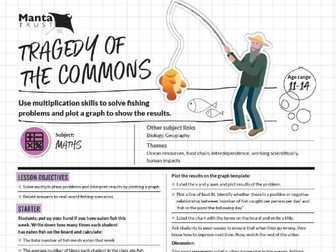
Manta Trust - KS3 Maths: Tragedy of the commons - A problem themed around the impact of overfishingQuick View
MantaTrust

Manta Trust - KS3 Maths: Tragedy of the commons - A problem themed around the impact of overfishing

(0)
This resource covers: KS3 (Ages 11-14): Maths (statistics and reasoning mathematically) describe, interpret and compare observed distributions of a single variable through appropriate graphical representation involving discrete, continuous and grouped data; and appropriate measures of central tendency (mean, mode, median) and spread (range, consideration of outliers) interpret when the structure of a numerical problem requires additive, multiplicative or proportional reasoning It also covers a topic that students may meet in GSCE biology: Sustainable fishing. This lesson plan begins with watching a short video clip which poses a maths problem. Students are encouraged to work out the maths problem and then practice their skills at creating a graph. The maths problem incorporates the theme of sustainable fishing and so there is also an environmental theme to this lesson.
Art for Change: (KS3 Art: Discuss &  create work that uses art to promote change)Quick View
MantaTrust

Art for Change: (KS3 Art: Discuss & create work that uses art to promote change)

(0)
This resource covers: KS3 Art (Ages 11-14): history of art movements evaluation of art work using and handling media and materials This lesson firstly uses a video to show examples of environmental themed art and encourages discussion around whether this can promote change. Students are later given an opportunity to produce their own art work with the aim of promoting positive social and environmental change, using a variety of techniques. We’d love to hear how you find using our resources! Please get in touch with us at jennifer.spacagna@mantatrust.org with any feedback.
Manta Trust - L'art pour le Changement (RESSOURCES EN FRANÇAIS)Quick View
MantaTrust

Manta Trust - L'art pour le Changement (RESSOURCES EN FRANÇAIS)

(0)
Expérimenter des méthodes artistiques qui favorisent un changement social et environnemental positif. Cette activité est en lien avec les matières d’arts plastiques, de technologie, de SVT, de géographie, de français et d’histoire, et a pour thèmes la devenir acteurs du changement, impacts humains, pollution et connexion avec la nature.
Manta Trust - Vocabulaire de la nature (RESSOURCES EN FRANÇAIS)Quick View
MantaTrust

Manta Trust - Vocabulaire de la nature (RESSOURCES EN FRANÇAIS)

(0)
Utilisez les flashcards pour apprendre à connaître les animaux marins et leurs habitats dans une langue étrangère. Cette activité est en lien avec les matières de langues vivantes, de SVT, de géographie et de français, et a pour thèmes la biodiversité des océans et chaîne alimentaire. Les ressources incluent également : Couleurs Nourriture Pays
Manta Trust - Personnification de la Nature (RESSOURCES EN FRANÇAIS)Quick View
MantaTrust

Manta Trust - Personnification de la Nature (RESSOURCES EN FRANÇAIS)

(0)
Une activité pratique pour amener les élèves à réfléchir aux environnements naturels tout en améliorant leurs compétences en lecture et en poésie. Cette activité est en lien avec les matières de français, de SVT et de géographie, et a pour thèmes la biodiversité des océans, les impacts humains et le lien avec la nature.
Manta Trust - Vocabulario de la Naturaleza (RECURSOS EN ESPAÑOL)Quick View
MantaTrust

Manta Trust - Vocabulario de la Naturaleza (RECURSOS EN ESPAÑOL)

(0)
Se puede usar para enseñar español como lengua extranjera. Usa tarjetas didácticas y palabras descriptivas para aprender y hablar sobre los animales del océano, sus hábitats y el medio ambiente. Esta actividad incluye enlaces a biología, geografía y lectoescritura, y abarca temas como la biodiversidad marina y la cadena alimentaria. Los recursos también incluyen: Colores Comida Países
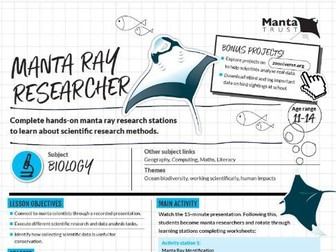
Manta Ray Researcher: Real-life scientific methods (KS3 Science Working Scientifically & Ecosystems)Quick View
MantaTrust

Manta Ray Researcher: Real-life scientific methods (KS3 Science Working Scientifically & Ecosystems)

(0)
This resources covers: KS3 (Ages 11-14): Experimental skills and investigations, Analysis and evaluation, Relationships in an ecosystem This is a lesson plan with accompanying pre-recorded video presentation from a marine biologist, this lesson will allow students to practice a variety of scientific reseach methods at different learning stations. Any additional resources required can be downloaded from: education.mantatrust.org
Plastic Pollution Experiment (KS3 Biology: ecosystem relationships, accumulation of toxic materials)Quick View
MantaTrust

Plastic Pollution Experiment (KS3 Biology: ecosystem relationships, accumulation of toxic materials)

(0)
This resource covers: KS3 (Ages 11-14): Interactions and interdependencies - Relationships in an ecosystem Students can use this game to learn how organisms affect, and are affected by, their environment, including the accumulation of toxic materials. In this game, designed for ages 11-14, students will be able to actively demonstrate how pollutants magnify up the food chain. This game will allow students to explore topics of food chains, interdependence and conservation in a fun and interactive manner. Any additional resources needed can be downloaded from: education.mantatrust.org
Marine Protected Areas (KS2 Geography: Geographical skills, interpret a coordinate grid map)Quick View
MantaTrust

Marine Protected Areas (KS2 Geography: Geographical skills, interpret a coordinate grid map)

(0)
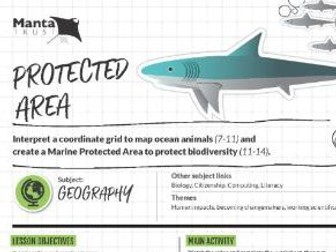
This resource covers: KS2 (Ages 7-11) Geography: Geographical skills and fieldwork - use maps, atlases, globes and digital/computer mapping to locate countries and describe features studied use the eight points of a compass, four and six-figure grid references, symbols and key (including the use of Ordnance Survey maps) to build their knowledge of the United Kingdom and the wider world This resource also covers… KS2 Maths: Geometry (position and direction) - describe positions on the full coordinate grid (all four quadrants) This lesson plan will allow students to start understanding the importance of protecting ocean ecosystems by watching and answering questions on a video, and interpreting a coordinate grid map to look at what areas should be protected in order to help ocean organisms. Any additional resources needed can be found at education.mantatrust.org
Personificación de la Naturaleza (RECURSOS EN ESPAÑOL)Quick View
MantaTrust

Personificación de la Naturaleza (RECURSOS EN ESPAÑOL)

(0)
Una actividad práctica para que los alumnos reflexionen sobre los entornos naturales, al tiempo que mejoran su capacidad de leer y escribir. Esta actividad incluye enlaces a las asignaturas de ciencias y geografía, y tiene temas de biodiversidad marina, impactos humanos y conexión con la naturaleza.