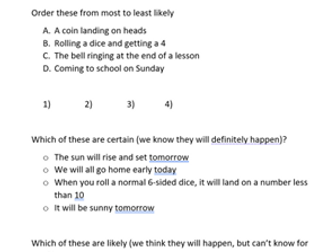
A quick worksheet looking at the words “certain”, “likely” and “impossible” and some scenarios such as rolling a six-sided dice. Aimed at students new to English
A walkthrough of the first 5 questions of a past Edexcel GCSE Chemistry past paper - alternating a question with an answer, with some hints/key words for my EAL students.
The first 9 questions of the June 2019 Edexcel Biology Paper 2 broken down into a PowerPoint presentation for use as a revision lesson. Includes hints for how to answer the question, and key word definitions for my EAL students
Worksheet explaining rounding numbers to the nearest 10, the nearest whole number, and 1 decimal place, aimed at students with English as an additional language. Uses visuals and number lines
For teaching percentages to people with English as an additional language. Starts with converting 50% and 10% into fractions then moves to finding decimal multiplier.
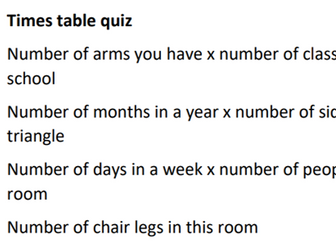
A short times tables quiz, ideal for a starter or warm-up activity. It also warms-up reasoning or problem-solving skills by applying times tables to work out problems like the number of chair legs in the room
 Quick View

 Quick View
 Quick View
 Quick View