IGCSE Business 0264 – Unit 3: Marketing | Knowledge OrganiserQuick View
a_mouton

IGCSE Business 0264 – Unit 3: Marketing | Knowledge Organiser

(0)
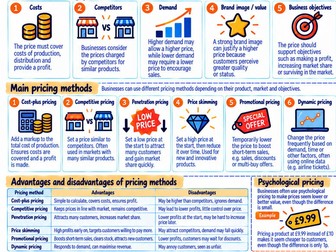
This colourful and easy-to-use Business Knowledge Organiser was made to support my students with revision and help them develop a better understanding of key business concepts. My students regularly use snippets from the organiser in their own notes, expanding on the content as we cover different topics. It also works well as a revision resource, providing a summary of essential knowledge in an accessible format. The knowledge organiser is aligned with the Cambridge IGCSE Business (0264) syllabus for 2027–2029 and is supplied as a printable A4 PDF covering Unit 3: Marketing. Topics covered 3.1 Marketing and the Market – The role of marketing, changing customer needs, market competition, market share calculations, mass and niche markets, market segmentation and targeting different customer groups. 3.2 Market Research – Primary and secondary research, research methods, questionnaires, sampling techniques, qualitative and quantitative data, interpreting research findings, and the advantages and disadvantages of different research methods. 3.3 Marketing Mix – The four Ps of marketing (Product, Price, Place and Promotion), branding, packaging, the product life cycle, extension strategies, pricing methods, distribution channels, advertising, sales promotions, ecommerce, marketing strategies and entering overseas markets. 3.4 Legal Controls – Legal controls affecting marketing, misleading advertising, consumer protection, faulty goods, customer rights and the impact of legislation on business marketing decisions. The organiser provides a useful summary of business concepts while encouraging students to develop their own notes, apply their knowledge and improve their examination technique. Format: Printable A4 PDF, 10 pages. Please note: This resource is supplied as a PDF and is not directly editable.
IGCSE Business 0264 – Unit 2: People in Business | Knowledge OrganiserQuick View
a_mouton

IGCSE Business 0264 – Unit 2: People in Business | Knowledge Organiser

(0)
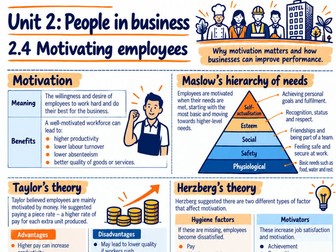
I created this colourful and easy-to-use Business Knowledge Organiser to support my students with revision and help them develop a better understanding of key business concepts. My students regularly use snippets from the organiser in their own notes, expanding on the content as we cover different topics in lessons. It also works well as a revision resource, providing a clear summary of essential knowledge in an accessible, illustrated format. The knowledge organiser is aligned with the Cambridge IGCSE Business (0264) syllabus for 2027–2029 and is supplied as a printable A4 PDF covering Unit 2: People in Business. Topics covered 2.1 Human Resource Management (HRM) – Recruitment and selection, internal and external recruitment, job descriptions, person specifications, employment contracts, training methods, employment law and workforce planning. 2.2 Organisation and Management – Organisational structures, chains of command, spans of control, delegation, management functions, leadership styles, trade unions, flexible working and workforce downsizing. 2.3 Methods of Communication – Internal and external communication, communication methods, advantages and disadvantages of different methods, barriers to effective communication and ways to overcome them. 2.4 Motivating Employees – The importance of motivation, Maslow’s hierarchy of needs, Taylor’s and Herzberg’s theories, financial and non-financial methods of motivation, and their advantages and disadvantages. The organiser provides a useful summary of business concepts while encouraging students to develop their own notes, apply their knowledge and improve their examination technique. Format: Printable A4 PDF, 8 pages. Please note: This resource is supplied as a PDF and is not directly editable.
IGCSE Business 0264 – Unit 1: Business Activity | Knowledge OrganiserQuick View
a_mouton

IGCSE Business 0264 – Unit 1: Business Activity | Knowledge Organiser

(0)
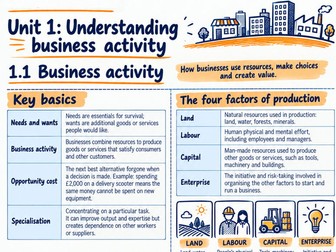
I have made the Business Studies knowledge organiser to help students with revision as this colourful Knowledge Organiser is easy to use. My students often use snips from the organiser to add into their notes and then expand the content as we cover topics. The PDF organiser matched the Cambridge IGCSE Business (0264), 2027–2029 syllabus. It’s a A4 printable PDF covering Unit 1: Understanding Business Activity The following topics are covered in this unit: 1.1 Business Activity – Needs, wants, scarcity, opportunity cost, factors of production and added value. 1.2 Economic Sectors – Primary, secondary and tertiary sectors, and public versus private sector organisations. 1.3 Enterprise, Business Growth and Size – Entrepreneurs, business plans, measuring business size and methods of growth. 1.4 Types of Business Organisation – Sole traders, partnerships, limited companies, franchises, joint ventures and social enterprises. 1.5 Business Objectives and Stakeholders – Business objectives, stakeholder interests and potential conflicts. Includes a basic and brief exam tips page to help students develop exam techniques based on: AO1 – Point: Demonstrate accurate business knowledge. AO2 – Apply: Use unique, relevant details from the business case study. AO3 – Analyse: Develop logical chains of reasoning. AO4 – Evaluate: Make supported judgement. Provides a good summary of concepts whilst supporting students in developing the skills needed for their Cambridge IGCSE Business examinations. Please note: This resource is supplied as a PDF and is not directly editable.
iGCSE Business 0264 Unit 1 Year 10 TestQuick View
a_mouton

iGCSE Business 0264 Unit 1 Year 10 Test

(0)
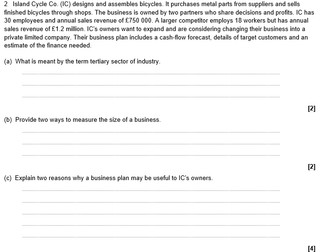
This is a Word document test that I use with Year 10 Business Studies students following the Cambridge IGCSE syllabus. I have found that it works well as a 45-minute assessment during a lesson time. It’s a basic test and the answer document also indicates the AO’s with the questions to it’s a little easier to mark and help students understand the basic assessment objectives in Business Studies. The test covers the following topics: Business growth Business plans Measuring business size Entrepreneurship Sectors of industry Specialisation Opportunity cost Factors of production Business ownership Assessing students early in Year 10 can be challenging, so please feel free to adapt and modify this test to suit your classes. The document has been formatted with spacing similar to that used in Cambridge examinations, helping students become familiar with exam-style layouts from the outset. A separate answer document is also included to support marking and to help students complete DIRT (Dedicated Improvement and Reflection Time) activities. I hope you find these resources useful.
iGCSE Business Studies Scheme of WorkQuick View
a_mouton

iGCSE Business Studies Scheme of Work

(0)
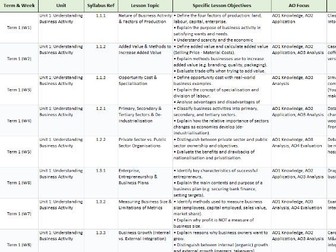
The Scheme of Work is based on the Cambridge International IGCSE Business Studies Syllabus updated for 2026. The course code has been updated from 0450 to 0264 and this scheme reflects the same course. This is based on the standard 2-year course teaching year 10 units 1-3 and units 4-6 in year 11. Based on my experience it is often useful to teach types of businesses early in year 10 and also introduce concepts from year 11 based on the class progress. This will depend on your individual groups I have added a few notes on this SOW. This work scheme includes recommended activities and a column for you to track classroom progress and add your own notes. I always date the topics that have been covered with some notes to track student progress. The Scheme of Work works well for me as a Excel file and I hope that you also find it useful.
IGCSE Business 0264 – Unit 4: Operations | Knowledge OrganiserQuick View
a_mouton

IGCSE Business 0264 – Unit 4: Operations | Knowledge Organiser

(0)
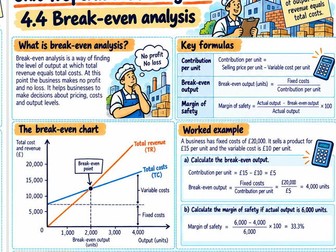
This knowledge organiser covered Unit 4: Operations Management and has been updated to align with Cambridge IGCSE Business (0264) syllabus for 2027–2029. My students regularly use snippets from the organisers I email and then add there own notes as we cover the topics in our lessons. The illustrations help students to remember the topics better and I have worked with various groups of students to come up with a layout that they like and helps them when it comes to revision. The following topics are covered in the Unit 4 Organiser. 4.1 Production of Goods and Services – Labour productivity, efficiency, lean production, just-in-time (JIT) inventory control, Kaizen, inventory management, job production, batch production and flow production, including their advantages and disadvantages. 4.2 Technology and Production of Goods and Services – The use of technology in business operations, automation and the advantages and disadvantages of technological change for businesses and employees. 4.3 Sustainable Production Methods – Sustainable production methods, renewable energy, reducing waste, recycling, reusing resources, environmentally friendly products and packaging, and the advantages and disadvantages of adopting sustainable business practices. 4.4 Costs, Scale of Production and Break-even Analysis – Fixed costs, variable costs, total costs, average costs, economies and diseconomies of scale, break-even calculations, break-even charts, margin of safety and the use of break-even analysis in business decision-making. 4.5 Quality of Goods and Services – The importance of quality, quality control, quality assurance, and the advantages and disadvantages of different approaches to maintaining quality. 4.6 Location Decisions – Factors influencing business location, including proximity to customers, labour availability, transport links, operating costs, access to raw materials and factors affecting international location decisions. The organiser provides a useful summary of Operations Management while encouraging students to develop their own notes, apply their knowledge and improve exam technique. Format: Printable A4 PDF. Please note: This resource is supplied as a PDF and is not directly editable.
IGCSE Business 0264 - Unit 5: Finance | Knowledge OrganiserQuick View
a_mouton

IGCSE Business 0264 - Unit 5: Finance | Knowledge Organiser

(0)
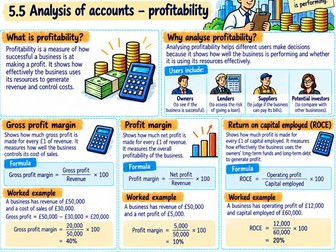
Updated from the 0450 Curriculum to the new Cambridge IGCSE Business (0264), Unit 5 – Financial Information and Decisions. Handy to help students understand financial concepts and makes for a great revision resource. My students often take snippets from the knowledge organisers I email and they then expand with notes and complete practice questions. Designed to align with the Cambridge IGCSE Business (0264) syllabus for 2027–2029, combining clear explanations, illustrations, essential formulas, worked calculations and exam-style questions. Rather than relying on lengthy textbook explanations, this knowledge organiser breaks down challenging financial topics into manageable sections, helping students develop confidence in financial calculations, interpreting accounts and making informed business decisions. The following topics are covered. 5.1 Business Finance: The need for finance, internal and external sources, short-term and long-term finance, working capital and choosing suitable sources of finance. 5.2 Cash Flow Forecasts: Cash inflows and outflows, constructing and interpreting cash flow forecasts, calculating closing balances and managing cash shortages. 5.3 Profit and Loss: Revenue, cost of sales, gross profit, expenses, profit calculations and interpreting statements of profit or loss. 5.4 Statement of Financial Position: Assets, liabilities, capital employed, working capital and understanding a business’s financial position. 5.5 Analysis of Accounts: Gross profit margin, profit margin, return on capital employed (ROCE), current ratio, acid test ratio, users of accounts and limitations of financial analysis. Students often find analysis of accounts challenging. This is why students enjoy using the organiser as it helps make the topic more accessible by combining essential knowledge and practical application. Format: Printable PDF, suitable printing and emailing to students. Please note that as a PDF format this document is not directly editable.