Year 7 Design & Technology – LEGO Heroes Graphics Project BookletQuick View
firstclickbusinesssolutions

Year 7 Design & Technology – LEGO Heroes Graphics Project Booklet

(0)
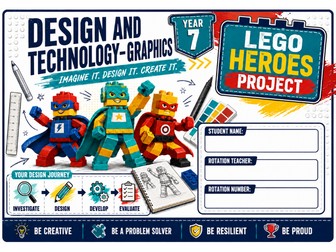
This comprehensive Year 7 Design & Technology Graphics booklet guides students through a full creative project themed around** LEGO Heroes and Villains.** The 22‑page resource covers the entire design process — from initial research and concept development to final product evaluation — using structured, visually engaging worksheets. It also includes a schemes of work. Each page scaffolds key design skills and literacy, helping students explore graphic communication, typography, materials, drawing techniques, and product design. Tasks are sequenced to build confidence and independence while aligning with** AQA GCSE Design & Technology (8552)** foundations. Includes: Project brief, glossary, and assessment criteria Worksheets on tools, safety, materials, typography, and perspective drawing Character design, logo development, and merchandise design tasks Literacy support boxes, success criteria, and WWW/EBI reflection prompts Printable A4 format for classroom or homework use **Perfect for: **KS3 Design & Technology, Graphics, or Art & Design rotations. Encourages creativity, technical accuracy, and professional presentation through a fun LEGO‑themed design challenge.
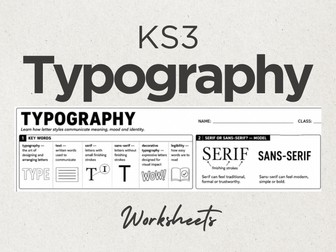
Typography Design Worksheet– Serif, Sans‑Serif and Decorative StylesQuick View
firstclickbusinesssolutions

Typography Design Worksheet– Serif, Sans‑Serif and Decorative Styles

(0)
This two-part Typography worksheet helps students explore how letter styles communicate meaning, mood, and identity through visual design. The first sheet introduces key terminology (serif, sans-serif, decorative, legibility) and guides learners to redesign words so their shape, weight, spacing, and texture match their meaning. It includes annotation prompts, success criteria, and literacy support for accessible reflection. The second sheet builds on this by comparing serif, sans-serif, and decorative styles through a character-based design task. Students test, refine, and evaluate their typography choices using structured reflection boxes (WWW/EBI) and stretch challenges. Ideal for KS3–KS4 Design & Technology, Art & Design, or Graphics lessons, this resource supports visual communication, creative typography, and design literacy. Includes: Two printable worksheets (Typography fundamentals + Character typography design) Key vocabulary and sentence starters for literacy support Success criteria and stretch tasks for differentiation Suitable for classroom or homework use
KS4 Design Process Knowledge Organiser – GCSE Design & TechnologyQuick View
firstclickbusinesssolutions

KS4 Design Process Knowledge Organiser – GCSE Design & Technology

(0)
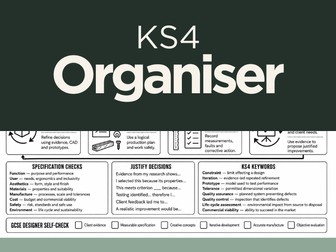
This KS4 Design Process Knowledge Organiser provides a clear, visual summary of the GCSE Design & Technology design cycle, building directly on the KS3 version. It helps students understand how professional designers move from identifying a client’s needs to evaluating a finished product using evidence‑based decisions and technical accuracy. The organiser breaks the process into eight structured stages — from defining context and researching users to manufacturing, testing, and evaluation — with concise explanations, icons, and literacy prompts to support written justification. It also includes specification checks, decision‑justification sentence starters, and KS4 keywords aligned with AQA GCSE Design & Technology (8552). Includes: The 8‑step GCSE design process (Context, Research, Brief, Concepts, Development, Manufacture, Testing, Evaluation) Specification checks covering function, user, aesthetics, materials, cost, safety, and environment Literacy support for justifying design decisions Key terminology for GCSE D&T (iteration, prototype, tolerance, quality control, sustainability) Designer self‑check section for reflection and assessment Perfect for: GCSE Design & Technology lessons, classroom displays, student folders, or homework reference sheets. Supports exam preparation and encourages analytical, evidence‑led design thinking.
KS3 Design Process Knowledge Organiser – Design & TechnologyQuick View
firstclickbusinesssolutions

KS3 Design Process Knowledge Organiser – Design & Technology

(0)
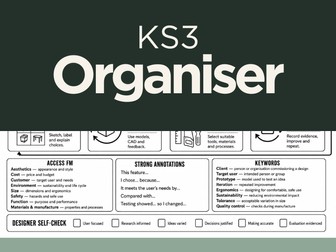
This KS3 Design Process Knowledge Organiser provides a clear, visual summary of the eight key stages in the design cycle — from identifying a need through to testing, evaluation, and iteration. It’s ideal for helping students understand how designers move from problem to solution using structured thinking and practical application. Each stage is supported by concise explanations, icons, and literacy prompts to reinforce understanding. The organiser also includes ACCESS FM criteria, keywords, and annotation sentence starters to strengthen written communication and design justification. Includes: The 8‑step KS3 design process (Identify, Research, Brief, Specification, Ideas, Develop, Make, Evaluate) ACCESS FM breakdown for specification writing Strong annotation examples and literacy support Key terminology for design and technology Designer self‑check section for reflection and assessment **Perfect for: **KS3 Design & Technology lessons, classroom displays, student folders, or homework reference sheets. Supports AQA GCSE Design & Technology (8552) progression and encourages independent, reflective design thinking.
CAM Processes Literacy Worksheet – 3D Printing, Laser Cutting, Lithography & GravureQuick View
firstclickbusinesssolutions

CAM Processes Literacy Worksheet – 3D Printing, Laser Cutting, Lithography & Gravure

(0)
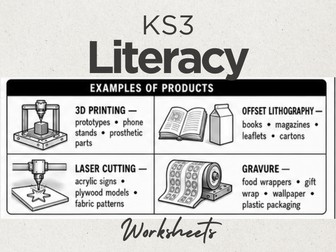
This literacy‑focused CAM Processes worksheet helps students understand and compare four key manufacturing methods: 3D printing, offset lithography, laser cutting, and gravure. It clearly explains how digital design data is converted into machine instructions and how each process affects product quality, quantity, cost, and material choice. Students use labelled diagrams, key vocabulary, and structured writing prompts (WHAT–HOW–WHY) to build full‑sentence explanations and evaluations. The sheet includes a comparison table, model answer, and an AQA‑style 6‑mark challenge, making it ideal for GCSE Design & Technology (AQA 8552) or KS3 technical literacy lessons. Includes: Illustrated explanations of four CAM processes Comparison table for quality, quantity, cost, and materials Key vocabulary and literacy support Model answer and exam‑style challenge Printable A4 worksheet for classroom or homework use