A Level Russia Alexander II and Alexander III notesQuick View
Celsie

A Level Russia Alexander II and Alexander III notes

(0)
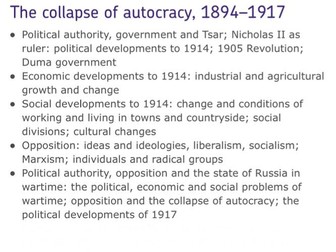
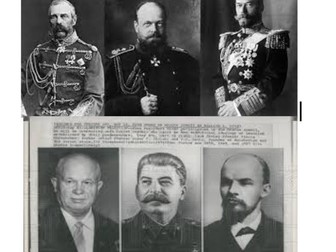
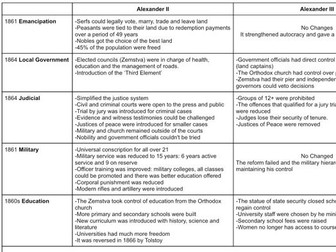
Alexander II – ‘tsar liberator’ (1855-1881) Reforms emancipation of the serfs military reform judicial reform education and censorship reform local government reform Alexander III – ‘the reaction’ (1881-1894) Reversing Reforms education censorship law and order judiciary Nationalism Russification anti-Semitism comparison of the Tsars
A level Russia LeninQuick View
Celsie

A level Russia Lenin

(0)
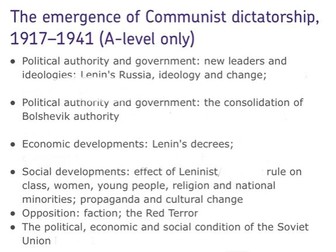
the rise of Lenin 1917 revolution the abdication of Nicholas II the provisonal government and dual authority end of the first world war bolshevik rise to power the civil war bolshevik opposition Lenin political control the New economic policy and war communism the Red Army and Cheka death of Lenin cult of personalty
A level Russia Nicholas II notesQuick View
Celsie

A level Russia Nicholas II notes

(0)
Russo Japan war bloody sunday st petersburg soviet 1905 revolution 1905 October manifesto opposition (Liberals, Socialist Revolutionaries, Social democrats) society under Nicholas economy under Nicholas the rise of Lenin
A level History Russia Stalin notesQuick View
Celsie

A level History Russia Stalin notes

(0)
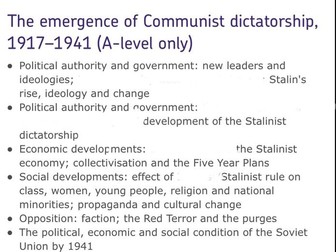
Leadership struggle after Lenins death (bukharin, stalin, trotsky, kamenev, zinoviev) the rise of Stalin collectivisation Five year plans (1,2,3,4,5) the great terror (causes, moscow show trails, party purges, the NKVD, social political and economic consequences) second world war (Nazi soviet pact, stalin as a war leader, politics, society, economy, after the war) the cult of personality socialist realism cultural revolution Society economy
1455-1471 Wars of the Roses notesQuick View
Celsie

1455-1471 Wars of the Roses notes

(0)
The origins of conflict, 1450–1459 English society and politics in 1450: the weakness of Henry VI’s rule; baronial factions; Cade’s rebellion; the loss of Normandy The impact on English politics of the emerging power and influence of Richard of York The outbreak of war: the first Battle of St Albans and the balance of military power in 1455 The uneasy peace: the influence of Margaret of Anjou; factional rivalries and their impact on English society The War of the Barons, 1459–1461 The renewal of war: York’s flight into exile; the emergence of Warwick ‘the Kingmaker’; the capture of Henry VI at Northampton Filling the political vacuum: the rule of Richard of York as Protector of England Shifting loyalties and the Lancastrian revival: Wakefield; the second Battle of St Albans; the death of York and the restoration of Henry VI Proclamation of Edward IV as King; Yorkist victory at Towton; the strengths and weaknesses of the Yorkists by 1461 The triumph of the Yorkists, 1461–1471 The personal rule of Edward IV and the political impact of his marriage to Elizabeth Woodville Factional rivalries: Warwick ‘the Kingmaker’; attempts to restore Henry VI; Margaret of Anjou; Edward, Prince of Wales The crushing of the Lancastrian cause: Barnet and Tewkesbury; the destruction of the Lancastrian nobility The impact of the baronial wars on English society by 1471: the weakening of the aristocracy; the impact on trade and the economy
1471-1483 Wars of the Roses Edward IVQuick View
Celsie

1471-1483 Wars of the Roses Edward IV

(0)
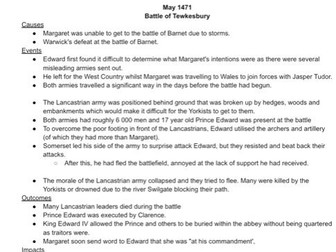
How Edward IV regained the throne in 1471 How he consolidated the throne in his second reign (policy towards the North, Ireland and Wales, Burgundy and Scotland, 1475 treaty of Picquingy) Edward IV domestic policy (law and order, royal finance) 1471 battle of Barnet 1471 battle of Tewksbury Edwards death
AQA Psychology Schizophrenia NotesQuick View
Celsie

AQA Psychology Schizophrenia Notes

(0)
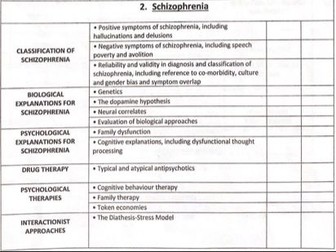
AQA Psychology notes includes classification and diagnosis (reliability and validity, positive and negative symptoms) Biological explanations (Genetics, Dopamine hypothesis, Neural correlates, Evaluation) Psychological explanations (Family dysfunction) Cognitive explanations (Dysfunctional thought processes) Drug therapy Psychological therapies (CBT, Family therapy, Token economies) The Interactionist approach (Diathesis stress model)
AQA Psychology Memory NotesQuick View
Celsie

AQA Psychology Memory Notes

(0)
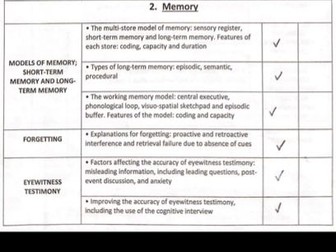
AQA Psychology notes on memory including -models of memory (multi-store model, working memory model + encoding, duration and capacity) -short and long term memory (types of long term) -explanations for forgetting (Interference, retrieval failure) -eyewitness testimony (factors affecting it and improving- cognitive interview)
AQA Psychology Social Influence notesQuick View
Celsie

AQA Psychology Social Influence notes

(0)
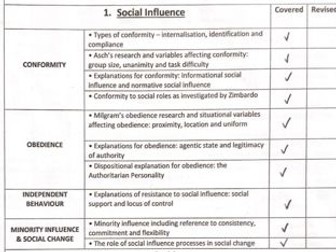
AQA Psychology notes for social influence Includes -Conformity: Types, Asch, Zimbardo and Explanations -Obedience: Milgram, Explanations (including dispositional and situational) -Independant Behaviour: Explanations of resistance to social influence (social support and locus of control) -Minority Influence and social change
A Level Russia Complete NotesQuick View
Celsie

A Level Russia Complete Notes

4 Resources
this bundle comprehensively covers the whole AQA Tsarist and Communist Russia course 1855-1964 Tsar Alexander II Tsar Alexander III Tsar Nicholas II Provisional Government and dual authority Lenin and the Bolsheviks Stalin’s dictatorship Khrushchev and the fall of Soviet Russia
1445-1470 Wars of the Roses BattlesQuick View
Celsie

1445-1470 Wars of the Roses Battles

(0)
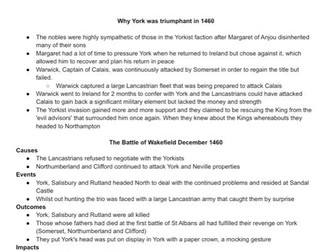
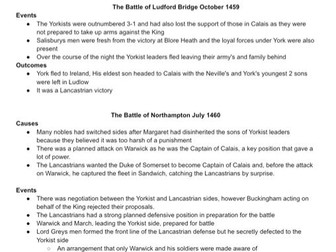
The loss of Normady Cade’s Rebellion 1450 Dartford Coupe 1452 First Battle of St Albans 1455 Blore Heath 1459 Northampton 1460 Wakefield 1460 Mortimers Cross 1461 Second Battle of St Albans 1461 Towton 1461 Hedgeley Moor 1464 Hexham 1464 Edgecote 1469 Losecoat Field 1470 All including the causes, events, outcomes and impacts.
AQA Psychology Issues and Debates notesQuick View
Celsie

AQA Psychology Issues and Debates notes

(0)
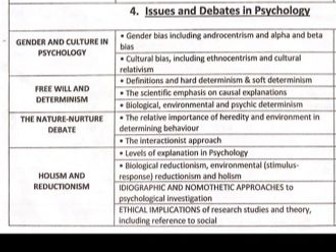
AQA issues and debates notes include gender and culture (gender bias and cultural bias) free will and determinism (definitions, biological environmental and psychic determinism, hard and soft determinism) nurture nature debate (importance of heredity and environment in determining behaviour, interactionist approach) holism and reductionism (biological and environmental reductionism, idiographic and nomathetic approaches, ethical implications of research)
AQA psychology psychopathology notesQuick View
Celsie

AQA psychology psychopathology notes

(0)
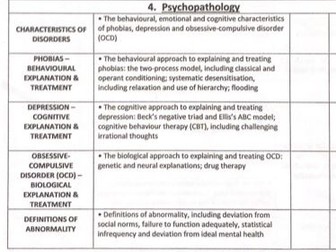
AQA psychology psychopathology notes include characteristics of disorders (behavioural, emotional and cognitive characteristics) phobias (behavioural explanation and treatment) depression (cognitive explanation and treatment) Obsessive Compulsive Disorder (Biological explanation and treatment) definitions of abnormality (deviation from social norms, failure to function, statistical infrequency, deviation from ideal mental health)