Description:
A complete, ready to teach lesson pack covering OCR GCSE Computer Science (J277) specification 2.4 - Boolean Logic. Built directly from the OCR spec and past paper question style, with no XOR or other off-spec content to confuse students.
Includes:
10 slide teaching PowerPoint covering AND, OR and NOT gates, truth tables, combining operators, worked real world examples, common exam mistakes, and a step by step method for building truth tables.
Practice worksheet with 3 sections, 10 questions, and 26 marks. Progresses from single gates to combined expressions to exam style scenario questions.
Full answer key with mark scheme guidance for teachers.
15 question multiple choice quiz with a separate answer key. Ideal for retrieval practice, starters, or homework.
Perfect for a single lesson or split across two, and ideal for cover lessons thanks to the fully resourced, self contained format.
Specification coverage: AND, OR and NOT operators, logic diagrams, truth tables, and combining Boolean operators, matching OCR J277/02 2.4 exactly.
Description:
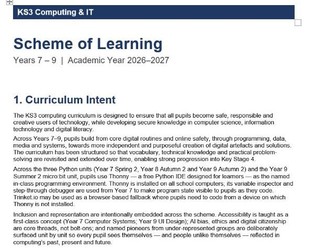
Stop rebuilding your KS3 curriculum from scratch every year. This is a complete, ready-to-teach Computing and IT scheme of learning covering all three years of Key Stage 3 (Years 7 to 9) for the 2026-27 academic year, built to take a department from the first week of September to the last week of July with no gaps to fill in yourself.
This is not a single lesson or a single topic. It is the full three-year curriculum map that most departments spend months building, written to the standard of a published scheme rather than a quick set of slides.
18 fully planned half-term units across Years 7, 8 and 9, covering:
Online safety and digital routines, computational thinking and flowcharts, spreadsheets and data modelling, Python programming from first principles through to advanced (using Thonny), living with AI, computer systems and binary, cyber security and digital resilience, data representation, computer networks and the internet, web development with HTML and CSS, image editing with GIMP, UI design with Canva, computer systems architecture and logic gates, algorithms including searching and sorting, and physical computing with the micro:bit.
Every single unit includes:
A half-term overview with teaching weeks, National Curriculum links and taxonomy coding.
A lesson by lesson breakdown with learning objectives, vocabulary focus and assessment notes.
Tier 1, Tier 2 and Tier 3 vocabulary lists for explicit vocabulary instruction.
Common misconceptions specific to each topic, so you can address them before they take root.
Low stakes retrieval practice checkpoints, with spaced recall intervals mapped out within and across units.
SMSC and British Values links for every topic.
Cognitive load tagging per lesson, showing schema dependencies so you can sequence teaching around what pupils already know.
Motivation and engagement strategies grounded in Self-Determination Theory for every unit.
Named pioneers and representation woven into the curriculum itself, not bolted on as an afterthought.
An iDEA Award extension homework structure that builds a pupil e-portfolio across all three years.
A clear, department-wide assessment model covering baseline testing, end of topic tests, practical rubric assessment and project evaluation, with a taxonomy legend mapping every lesson to the strands it covers.
This is the document Heads of Department wish they had time to write. Use it as your department’s curriculum map for a full Ofsted-ready review, hand it to a new or trainee teacher as a complete starting point, or use it to benchmark and strengthen your existing KS3 provision.
Ideal for: Heads of Computing planning a curriculum review, new and trainee teachers who need a fully resourced starting point, departments moving toward explicit, retrieval-based curriculum design, and any school wanting a coherent, evidenced pathway from Year 7 straight through into GCSE.


 Quick View