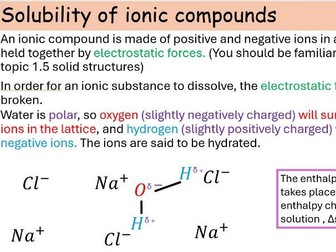
WJEC A level chemistry A2 Unit 3 Topic 3.6: Enthalpy changes for solids and solutions powerpoints for whole topic
Each lesson covers a spec point:
Lesson 1: Lesson 1 - Standard enthalpy changes, and solubility of ionic compounds in water
Lesson 2: Born-Haber cycles and stability of compounds
Each lesson has notes, small tasks and exam questions
Accessible for students
WJEC A level chemistry A2 Unit 3 Topic 3.5: Chemical Kinetics powerpoints for whole topic
Each lesson covers a spec point:
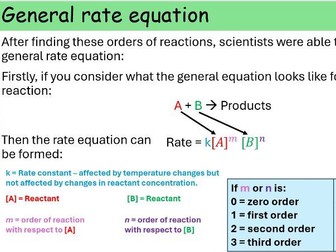
Lesson 1: Sampling and quenching, Finding reaction order and the general rate equation
Lesson 2: Finding units for k, rate determining steps and mechanisms
Lesson 3: Arrhenius equation and effect of catalysts on rate.
Each lesson has notes, small tasks and exam questions
Accessible for students
WJEC A level Biology A2 Unit 3 Topic 3.5: Populations and ecosystems powerpoints for whole topic
Each lesson covers a spec point:
Lesson1: Populations
Lesson 2: Sampling
Lesson 3: Ecosystems and biomass transfer
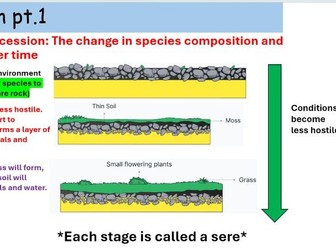
Lesson 4: Succession
Lesson 5: Carbon cycle and the human impact on the carbon cycle
Lesson 6: Nitrogen cycle, human impact on the nitrogen cycle, and eutrophication
Each lesson has notes, small tasks and exam questions
Accessible for students
WJEC A level Biology A2 Unit 3 Topic 3.3: Respiration powerpoints for whole topic
Each lesson covers a spec point:
Lesson1: ATP and an introduction to respiration
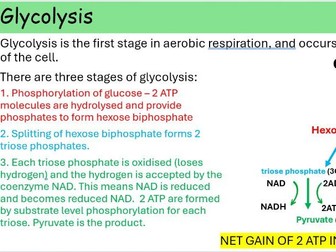
Lesson 2: Glycolysis and link reaction
Lesson 3: Krebs Cycle
Lesson 4: Electron transport chain
Lesson 5: Anaerobic respiration and energy budgets
Lesson 6: Alternative respiratory substrates
Each lesson has notes, small tasks and exam questions
Accessible for students
WJEC A level Biology AS Unit 1 Topic 1.3: Cell membranes and transport powerpoints for whole topic
Each lesson covers a spec point:
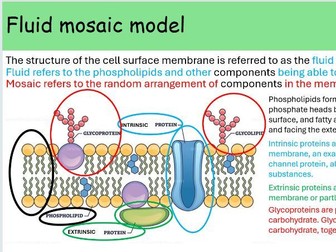
Lesson1: Fluid mosaic model and factors affecting it’s permeabiltiy
Lesson 2: Simple/facilitated diffusion and factors that affect them
Lesson 3: Osmosis
Lesson 4: Active transport and bulk transport
Each lesson has notes, small tasks and exam questions
Accessible for students
WJEC A level chemistry AS Unit 1 Topic 1.3: Chemical calculations powerpoints for whole topic
Each lesson covers a spec point:
Lesson 1: Relative mass terms and mass spectrometry
Lesson 2: Empirical and molecular formula
Lesson 3: Avogadro, grams, moles, concentration, and solubility
Lesson 4: Stoichiometry
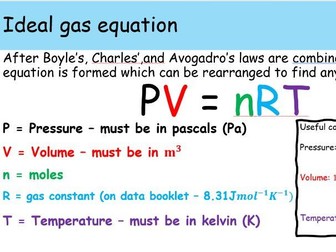
Lesson 5: Gas laws and the ideal gas equation
Lesson 6: Atom economy, % yield, %error, and significant figures
Each lesson has small tasks and exam questions
WJECA level chemistry A2 Unit 4 Topic 4.2: Aromaticity powerpoints for whole topic
Each lesson covers a spec point:
Lesson 1: structure + bonding in benzene
Lesson 2: benzene’s resistance to addition reactions & electrophilic substitution mechanisms (nitrations, halogenation, friedel-crafts alkylation)
Lesson 3: C-Cl bond strength + past paper question revision for whole topic
Each lesson has notes, small tasks and exam questions
Accessible for students
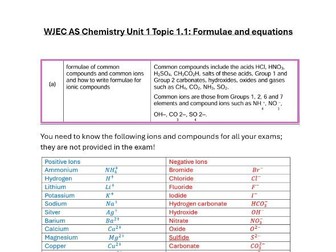
WJEC A level chemistry AS Unit 1 Topic 1.1: Formulae and equations powerpoints for whole topic
Each lesson covers a spec point:
Lesson 1: Chemical formulae and oxidation numbers
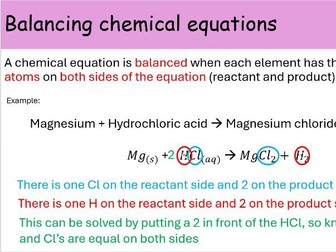
Lesson 2: Chemical and ionic equations
Accessible for students
WJEC A level chemistry AS Unit 1 Topic 1.6: The periodic table powerpoints for whole topic
Each lesson covers a spec point:
Lesson 1: Elements arranged by atomic number, recap of electronic structure, recap of oxidation and reduction
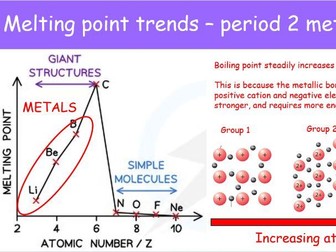
Lesson 2: Trends in the periodic table
Lesson 3: Reactivity of groups 1&2, group 2 metals with oxygen, steam, and water, cation reactions, and flame tests
Lesson 4: Thermal stability of group 2 hydroxides & carbonates, solubility of group 2 hydroxides & sulfates, and group 1 & 2 oxides
Lesson 5/6: Group 7
Lesson 7: Salt formation
Each lesson has small tasks and exam questions
Accessible for students
WJEC A level Biology AS Unit 1 Topic 1.2: Cell structure and organisation powerpoints for whole topic
Each lesson covers a spec point:
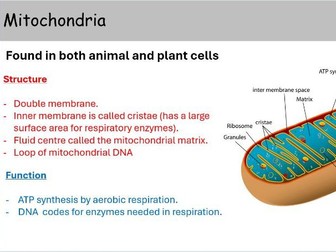
Lesson1: Eukaryotic cell organelles
Lesson 2:Prokaryotic cells, viruses, and their differences compared to eukaryotes
Lesson 3: Levels of organisation
Each lesson has notes, small tasks and exam questions
Accessible for students


 Quick View
 Quick View
 Quick View
 Quick View
 Quick View
 Quick View
 Quick View
 Quick View
 Quick View
 Quick View