It includes:
Two introductory PowerPoints that help your AS Level Psychology students get a clear and friendly first look at the learning approach, in a way that’s easy to follow from the start.
Additional handout with a summary of main key points to learn from Learning Approach (Classical, Operant &Social Learning Theories), main methodology used by researchers & Issues and Debates.
Ready to teach files:
A) Introduction to Social Approach PowerPoint
B) Milgram:
Milgram PowerPoint
Milgram Revision Notes (summary notes)
C) Perry et al.:
Personal Space Presentation (introduction to Perry et al.)
Perry et al PowerPoint Presentation
Perry et al. Revision Notes
D) Piliavin et al.:
Piliavin Presentation
Piliavin Revision Notes
E) Evaluate Example Answer of the 3 Core Studies on the Social Approach
F) Psychology being investigated of the 3 core studies of the social approach.
G) Revision Social Approach PowerPoint
It includes all material you need to teach the Learning Approach (CIE):
Evaluate Questions:
PowerPoint that explains how to write the perfect Evaluate Response (with AO1, AO2 and AO3). PowerPoint contains examples.
One Evaluate Example Answers for each of the 3 core studies in the Learning Approach
Psychology Being Investigated - 3 core studies
Bandura et al.
Extended PowerPoint
Bandura Revision Notes (summary notes)
Fagen et al.
Introductory PowerPoint on Operant Conditioning (for revision)
Fagen Revision Notes
Fagen Intro PowerPoint
Fagen Activity for Students
Saavedra and Silverman
Saavedra & Silverman Revision Notes
Saavedra & Silverman Intro PowerPoint
Saavedra & Silverman Activity for Students
Two complete revision systems in one:
One designed for GCSE/IGCSE students
One for A Level students
Both ready to print and hand out at the start of exam season :)
Each pack follows the same proven 3-template structure, adapted to the demands of each level:
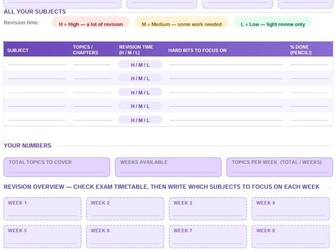
Template 1 – Big Picture: Students map out all their subjects, set priorities, plan a 12-week revision countdown and track progress week by week.
Template 2 – Weekly Planner: A realistic day-by-day schedule.
The IGCSE version includes fixed school hours
The A Level version is fully flexible so students plan around their own timetable.
Template 3 – Topic Tracker: One sheet per subject to log topics, rate confidence (1–5) and flag anything that needs revisiting before the exam.
Clear layout, friendly language, enough writing space to actually be useful. Works brilliantly in form time, study skills sessions or as something students set up independently.
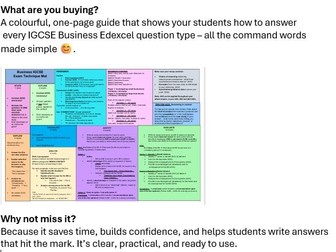
IGCSE Business Edexcel Exam Guide – Command Words Made Simple
This one-page, colourful resource helps students tackle IGCSE Business exam questions with confidence. It breaks down each command word (state, outline, explain, analyse, justify and more) into simple, clear structures so students know how to answer every question type.
It also includes key exam tips and useful reminders about what to expect in the paper. Perfect for revision, classroom displays, or to keep in their folders.
Easy to use, student-friendly, and designed to make exam technique a little less stressful! Hope it helps your students, it certainly has helped many of mine :)
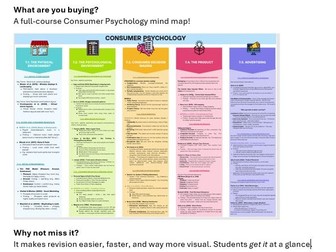
This colourful, one-page mind map covers the entire Consumer Psychology unit for Cambridge International A-Level (Year 13) — perfect for visual learners and anyone who likes their revision clear and organised. All the key studies are mapped out by topic, so students can quickly see what goes where, how ideas connect, and what they need to know for exams.
It’s bright, easy to follow, and brings the whole course together on one sheet — ideal for pinning up at home, using in lessons, or handing out for revision. Works brilliantly as a summary after finishing the unit, or as a reference throughout the year.
Best printed in colour on A3 paper to get the full benefit — the layout really helps with memory and understanding, especially when things start to blur together close to exam time.
Whether you’re teaching the topic or revising it, this is a great way to keep Consumer Psychology simple, structured, and (dare we say) enjoyable.
Kickstart your CIE Sociology A Level course with these introductory powerpoints perfect for your first few lessons.
The 1st PowerPoint covers the essentials: What is Sociology, the Origins of Sociology, and Key Concepts. Great way to engage students from the start with interactive class activities that spark interest and lay a solid foundation for the year ahead.
The 2nd PowerPoint dives deep into the crucial debate of Structuralism vs. Social action, providing clear, concise explanations of key theories like Functionalism, Marxism, and Feminism, as well as Symbolic Interactionism, Looking glass-self theory, Labelling Theory, Dramaturgical approach, and Social exchange theory.
These resources set the stage, offering an overview of the course while sparking students’ interest. They have been designed to make complex ideas accessible, with colourful slides, interactive class activities, and embedded videos.
Explore Topic 1.3. Identy and Culture, of the CIE A Level Sociology syllabus, with this PowerPoint presentation focused on social change.
Includes the perspectives of key sociological thinkers: Karl Marx, Max Weber, and Émile Durkheim. Helps students understand how each theorist views the impact of social change on identity and culture. Includes embedded videos to enhance learning experience.
Don’t miss this PowerPoint bundle tailored for the CIE A-Level Sociology curriculum and focused on Topic 1.1 - Process of Learning and Socialisation.
These 3 dynamic presentations cover:
Nature vs. Nurture debate
Primary Socialisation theories (featuring Piaget, Mead, Cooley, Goffman, Bandura, Tarde and feral children).
Secondary Socialisation influences (including formal education, peer groups, workplace, religion, and media).
Engaging class activities and embedded videos will help you make complex concepts accessible and interactive for students.
It includes 2 PowerPoints with colourful slides that explain Topic 1.2. Social Control, Conformity and Resistance (CIE A Level Sociology). It covers:
A. Role of structure and agency in shaping relationships between individuals and society.
B. Factors explaining why individuals conform to social expectations.
C. Mechanisms through which order is maintained
D. Deviance and non-conformity
It includes class activities and embedded videos to enhance understanding and foster critical thinking. Great for both in-class teaching and independent study.
Let’s Launch It!
This fun, hands-on project gets students thinking like real entrepreneurs. They’ll come up with a business idea, plan it, launch it, and reflect on how it went – all while applying what they’ve learned in class.
The project’s broken into clear weekly phases and works really well over a few weeks. Great for bringing the content to life and letting students experience the obstacles and joys of runnning their own business!
Hope this resource helps! (I’ve usually used it soon after Year 10 students begin this course to get them hands-on with real life application of the course!)
Boardroom Battle!
Get students revising without even realising it! In this fun group project, they’ll design and build their own trivia board game using Unit 1 and Unit 2 content (ot any other Units you wish).
From writing questions to designing the board and making up the rules, it’s a creative way to review key topics while working as a team. Great for end-of-term/ end-of-year or as a revision activity with a twist!


 Quick View