Listening and Talking Challenge/Fast Finisher CardsQuick View
ErinM411538

Listening and Talking Challenge/Fast Finisher Cards

(0)
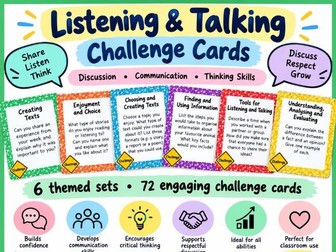
A comprehensive set of Listening and Talking Challenge Cards/ Fast Finsher Cards designed to encourage purposeful discussion, confident communication, active listening and higher-order thinking across the primary classroom. This resource contains six themed sets of challenge cards, providing a wide range of open-ended questions and activities that can be used across different stages and abilities. Pupils are encouraged to explain their ideas, listen and respond to others, justify opinions, ask effective questions, collaborate, evaluate information and communicate clearly. The challenge cards cover key areas of Listening and Talking, including: Creating Texts – sharing experiences, summarising discussions, presenting ideas, considering different viewpoints and participating respectfully in group discussions. Enjoyment and Choice – discussing favourite texts and media, making recommendations, explaining preferences and comparing different forms of communication. Choosing and Creating Appropriate Texts – considering audience, purpose, format, tone and how information can be communicated effectively. Finding and Using Information – organising information, selecting appropriate vocabulary, presenting key facts and communicating information clearly to an audience. Tools for Listening and Talking – turn-taking, collaboration, encouraging others to contribute, discussing different ideas and resolving disagreements respectfully. Understanding, Analysing and Evaluating – distinguishing between fact and opinion, questioning sources, considering influence and bias, and evaluating information critically. The questions range from accessible conversation starters to more challenging tasks requiring pupils to analyse, justify, evaluate and reflect, making the cards useful for differentiation and progression. Perfect for use during literacy lessons, talking and listening groups, morning activities, partner work, cooperative learning, class discussions, plenaries, assessment opportunities or fast-finisher tasks. The cards can be printed and laminated for repeated use , placed at discussion stations, selected at random or used by the teacher to generate meaningful whole-class conversations. A versatile, low-prep resource for developing confident speakers, thoughtful listeners and respectful communicators while supporting key Curriculum for Excellence Literacy and English skills.
Writing Challenge/ Fast Finisher CardsQuick View
ErinM411538

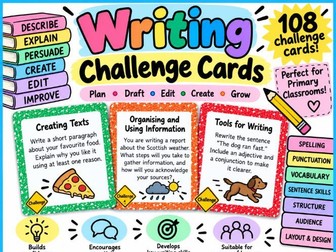
Writing Challenge/ Fast Finisher Cards

(0)
A comprehensive collection of 108 Writing Challenge Cards designed to develop pupils’ confidence, independence and creativity across key areas of Curriculum for Excellence Literacy and English. This pack contains 9 sets of 12 challenge cards, with activities covering the main aspects of writing: Creating Texts, Enjoyment and Choice, Organising and Using Information, and Tools for Writing. The cards include a mixture of quick tasks, discussion prompts, practical writing activities and extended challenges, making them ideal for differentiation and progression across the primary classroom. What is covered? Creating Texts – 2 sets Pupils explore descriptive, informative, narrative, opinion and persuasive writing. Tasks range from describing everyday experiences and explaining processes to producing letters, speeches, reports and balanced arguments supported with evidence. Enjoyment and Choice Challenges encourage pupils to think about purpose, audience and text type, choose appropriate formats, adapt their language, create persuasive pieces and experiment with creative writing. More advanced tasks explore digital versus traditional formats and writing effectively for a specific audience. Organising and Using Information – 2 sets Pupils develop skills in researching, note-taking, selecting and acknowledging sources, judging reliability and organising information effectively. Activities also explore headings, paragraphs, bullet points, vocabulary, genre, audience and planning different forms of writing. Tools for Writing – 4 sets A wide variety of challenges develops essential technical and creative writing skills, including: Spelling strategies, suffixes and homophones Proofreading and self-correction Capital letters and punctuation Simple, compound and complex sentences Conjunctions, adjectives and adverbs Paragraphing and sentence variety Dialogue and descriptive writing Coherence, flow and editing Peer feedback and evaluating writing Audience and purpose Titles, headings and bullet points Layout, graphics, fonts and white space Creating posters, brochures, presentations and digital texts The challenges range from short, accessible activities to tasks requiring pupils to explain, justify, create, edit, analyse and evaluate, allowing teachers to select cards to suit different learners and levels of challenge. Perfect for: Writing lessons Literacy rotations Early-finisher activities Independent learning Writing stations Morning tasks Partner or group work Homework Assessment opportunities Extension and challenge Plenaries Supply teaching The cards can be printed, cut out and laminated for repeated classroom use, placed in a challenge-card station or selected individually to complement your current writing focus. A versatile, low-prep writing resource that can be used throughout the year to encourage pupils to become more confident, thoughtful and independent writers.
Reading Challenge/ Fast Finisher CardsQuick View
ErinM411538

Reading Challenge/ Fast Finisher Cards

(0)
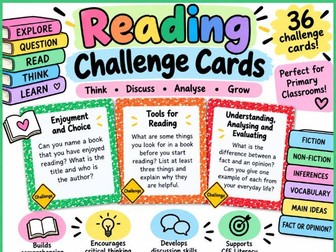
A versatile set of 36 Reading Challenge Cards designed to develop pupils’ reading comprehension, confidence, critical thinking and ability to discuss and respond to a wide range of texts. This resource contains three themed sets of 12 challenge cards, covering key areas of Curriculum for Excellence Literacy and English. The open-ended tasks encourage pupils to explain their thinking, justify opinions, apply reading strategies and engage more deeply with fiction, non-fiction and media texts. The three sets include: Enjoyment and Choice – encourages pupils to discuss books and authors they enjoy, describe characters, explore themes, recommend texts, compare authors and reflect on how their reading preferences develop over time. Tools for Reading – develops practical reading strategies including making predictions, tackling unfamiliar vocabulary, adjusting reading pace, using illustrations and context clues, making inferences and selecting strategies to improve comprehension. Understanding, Analysing and Evaluating – supports higher-order thinking through activities exploring fact and opinion, bias, credibility, advertising, source reliability, social media influence and forming informed opinions. The challenges progress from accessible discussion prompts to more demanding tasks requiring pupils to analyse, compare, evaluate, justify and reflect, making the resource useful for a range of learners and classroom contexts. Perfect for: Guided and group reading Reading comprehension sessions Partner and small-group discussion Literacy rotations Independent reading tasks Fast finishers Plenaries and assessment Book clubs and novel studies Homework or home-learning activities The colourful challenge-card format makes the resource easy to print, laminate and reuse, while the open-ended questions mean many of the cards can be used repeatedly with different books and texts. A useful low-prep reading resource for encouraging pupils to move beyond simply retrieving information and become more thoughtful, independent and critical readers.
CfE Literacy Challenge Cards Bundle – Reading, Writing, Listening & Talking | 216 Cards  A huge Curriculum for Excellence Literacy Challenge Cards/ Fast Finisher BundleQuick View
ErinM411538

CfE Literacy Challenge Cards Bundle – Reading, Writing, Listening & Talking | 216 Cards A huge Curriculum for Excellence Literacy Challenge Cards/ Fast Finisher Bundle

3 Resources
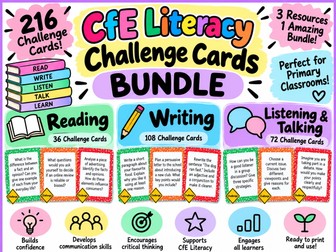
A huge Curriculum for Excellence Literacy Challenge Cards Bundle bringing together Reading, Writing and Listening & Talking in one versatile classroom resource. This bundle contains 216 challenge cards across 18 themed sets, giving you a wide range of engaging, low-prep activities for developing pupils’ confidence, independence, communication, comprehension, writing and higher-order thinking skills. The cards move from accessible prompts to more challenging activities requiring pupils to explain, justify, compare, analyse, evaluate, create and reflect, making them ideal for differentiation and use across a range of primary stages. Included in the bundle Reading Challenge Cards – 36 cards Three themed sets covering: Enjoyment and Choice Tools for Reading Understanding, Analysing and Evaluating Pupils develop skills such as making predictions, tackling unfamiliar vocabulary, using reading strategies, making inferences, discussing texts, exploring fact and opinion and evaluating the credibility of information. Writing Challenge Cards – 108 cards Nine themed sets covering: Creating Texts Enjoyment and Choice Organising and Using Information Tools for Writing Challenges develop spelling, punctuation, sentence structure, vocabulary, paragraphing, descriptive writing, persuasive writing, narrative writing, proofreading, editing, research, audience awareness, purpose, layout and presentation. Listening & Talking Challenge Cards – 72 cards Six themed sets focusing on: Creating Texts Enjoyment and Choice Choosing and Creating Texts Finding and Using Information Tools for Listening and Talking Understanding, Analysing and Evaluating Pupils are encouraged to share ideas confidently, listen and respond to others, justify opinions, ask effective questions, collaborate, discuss different viewpoints and take part in respectful group conversations. Perfect for: Literacy rotations Reading and writing groups Talking and listening activities Morning work Fast finishers Partner and group tasks Independent learning Guided reading Writing stations Plenaries Assessment opportunities Extension and challenge Homework Supply teaching The colourful challenge-card format makes the resources ideal for printing, cutting out and laminating for repeated classroom use. Teachers can select cards to match a current learning focus, allow pupils to choose independently or create dedicated literacy challenge stations. With 216 reusable activities, this bundle provides an extensive bank of literacy tasks that can be used throughout the school year. A fantastic low-prep CfE Literacy bundle for helping pupils become confident communicators, thoughtful readers and independent writers while encouraging creativity, discussion and critical thinking.
Early Spelling Strategies Early Level Anchor ChartsQuick View
ErinM411538

Early Spelling Strategies Early Level Anchor Charts

(0)
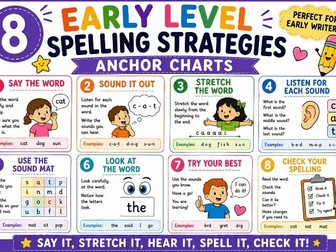
Support young learners as they develop confidence with early spelling using this colourful set of Early Level Spelling Strategies Anchor Charts. Designed in a bright, child-friendly primary style, these posters introduce simple strategies children can use when they are unsure how to spell a word. Each chart uses clear language, visual prompts and easy examples to encourage children to listen carefully, use phonics knowledge and have a go independently. This resource includes 8 separate anchor charts: Say the Word – saying the word clearly and slowly before trying to spell it Sound It Out – listening for each sound and writing the sounds that can be heard Stretch the Word – stretching a word slowly from beginning to end Listen for Each Sound – identifying the first, middle and final sounds Use the Sound Mat – using familiar sounds and phonics prompts to support spelling Look at the Word – noticing the letters and remembering how familiar or tricky words look Try Your Best – encouraging children to use the sounds they know and attempt unfamiliar spellings Check Your Spelling – rereading the word, checking the sounds and making changes where needed Why you’ll love this resource: bright and engaging Early Level design, clear child-friendly explanations, strong links to phonics and segmenting, support for independent spelling attempts, and visual reminders that can be referred to during writing lessons. These posters are ideal for whole-class teaching, small-group phonics work, writing interventions, literacy displays, writing areas and independent classroom reference. Each anchor chart is presented on its own page for easy printing and display. Format: PDF Pages: 8 anchor charts Suitable for: Early Level, EYFS, Reception, P1, phonics, spelling, segmenting, early writing and literacy support A colourful, practical resource to help children say it, stretch it, hear the sounds, spell it and check it with confidence!
Early Vocabulary Early Level Anchor ChartsQuick View
ErinM411538

Early Vocabulary Early Level Anchor Charts

(0)
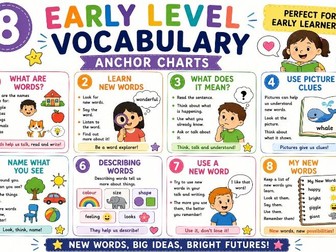
Help young learners build a richer vocabulary with this colourful set of Early Level Vocabulary Anchor Charts. Designed in a bright, child-friendly primary style, these posters introduce simple strategies for noticing, understanding, remembering and using new words. Each chart uses clear language, visual prompts and familiar examples to make vocabulary development accessible and engaging for Early Level learners. This resource includes 8 separate anchor charts: What Are Words? – introducing words as the names we use for people, places, things, animals and ideas Learn New Words – encouraging children to look, say, listen to and explore unfamiliar words What Does It Mean? – using context, discussion and prior knowledge to understand meaning Use Picture Clues – using illustrations and visual clues to work out what a word means Name What You See – building vocabulary by identifying and naming familiar objects and pictures Describing Words – introducing words that tell us more about colour, size, shape, feeling and other features Use a New Word – encouraging children to say and use newly learned vocabulary in speech and writing My New Words – helping children collect, remember and celebrate new vocabulary Why you’ll love this resource: bright and engaging Early Level design, clear child-friendly explanations, visual support for word meaning, encouragement of speaking and listening, links to early reading and writing, and simple strategies children can use independently. These charts are ideal for whole-class vocabulary teaching, literacy displays, story time, guided reading, small-group work, EAL support and independent classroom reference. Each anchor chart is presented on its own page for easy printing and display Format: PDF Pages: 8 anchor charts Suitable for: Early Level, EYFS, Reception, P1, vocabulary, speaking and listening, early reading, early writing and literacy support A colourful, practical resource to help children notice new words, understand what they mean and confidently use them in their own talk and writing!
Listening and Talking Early Level Anchor ChartsQuick View
ErinM411538

Listening and Talking Early Level Anchor Charts

(0)
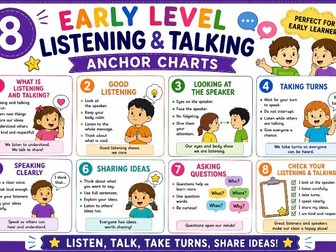
Support young learners as they build confidence in speaking, listening and sharing ideas with this colourful set of Early Level Listening & Talking Anchor Charts. Designed in a bright, child-friendly primary style, these posters introduce the key behaviours and skills children need for successful classroom communication. Each chart uses simple language, clear visual prompts and relatable examples to help children understand how to listen carefully, speak clearly, take turns and join in discussions. This resource includes 8 separate anchor charts: What Is Listening and Talking? – introducing the importance of listening, speaking and taking turns Good Listening – looking at the speaker, keeping a calm body and thinking about what is being said Looking at the Speaker – using eyes, body position and attention to show good listening Taking Turns – waiting patiently, not interrupting and giving everyone a chance to speak Speaking Clearly – using a clear voice, facing the listener and saying ideas clearly Sharing Ideas – thinking first, using full sentences and explaining ideas to others Asking Questions – using question words such as who, what, where, when and why to find out more Check Your Listening & Talking – a pupil-friendly checklist for reflecting on listening, speaking and participation Why you’ll love this resource: bright and engaging Early Level design, clear child-friendly language, strong visual support, encouragement of respectful communication, and practical reminders children can use independently during class discussions and group work. These posters are ideal for whole-class teaching, circle time, literacy lessons, group discussions, communication support, classroom displays and independent reference. Each anchor chart is presented on its own page for easy printing and display. Format: PDF Pages: 8 anchor charts Suitable for: Early Level, EYFS, Reception, P1, listening and talking, speaking and listening, communication skills and literacy support A colourful, practical resource to help children listen carefully, speak clearly, share ideas and communicate with confidence!
Rhyming Early Level Anchor ChartsQuick View
ErinM411538

Rhyming Early Level Anchor Charts

(0)
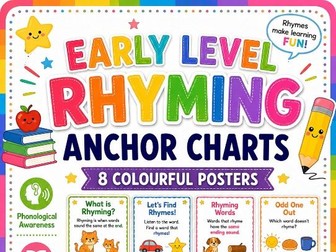
Help young learners develop confidence with rhyme using this colourful set of Early Level Rhyming Anchor Charts. Designed in a bright, child-friendly primary style, these posters introduce rhyming through simple explanations, clear examples and engaging visual prompts. They are ideal for whole-class phonological awareness lessons, literacy displays, small-group work, oral language activities and early reading support. This resource includes 8 separate anchor charts: What Is a Rhyme? – understanding that rhyming words have the same ending sound Hear the Rhyme – listening carefully to two words and deciding whether they rhyme Match Rhyming Words – pairing words that share the same ending sound Finish the Rhyme – choosing a word that completes a rhyming pair Odd One Out – identifying which word does not rhyme with the others Make a Rhyme – thinking of a new word that rhymes with a given word Rhymes in Songs – noticing and enjoying rhymes in songs, chants and oral language Check Your Rhyming – a pupil-friendly checklist for reviewing rhyming skills Why you’ll love this resource: bright and engaging Early Level design, clear child-friendly language, strong links to phonological awareness, lots of visual examples, and simple strategies children can use when listening for rhyme. These posters are ideal for whole-class teaching, nursery and P1 literacy, phonological awareness sessions, small groups, intervention work, literacy displays and independent reference. Each anchor chart is presented on its own page for easy printing and display. Format: PDF Pages: 8 anchor charts Suitable for: Early Level, EYFS, Nursery, Reception, P1, rhyming, phonological awareness, early reading and literacy support A colourful, practical resource to help children listen for ending sounds, spot rhymes, make rhymes and enjoy playing with words!
Early Literacy Toolkit Early Level Anchor ChartsQuick View
ErinM411538

Early Literacy Toolkit Early Level Anchor Charts

(0)
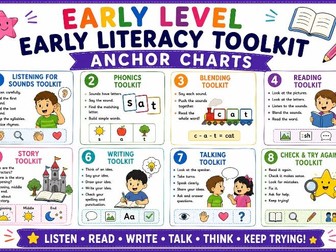
Support young learners across the key areas of early literacy with this colourful set of Early Literacy Toolkit Anchor Charts. Designed in a bright, child-friendly primary style, these posters give children simple strategies they can use when listening for sounds, learning phonics, blending, reading, understanding stories, writing, talking and checking their work. Each chart uses clear language, visual prompts and familiar examples to encourage confidence and independence. This resource includes 8 separate anchor charts: Listening for Sounds Toolkit – listening carefully, identifying first and last sounds, clapping syllables and spotting rhyme Phonics Toolkit – matching sounds to letters, recognising phonemes and building simple words Blending Toolkit – saying individual sounds and pushing them together to read whole words Reading Toolkit – using pictures, letters, sounds and blending to work out unfamiliar words Story Toolkit – identifying characters and setting and talking about the beginning, middle and end Writing Toolkit – thinking of an idea, saying it, drawing it, writing it and checking punctuation Talking Toolkit – looking at the speaker, taking turns, speaking clearly, sharing ideas and asking questions Check & Try Again Toolkit – rereading, spotting mistakes, making corrections, asking for help and persevering Why you’ll love this resource: bright and engaging Early Level design, clear child-friendly explanations, coverage of several key literacy skills in one set, strong visual support, and practical strategies children can refer to independently. These posters are ideal for whole-class teaching, literacy rotations, small-group support, phonics sessions, reading and writing areas, intervention work and classroom displays. Each anchor chart is presented on its own page for easy printing and display. Format: PDF Pages: 8 anchor charts Suitable for: Early Level, EYFS, Reception, P1, phonics, reading, writing, listening and talking, blending and early literacy A colourful, practical toolkit to help young learners listen, read, write, talk, think and keep trying with confidence!
Mark Making and Early Writing Early Level Anchor ChartsQuick View
ErinM411538

Mark Making and Early Writing Early Level Anchor Charts

(0)
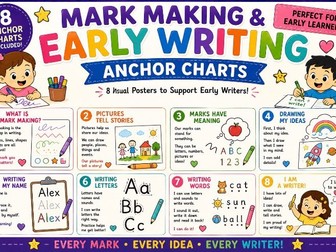
Support young learners as they begin their writing journey with this colourful set of Early Level Mark Making & Early Writing Anchor Charts. Designed in a bright, child-friendly primary style, these posters help children understand that drawing, scribbling, making marks, writing letters and creating simple words are all important steps towards becoming confident writers. The clear language and visual examples make the resource ideal for Early Level classrooms, nursery settings, P1, writing areas and literacy displays. This resource includes 8 separate anchor charts: What Is Mark Making? – introducing scribbles, lines, shapes and early marks as the beginning of writing Pictures Tell Stories – showing how drawings can communicate ideas and tell simple stories Marks Have Meaning – helping children understand that their marks can represent ideas, objects and messages Drawing My Ideas – encouraging children to think, draw and add details before writing Writing My Name – supporting children to recognise, trace, copy and practise their own name Writing Letters – introducing letter formation, letter sounds and regular practice Writing Words – using sounds and letters to begin building and writing simple words I Am a Writer! – celebrating children as writers and encouraging confidence, creativity and perseverance Why you’ll love this resource: Bright and engaging Early Level design Clear, child-friendly language Supports pre-writing and early writing development Encourages confidence with mark making Helps children understand that pictures and marks communicate meaning Supports name writing, letter formation and early spelling Encourages creativity and independence Ideal for whole-class teaching, small groups and continuous provision Perfect for writing areas, literacy walls and classroom displays Each anchor chart is presented on its own page for easy printing and display This resource is ideal for Early Level / EYFS / Nursery / Reception / P1 learners who are beginning to experiment with marks, drawings, letters and words. Format: PDF Pages: 8 anchor charts Suitable for: Early Level, EYFS, Nursery, Reception, P1, mark making, pre-writing, early writing, handwriting and literacy A colourful, encouraging resource that celebrates every stage of the journey from first marks to confident early writing!
Writing Basics Early Level Anchor ChartsQuick View
ErinM411538

Writing Basics Early Level Anchor Charts

(0)
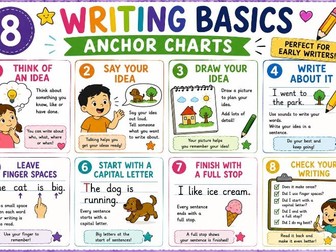
Support young learners as they begin to develop confidence with independent writing using this colourful set of Early Level Writing Basics Anchor Charts. Designed in a bright, child-friendly primary style, these posters break the early writing process into simple, manageable steps. Each chart uses clear language, visual examples and helpful reminders to support children from generating an idea through to checking their finished writing. This resource includes 8 separate anchor charts: Think of an Idea – choosing a simple topic and thinking about who, what or where to write about Say Your Idea – rehearsing an idea aloud before beginning to write Draw Your Idea – using pictures to plan, remember and add detail Write About It – turning an idea into a simple written sentence and using sounds to support spelling Leave Finger Spaces – remembering to leave a clear space between each word Start with a Capital Letter – recognising that sentences begin with a capital letter Finish with a Full Stop – using a full stop to show where a sentence ends Check Your Writing – a pupil-friendly checklist for reviewing ideas, spaces, capital letters, punctuation and effort Why you’ll love this resource: Bright and engaging Early Level design Clear, child-friendly explanations Supports the full early writing process Encourages oral rehearsal before writing Develops sentence-writing confidence Reinforces finger spaces, capital letters and full stops Supports early spelling through sounding out Encourages children to reread and check their work Ideal for whole-class teaching, small groups and writing interventions Perfect for writing walls, literacy areas and independent reference Each anchor chart is presented on its own page for easy printing and display This resource is ideal for Early Level / EYFS / Reception / P1 learners who are beginning to move from drawing and mark making into simple independent sentence writing. Format: PDF Pages: 8 anchor charts Suitable for: Early Level, EYFS, Reception, P1, early writing, sentence writing, punctuation and literacy support A colourful, practical resource to guide children from their very first idea to a complete, checked sentence!
Building Simple Sentences Early Level Anchor ChartsQuick View
ErinM411538

Building Simple Sentences Early Level Anchor Charts

(0)
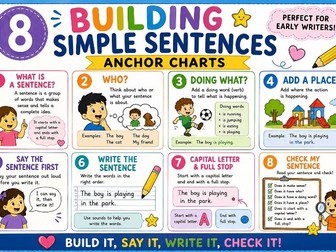
Help young learners understand how to build clear, simple sentences with this colourful set of Early Level Building Simple Sentences Anchor Charts. Designed in a bright, child-friendly primary style, these posters break sentence building into manageable steps using simple language, visual prompts and clear examples. They are ideal for whole-class teaching, writing lessons, literacy displays, small-group support and independent reference. This resource includes 8 separate anchor charts: What Is a Sentence? – introducing a sentence as a group of words that makes sense and shares a complete idea Who? – identifying who or what the sentence is about Doing What? – adding the action or verb to explain what is happening Add a Place – adding where the action happens to give more detail Say the Sentence First – encouraging oral rehearsal before writing Write the Sentence – putting the words in the correct order and using sounds to support spelling Capital Letter & Full Stop – remembering to start with a capital letter and finish with a full stop Check My Sentence – a simple pupil-friendly checklist for making sure the sentence makes sense and includes the key features Why you’ll love this resource: Bright and engaging Early Level design Clear, child-friendly explanations Supports sentence construction step by step Reinforces who + action + place Encourages oral rehearsal before writing Supports early spelling and word order Reinforces capital letters and full stops Helps children check and improve their own work Ideal for whole-class teaching, small groups and interventions Perfect for writing walls and independent classroom reference Each anchor chart is presented on its own page for easy printing and display This resource is ideal for Early Level / EYFS / Reception / P1 learners who are beginning to move from individual words and phrases into complete simple sentences. Format: PDF Pages: 8 anchor charts Suitable for: Early Level, EYFS, Reception, P1, sentence building, sentence structure, early writing and literacy support A colourful, practical resource to help children move from “who?” and “doing what?” to writing complete, confident sentences!
Handwriting Basics Early Level Anchor ChartsQuick View
ErinM411538

Handwriting Basics Early Level Anchor Charts

(0)
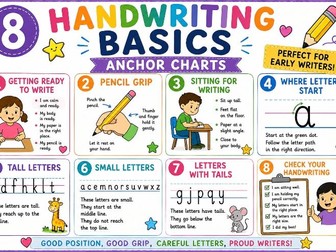
Support young learners as they develop confident, neat and comfortable handwriting with this colourful set of Early Level Handwriting Basics Anchor Charts. Designed in a bright, child-friendly primary style, these posters introduce the foundations of handwriting through simple explanations, clear visual examples and practical reminders. They are ideal for whole-class handwriting lessons, literacy displays, writing areas, fine-motor support and independent classroom reference. This resource includes 8 separate anchor charts: Getting Ready to Write – preparing the body, paper and pencil before beginning Pencil Grip – showing children how to hold a pencil gently and comfortably Sitting for Writing – encouraging good posture, feet placement and paper position Where Letters Start – helping children recognise the correct starting point for letter formation Tall Letters – introducing letters that reach up towards the top line Small Letters – supporting correct size and positioning of smaller letters Letters with Tails – showing how some letters drop below the writing line Check Your Handwriting – a pupil-friendly checklist for posture, pencil grip, letter formation, size and effort Why you’ll love this resource: bright and engaging Early Level design, clear child-friendly language, visual demonstrations of pencil grip and posture, support for correct letter formation, reinforcement of letter size and positioning, and a useful self-checking poster to encourage independence. These charts are ideal for Early Level / EYFS / Reception / P1 learners, particularly children who are beginning formal handwriting practice or need additional visual support with pencil control and letter formation. Format: PDF Pages: 8 anchor charts Suitable for: Early Level, EYFS, Reception, P1, handwriting, letter formation, pencil grip, fine motor skills and early writing A colourful, practical handwriting resource to help children sit well, hold their pencil correctly, form letters carefully and build confidence as writers!
Early Non-Fiction Early Level Anchor ChartsQuick View
ErinM411538

Early Non-Fiction Early Level Anchor Charts

(0)
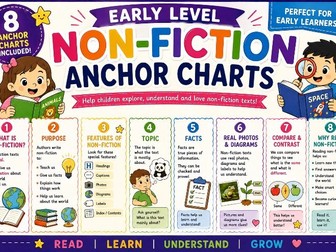
Help young learners explore and understand non-fiction texts with this colourful set of Early Level Non-Fiction Anchor Charts. Designed in a bright, child-friendly primary style, these posters introduce the key features and purposes of non-fiction using simple explanations, clear examples and engaging visuals. They are ideal for literacy displays, guided reading, topic work, whole-class teaching, small groups and early reading support. This resource includes 8 separate anchor charts: What Is Non-Fiction? – introducing non-fiction as real information about the world around us Purpose – exploring why we read non-fiction and how it helps us learn Features of Non-Fiction – introducing headings, captions, photographs and labels Topic – identifying what a non-fiction text is mostly about Facts – understanding that facts are true pieces of information Real Photos & Diagrams – using photographs, diagrams and labels to support understanding Compare & Contrast – noticing what is the same and different between people, places, animals or things Why Read Non-Fiction? – recognising how non-fiction helps us learn, answer questions and understand the world Why you’ll love this resource: Bright and engaging Early Level design Clear, child-friendly language Introduces key non-fiction vocabulary Supports early reading comprehension Helps children identify facts, topics and text features Encourages children to use pictures, labels and headings for clues Links naturally to topic and interdisciplinary learning Ideal for whole-class, guided reading and small-group work Perfect for literacy walls, reading corners and non-fiction displays Each anchor chart is presented on its own page for easy printing and display This resource is ideal for Early Level / EYFS / Reception / P1 learners who are beginning to explore information texts and recognise the difference between fiction and non-fiction. Format: PDF Pages: 8 anchor charts Suitable for: Early Level, EYFS, Reception, P1, non-fiction, information texts, reading comprehension and early literacy A colourful, practical resource to help children find facts, explore real information and become confident non-fiction readers!
Blending and Segmenting Early Level Anchor ChartsQuick View
ErinM411538

Blending and Segmenting Early Level Anchor Charts

(0)
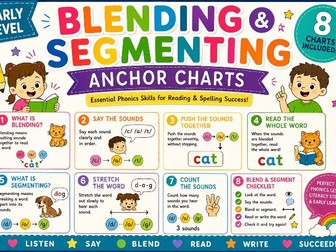
Help young learners build confidence with early reading and spelling using this colourful set of Early Level Blending & Segmenting Anchor Charts. Designed in a bright, child-friendly primary style, these posters break blending and segmenting into clear, manageable steps with simple explanations, visual prompts and easy examples. They are ideal for phonics displays, literacy lessons, small-group work, intervention support and independent reference. This resource includes 8 separate anchor charts: What Is Blending? – introducing how sounds are pushed together to read a word Say the Sounds – saying each sound clearly and in order Push the Sounds Together – blending individual sounds smoothly Read the Whole Word – moving from separate sounds to reading the complete word What Is Segmenting? – introducing how words can be stretched apart into individual sounds Stretch the Word – slowing down a word to hear each sound clearly Count the Sounds – identifying and counting the sounds heard in a word Blend & Segment Checklist – a simple pupil-friendly reminder to look, say, blend or segment, and try again These charts support children in developing key phonics skills needed for both word reading and spelling, while encouraging them to listen carefully to the sounds they can hear. Why you’ll love this resource: Bright and engaging early years design Clear, child-friendly explanations Simple CVC examples Supports both reading and spelling Reinforces oral blending and segmenting Encourages careful listening and sound recognition Ideal for whole-class phonics, small groups and interventions Perfect for literacy walls and phonics displays Each anchor chart is presented on its own page for easy printing and display Format: PDF Pages: 8 anchor charts Suitable for: Early Level, EYFS, Reception, P1, phonics, blending, segmenting, early reading and spelling support A practical, colourful resource to help children hear sounds, blend words and segment confidently!
Common/Tricky Words Early Level Anchor ChartsQuick View
ErinM411538

Common/Tricky Words Early Level Anchor Charts

(0)
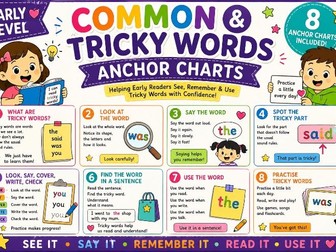
Help young learners recognise, remember and use common and tricky words with this colourful set of Early Level Common & Tricky Words Anchor Charts. Designed in a bright, child-friendly primary style, these posters introduce simple strategies for learning words that children see often in reading and writing. Each chart uses clear explanations, visual prompts and easy examples to make tricky words less intimidating and easier to remember. This resource includes 8 separate anchor charts: What Are Tricky Words? – introducing words that cannot always be sounded out easily Look at the Word – noticing the whole word, its shape and its letters Say the Word – saying and repeating tricky words aloud Spot the Tricky Part – identifying the part of the word that does not follow an expected sound pattern Look, Say, Cover, Write, Check – a simple strategy for practising tricky words Find the Word in a Sentence – spotting tricky words in context Use the Word – saying, writing and using tricky words in sentences Practise Tricky Words – encouraging short, regular practice using reading, flashcards and games Why you’ll love this resource: Bright and engaging early years design Clear, child-friendly explanations Supports early reading and spelling Encourages recognition of high-frequency and tricky words Introduces useful independent learning strategies Supports reading fluency and confidence Reinforces seeing, saying, remembering and using words Ideal for whole-class phonics, small groups and interventions Perfect for literacy walls, word walls and phonics displays Each anchor chart is presented on its own page for easy printing and display This resource is ideal for Early Level / EYFS / Reception / P1 learners who are beginning to build a bank of common words they can recognise and use confidently. Format: PDF Pages: 8 anchor charts Suitable for: Early Level, EYFS, Reception, P1, phonics, tricky words, common words, early reading and spelling support A colourful, practical resource to help children look, say, remember, read and use tricky words with confidence!
Early Reading Comprehension Early Level Anchor ChartsQuick View
ErinM411538

Early Reading Comprehension Early Level Anchor Charts

(0)
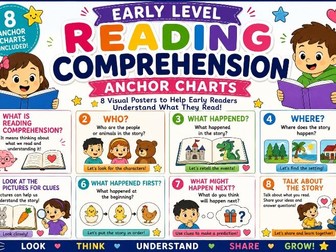
Help young learners build confidence in understanding what they read with this colourful set of Early Level Reading Comprehension Anchor Charts. Designed in a bright, child-friendly primary style, these posters introduce simple comprehension strategies using clear explanations, visual prompts and easy examples. They are ideal for whole-class teaching, guided reading, small-group work, literacy displays and early reading support. This resource includes 8 separate anchor charts: What Is Reading Comprehension? – introducing comprehension as thinking about and understanding what we read Who? – identifying the people, animals or characters in a story What Happened? – recalling key events and talking about what happened in the story Where? – identifying the setting or place where the story happens Look at the Pictures for Clues – using illustrations to help understand meaning What Happened First? – sequencing events and identifying the beginning of a story What Might Happen Next? – making simple predictions using clues from the text and pictures Talk About the Story – sharing ideas, answering questions and retelling parts of the story Why you’ll love this resource: Bright and engaging Early Level design Clear, child-friendly explanations Supports early reading comprehension Encourages children to think and talk about texts Reinforces who, what and where questions Develops sequencing and prediction skills Makes good use of picture clues Ideal for whole-class, guided reading and intervention work Perfect for literacy walls and reading corners Each anchor chart is presented on its own page for easy printing and display This resource is ideal for Early Level / EYFS / Reception / P1 learners who are beginning to develop confidence in talking about stories and demonstrating their understanding. Format: PDF Pages: 8 anchor charts Suitable for: Early Level, EYFS, Reception, P1, reading comprehension, guided reading, early literacy and reading support A colourful, practical resource to help children look, think, predict, talk and understand what they read!
Early Reading Skills Early Level Anchor ChartsQuick View
ErinM411538

Early Reading Skills Early Level Anchor Charts

(0)
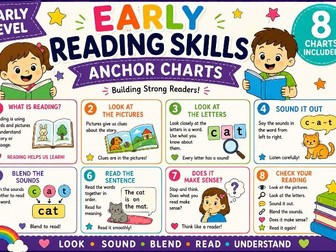
Support young learners as they begin to build confidence with reading using this colourful set of Early Level Reading Skills Anchor Charts. Designed in a bright, child-friendly primary style, these posters introduce simple strategies children can use when reading words, sentences and picture books. Each chart uses clear explanations, visual prompts and easy examples to help make early reading skills accessible and memorable. This resource includes 8 separate anchor charts: What Is Reading? – introducing reading as using words and pictures to understand a story or message Look at the Pictures – using illustrations as clues to support meaning Look at the Letters – noticing letters and using what we know about them Sound It Out – saying the sounds in a word to help read unfamiliar words Blend the Sounds – pushing sounds together to read the whole word Read the Sentence – putting words together and reading for meaning Does It Make Sense? – encouraging children to stop, think and check their understanding Check Your Reading – a simple pupil-friendly checklist using pictures, letters, sounds, blending and meaning Why you’ll love this resource: Bright and engaging early years design Clear, child-friendly explanations Supports early phonics and reading development Encourages children to use a range of reading strategies Reinforces picture clues, letter recognition, sounding out and blending Helps children begin reading for meaning Encourages independence and self-checking Ideal for whole-class teaching, small groups and intervention Perfect for literacy walls, reading corners and phonics displays Each anchor chart is presented on its own page for easy printing and display This resource is ideal for Early Level / EYFS / Reception / P1 learners who are beginning to develop confidence when reading simple words and sentences. Format: PDF Pages: 8 anchor charts Suitable for: Early Level, EYFS, Reception, P1, early reading, phonics, literacy and reading support A colourful, practical resource to help young learners look, sound out, blend, read and understand!
Books and Print Early Level Anchor ChartsQuick View
ErinM411538

Books and Print Early Level Anchor Charts

(0)
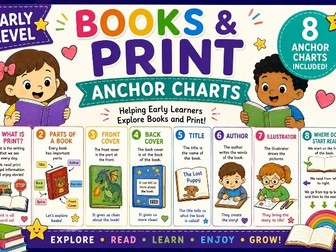
Help young learners develop an understanding of how books and print work with this colourful set of Early Level Books & Print Anchor Charts. Designed in a bright, child-friendly primary style, these posters introduce key early literacy concepts using simple explanations, clear examples and engaging visuals. They are ideal for Early Level literacy displays, reading corners, whole-class teaching, small-group work and introducing children to the features of books. This resource includes 8 separate anchor charts: What Is Print? – recognising that print is the writing we see in books, signs, labels and everyday life Parts of a Book – identifying key features such as the front cover, back cover and title Front Cover – exploring how the front cover gives us clues about a book Back Cover – looking at how the back cover can tell us more about the story or information inside Title – understanding that the title is the name of the book Author – learning that the author writes the words in a book Illustrator – learning that the illustrator creates the pictures Where Do We Start Reading? – introducing front-to-back book order, left-to-right reading and moving down to the next line Why you’ll love this resource: Bright and engaging Early Level design Clear, child-friendly language Supports early print awareness Introduces important book terminology Encourages children to explore books independently Helps develop early reading behaviours Supports discussion about authors, illustrators, titles and covers Perfect for reading corners, literacy walls and classroom displays Each anchor chart is presented on its own page for easy printing and display This resource is ideal for Early Level / EYFS / Reception / P1 learners who are beginning to understand how books are organised and how print is used to communicate meaning. Format: PDF Pages: 8 anchor charts Suitable for: Early Level, EYFS, Reception, P1, print awareness, early reading, literacy and book skills A colourful, practical resource to help children understand books, recognise print and build strong early reading foundations!
Story and Fiction Early Level Anchor ChartsQuick View
ErinM411538

Story and Fiction Early Level Anchor Charts

(0)
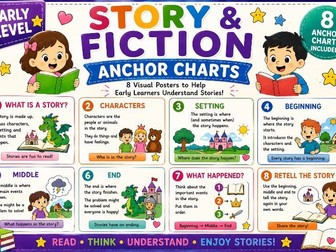
Help young learners understand how stories are built with this colourful set of Early Level Story & Fiction Anchor Charts. Designed in a bright, child-friendly primary style, these posters introduce the key features of fiction using simple explanations, clear examples and engaging visuals. They are ideal for whole-class teaching, story discussions, guided reading, writing lessons, literacy displays and reading corners. This resource includes 8 separate anchor charts: What Is a Story? – introducing stories as made-up texts with characters, events and a clear structure Characters – identifying the people or animals in a story and discussing what they do and how they feel Setting – exploring where and sometimes when a story takes place Beginning – understanding how a story starts and introduces characters and setting Middle – recognising where the main events and problems happen End – understanding how the story finishes and how problems may be solved What Happened? – recalling and sequencing the important events in a story Retell the Story – using beginning, middle and end to tell the story again in your own words Why you’ll love this resource: Bright and engaging Early Level design Clear, child-friendly language Supports understanding of fiction texts Reinforces characters, setting and story structure Develops sequencing and retelling skills Encourages children to talk about what they have read Useful for both reading and writing lessons Ideal for whole-class, small-group and intervention work Perfect for literacy walls, reading corners and story-writing areas Each anchor chart is presented on its own page for easy printing and display This resource is ideal for Early Level / EYFS / Reception / P1 learners who are beginning to recognise how stories are structured and talk about what happens in fiction texts. Format: PDF Pages: 8 anchor charts Suitable for: Early Level, EYFS, Reception, P1, fiction, stories, reading comprehension, retelling and early writing support A colourful, practical resource to help children recognise characters, explore settings, sequence events and confidently retell stories!
Phonics Basics Early Level Anchor ChartsQuick View
ErinM411538

Phonics Basics Early Level Anchor Charts

(0)
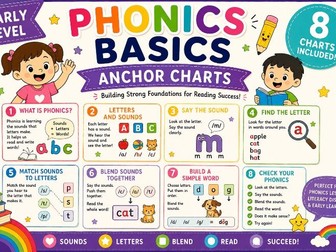
Support young learners as they begin their phonics journey with this colourful set of Early Level Phonics Basics Anchor Charts. Designed in a bright, child-friendly primary style, these posters introduce the foundations of phonics using simple explanations, clear examples and engaging visual prompts. They are perfect for Early Level literacy displays, phonics lessons, reading areas, small-group teaching and independent reference. This resource includes 8 separate anchor charts: What Is Phonics? – introducing how letters and sounds help us read and write Letters and Sounds – understanding that letters represent the sounds we hear and say Say the Sound – encouraging learners to recognise a letter and say its sound clearly Find the Letter – spotting and identifying letters within words Match Sounds to Letters – connecting the sounds we hear with the correct written letters Blend Sounds Together – pushing individual sounds together to read a whole word Build a Simple Word – choosing letters, putting them in order and blending the sounds Check Your Phonics – a simple pupil-friendly checklist encouraging children to look, say, blend, read and try again These posters are ideal for developing letter recognition, sound awareness, blending and early word-reading skills. The clear steps and repeated visual language help children build confidence and independence while reinforcing the basic strategies they need when approaching unfamiliar words. The bright primary design makes the charts ideal for phonics walls, literacy displays, reading corners, intervention groups and classroom reference, with each anchor chart presented on its own page for easy printing and display. Format: PDF Pages: 8 anchor charts Suitable for: Early Level, EYFS, Reception, P1, phonics, early reading, blending and literacy support A colourful, practical phonics resource to help children learn their sounds, blend confidently and begin to read independently!