GCSE PE OCR Snakes and LaddersQuick View
bygravel1

GCSE PE OCR Snakes and Ladders

(0)
This includes, the powerpoint explaining the rules of the game and 2 sets of questions used which cover all Paper One Topics. Start Questions are designed for high attainers to stretch them throughout the game. Use a snakes and ladders board and print out on A3.
AAQ Early Childhood Development - Language DevelopmentQuick View
bygravel1

AAQ Early Childhood Development - Language Development

(0)
In this lesson, students will learn the developmental milestones of language development, looking at non-verbal and verbal types of language. As well, exploring what happens at each stage of their language development. Students will gain an understanding of what happens for children who are bilingual as well as have English as additional language.
GCSE PE OCR Label of Heart and Pathway of BloodQuick View
bygravel1

GCSE PE OCR Label of Heart and Pathway of Blood

(0)
The powerpoint presentation breaks down the label of the heart, as well looks at the pathway of blood. A starter activity, introducing the cardiovascular system with a game to test their memory and knowledge, as well as their art skills. All resources attached.
AAQ Early Childhood Dev - Chomsky and BrownQuick View
bygravel1

AAQ Early Childhood Dev - Chomsky and Brown

(0)
Students learn the studies of Chomsky and Brown in regards to language development. The powerpoint goes through the theory but highlights the key points in bold and underlined, to show students what they need to know for their exam. Resources are attached - an exam question which asks questions about how Chomsky and Browns theory is being shown throughout the case study provided.
GCSE PE OCE - Respiratory Lessons.Quick View
bygravel1

GCSE PE OCE - Respiratory Lessons.

(0)
3 lessons attached based on the Respiratory lesson with the resources to go alongside. Students learn about: Pathway of Air Mechanics of Breathing Gaseous Exchange Diffusion Aerobic and Anaerobic
Pearsons - BTEC Travel and Tourism - Level 3 - Unit 3 - Principles of MarketingQuick View
bygravel1

Pearsons - BTEC Travel and Tourism - Level 3 - Unit 3 - Principles of Marketing

(0)
Pearson Unit 3 - Principles of Marketing. All powerpoints included, give detailed information about Learning Aim A, B, C and D. This is a step by step guide which supports and helps students achieve the distinction criteria within their assignments. Learning Aim A - : Explore the role of marketing activities in influencing customer decisions and meeting customer needs in travel and tourism Learning Aim B - Examine the impact that marketing activities have on the success of different travel and tourism organisations Learning Aim C - Carry out market research in order to identify a new travel and tourism product or service Learning Aim D - Produce a promotional campaign for a new travel and tourism product or service, to meet stated objectives
AAQ - Early Childhood Dev - Information ProcessingQuick View
bygravel1

AAQ - Early Childhood Dev - Information Processing

(0)
AAQ Early Childhood Development. This powerpoint discusses information processing, where we discuss the multi store model of memory, sensory memory and short and long term memory. Students are encouraged to make links with how child can process and retain information effectively.
AAQ - Early Childhood Development - Vygotsky - Zone of Proximal DevelopmentQuick View
bygravel1

AAQ - Early Childhood Development - Vygotsky - Zone of Proximal Development

(0)
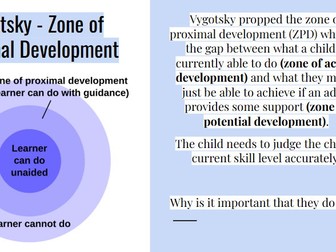
AAQ Early Childhood Development - A powerpoint with all the necessary information based on Vygotksy Zone of Proximal Development. This gives a good understanding and insight into Vygotksy in a simplistic way which students can apply within the exam. Attached is also a case study for students to apply their knowledge and understanding of Vygotksys theory.
AAQ - Early Childhood Development - Bruners Modes of Cognitive RepresentationQuick View
bygravel1

AAQ - Early Childhood Development - Bruners Modes of Cognitive Representation

(0)
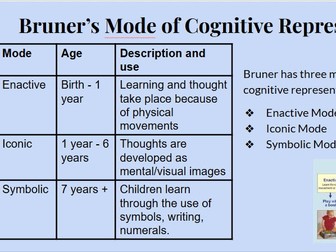
AAQ Early Childhood Development - This powerpoint consists of all the information required about Bruners Modes of Cognitive Representation. Once the information has been gone through, you will then find an exam question, where students need to show their understanding. The resource that follows is a Bruner Diffit Resource. This shows keywords and their definitions and challenges students to use this within a sentence, it also has a variety of questions, where students need to read the text about Bruner.
Level 3 - NEW AAQ - Early Childhood Development - PiagetsTheoriesQuick View
bygravel1

Level 3 - NEW AAQ - Early Childhood Development - PiagetsTheories

(0)
This resource is from the new Early Childhood Development specification. This powerpoint consists of all information regarding Piagets schema theory, examples and an exam question and mark scheme. Also, the information regarding Piagets Universal Stages Theory, where it breakdown the essential information needed for each universal stage.
NEW AAQ - Early Childhood Development - L3 - Physical DevelopmentQuick View
bygravel1

NEW AAQ - Early Childhood Development - L3 - Physical Development

(0)
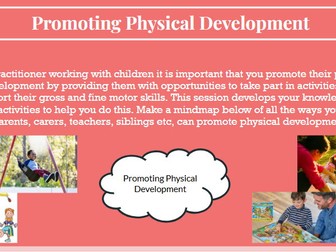
AAQ Early Childhood Development L3 Pearsons - New Unit. These are all the powerpoints for Physical Development, full of activities and resources to use alongside this. This includes 4 powerpoints with resources to use! This is all relevant information needed for physical development for the exam. Focuses on growth and development, looking at the different milestones which children need to reach in order to achieve effective overall development.
Pearsons - BTEC Travel and Tourism - Level 3 - Unit 9 PowerpointsQuick View
bygravel1

Pearsons - BTEC Travel and Tourism - Level 3 - Unit 9 Powerpoints

(0)
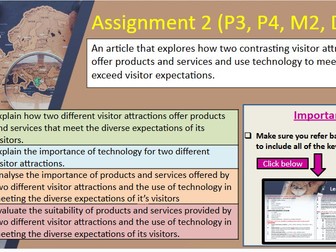
Unit 9 - Visitor Attractions. 3 different powerpoints for the three different learning aims. All powerpoints consist of a lot of information to meet pass, merit and distinction criteria. Some example paragraphs are available in the powerpoints. Learning Aim A: Investigate the nature, role and appeal of visitor attractions powerpoint. Learning Aim B: Examine how visitor attractions meet the diverse expectations of visitors powerpoint. Learning Aim C: Explore how visitor attractions respond to competition and measure their success and appeal powerpoint.