I can write simple fractions KS1 Worksheets 2Quick View
misswenham

I can write simple fractions KS1 Worksheets 2

(0)
This set of Key Stage 1 maths worksheets builds on basic fraction skills by helping pupils confidently write simple fractions. Perfect for Year 1 and Year 2, the activities combine clear visuals with practical exercises to reinforce fraction notation. Learning Objectives: Write fractions to represent parts of a whole and parts of a group. Understand numerator and denominator in simple fractions. Connect fraction symbols to real-life examples and visuals. Worksheet Features: Bright, engaging illustrations showing divided shapes and groups. Clear, guided examples explaining fraction writing. Varied tasks such as matching fractions to pictures, completing fraction sentences, and writing fractions for shaded areas. Everyday contexts like sharing items or dividing objects to support meaningful learning.
KS1 Sentence openersQuick View
misswenham

KS1 Sentence openers

(0)
This resource supports pupils in improving sentence variety by introducing a range of sentence openers suitable for Key Stage 1 and Key Stage 2 writing. It is designed to help learners move beyond repetitive sentence structures and create more engaging and fluent pieces of work. Learning Objectives: Recognise different types of sentence openers (time, place, manner, -ing verbs, adverbs, conjunctions, etc.). Use varied sentence starters to improve writing style and flow. Apply appropriate openers for different text types, such as stories, reports, and persuasive writing. Resource Features: Examples of sentence openers categorised by type. Model sentences showing openers in context. Practice activities for pupils to rewrite sentences with varied starters. Prompts and word banks to support independent writing.
Identifying money worksheets HA,MA,LAQuick View
misswenham

Identifying money worksheets HA,MA,LA

(0)
This set of Identifying Money worksheets is differentiated for High Ability (HA), Middle Ability (MA), and Lower Ability (LA) learners, providing targeted practice for recognising and naming UK coins and notes. Differentiation: HA: Identify and match coins and notes to their values, including mixed coin totals and problem-solving questions. MA: Recognise coins and notes, match them to values, and complete simple addition of coins. LA: Focus on naming individual coins and notes, identifying their features, and matching them to their values. Purpose and Approach: Reinforces recognition of UK currency through clear images and structured activities. Builds confidence in handling money and linking coin appearance to value. Can be used for independent work, guided practice, or home learning.
I am Malala week long english lessonQuick View
misswenham

I am Malala week long english lesson

(0)
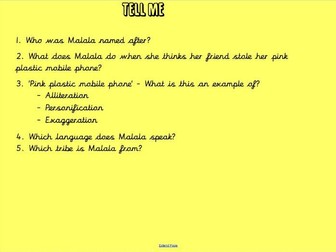
Overview of Teaching Resources This sequence of Year 5 and 6 lessons is built around reading excerpts from I Am Malala, up to chapter 6, and combines comprehension, grammar, and writing skills. The lessons are structured to deepen pupils’ understanding of the text while developing key literacy competencies. Learning Objectives Covered: Apply understanding of the text using VIPERS skills Pupils engage in targeted reading activities to practise Vocabulary, Inference, Prediction, Explanation, Retrieval, and Summarising. Identify fronted adverbials within a text and their purpose Learners locate examples in I Am Malala and discuss how they shape sentence structure and meaning. Use apostrophes for contraction and possession Short, focused grammar tasks reinforce correct punctuation use within their own writing. Use inverted commas for dialogue Pupils learn to punctuate direct speech accurately, linking it to moments in the text. Understand the features of a diary Analysis of diary extracts helps pupils identify structure, tone, and purpose, preparing them for their own diary writing. Format and Approach: Lessons integrate reading comprehension with writing and grammar skills, anchored in a high-quality, thought-provoking text. Uses I Am Malala as a stimulus to encourage discussion of key themes and empathy with real-world experiences. Combines modelled examples, guided practice, and independent application. This unit supports both deep reading and purposeful writing, helping pupils to make connections between the text, grammar concepts, and their own creative work.
I can measure and compare length KS1 WorksheetsQuick View
misswenham

I can measure and compare length KS1 Worksheets

(0)
This set of Key Stage 1 maths worksheets helps pupils develop skills in measuring and comparing length. Designed for Year 1 and Year 2, the activities use clear visuals and practical tasks to make understanding length concepts engaging and accessible. Learning Objectives: Measure length using standard and non-standard units. Compare lengths of different objects. Use appropriate vocabulary such as longer, shorter, taller, and equal. Worksheet Features: Bright illustrations showing measurement tools and objects. Step-by-step examples demonstrating measurement and comparison. Varied activities including measuring with rulers, comparing lengths, and ordering objects by size. Real-life contexts like measuring furniture, ropes, or classroom items to connect learning to everyday life.
I can write simple fractions KS1 WorksheetsQuick View
misswenham

I can write simple fractions KS1 Worksheets

(0)
This set of Key Stage 1 maths worksheets helps pupils practise writing simple fractions. Designed for Year 1 and Year 2, the activities use clear visuals and straightforward tasks to support understanding of fraction notation. Learning Objectives: Recognise fractions as parts of a whole. Write simple fractions using numbers and symbols (e.g., 1/2, 1/3). Relate fraction notation to shaded parts of shapes and groups. Worksheet Features: Bright, clear images of shapes divided into equal parts. Step-by-step examples modelling how to write fractions. Varied exercises including matching, filling in blanks, and writing fractions for shaded sections. Practical contexts such as dividing food or objects to make fraction writing meaningful.
I can find a third KS1 WorksheetsQuick View
misswenham

I can find a third KS1 Worksheets

(0)
This set of Key Stage 1 maths worksheets supports pupils in finding a third of shapes, amounts, and quantities. Suitable for Year 1 and Year 2, the activities use clear images and practical examples to build confidence with this key fraction concept. Learning Objectives: Find one third of shapes, groups, and numbers. Understand equal sharing and division into three parts. Solve simple problems involving finding a third in everyday contexts. Worksheet Features: Bright visuals showing shapes and objects divided into thirds. Guided examples demonstrating how to find a third. Varied tasks including colouring, counting, and problem-solving. Real-life scenarios like sharing treats and dividing objects to connect learning with daily life
I can identify thirds KS1 WorksheetsQuick View
misswenham

I can identify thirds KS1 Worksheets

(0)
This set of Key Stage 1 maths worksheets helps pupils understand and identify thirds as part of a whole. Designed for Year 1 and Year 2, the activities use clear visuals and hands-on examples to make learning fractions engaging and accessible. Learning Objectives: Recognise and name thirds in shapes and quantities. Understand the concept of dividing objects and amounts into three equal parts. Apply knowledge of thirds in simple practical tasks and problems. Worksheet Features: Bright, clear illustrations of shapes divided into thirds. Step-by-step examples to model identifying and shading thirds. A range of activities from colouring and matching to problem-solving. Real-life contexts such as sharing food or dividing objects to make fractions relatable.
Pictogram worksheets KS1Quick View
misswenham

Pictogram worksheets KS1

(0)
This set of Key Stage 1 maths worksheets supports pupils in developing their skills to interpret and answer questions about pictograms. Suitable for Year 1 and Year 2, the activities use simple images and clear data to make understanding pictograms easy and fun. Learning Objectives: Recognise and interpret pictograms using symbols and pictures. Answer questions about data presented in pictograms. Develop reasoning skills by comparing and analysing information visually. Worksheet Features: Bright, engaging pictograms with clear symbols. Step-by-step guidance on reading and understanding pictograms. Varied question types, including multiple-choice, fill-in-the-blank, and short answer. Real-life contexts like favourite fruits, pets, and weather to relate data to pupils’ experiences.
I can subtract money KS1 WorksheetsQuick View
misswenham

I can subtract money KS1 Worksheets

(0)
This set of Key Stage 1 maths worksheets helps pupils develop their ability to subtract amounts of money using UK coins and notes. Designed for Year 1 and Year 2, the activities use clear visuals and practical scenarios to make money subtraction engaging and accessible. Learning Objectives: Recognise and identify UK coins and notes. Subtract amounts of money using coins of the same and different values. Apply subtraction skills to real-life situations, such as giving change. Worksheet Features: Bright, clear images of coins and notes to support recognition. Step-by-step examples to model subtraction strategies. Varied activities, from simple coin subtraction to mixed-value money problems. Word problems set in everyday contexts like shopping and pocket money.
Year 1/Year 2 The Mass presentationQuick View
misswenham

Year 1/Year 2 The Mass presentation

(0)
This Key Stage 1 maths presentation introduces Year 1 and Year 2 pupils to the concept of mass, helping them understand how to compare, measure, and record mass using standard and non-standard units. Learning Objectives: Recognise that mass is the measure of how heavy something is. Compare the mass of different objects using language such as heavier and lighter. Measure and record mass using non-standard units (e.g., cubes) and standard units (grams and kilograms). Presentation Features: Bright, pupil-friendly visuals to illustrate concepts clearly. Interactive slides that encourage predictions and reasoning. Step-by-step explanations for using scales and recording results. Opportunities for discussion and practical class activities.
KS1 Adding MoneyQuick View
misswenham

KS1 Adding Money

(0)
This Key Stage 1 maths resource helps pupils develop the skills to add amounts of money using UK coins and notes. It supports Year 1 and Year 2 learners in building confidence with money calculations through visual examples and practical activities. Learning Objectives: Recognise and identify UK coins and notes. Add amounts of money using coins of the same and different values. Apply addition skills to real-life money problems. Resource Features: Clear visual representations of coins and notes. Step-by-step worked examples for adding money. Practice activities ranging from simple coin combinations to mixed-value totals. Opportunities to solve word problems in everyday contexts, such as shopping scenarios.
Identifying coinsQuick View
misswenham

Identifying coins

(0)
This Key Stage 1 maths lesson helps Year 2 pupils recognise and identify different coins and notes, building their understanding of UK money. Designed to be interactive and practical, it encourages pupils to handle real or replica coins and link their values to everyday contexts. Learning Objective: Identify and name UK coins and notes, recognising their values and distinguishing features. Lesson Approach: Starter activity using visual flashcards or real coins to recap coin names and values. Sorting task where pupils group coins by size, colour, and value. Practical identification games, such as matching coins to price tags or playing “guess the coin” from descriptions. Opportunities to link learning to real-life situations, such as buying items in a shop role-play.
Set of four lessons - Adding FractionsQuick View
misswenham

Set of four lessons - Adding Fractions

(0)
This Upper Key Stage 2 maths resource supports pupils in developing confidence and fluency with adding and subtracting fractions. Designed to be used in conjunction with Power Maths, it combines interactive teaching slides with structured textbook practice to ensure pupils gain both conceptual understanding and procedural accuracy. Learning Objectives: Add fractions with the same denominator. Add fractions with different denominators. Subtract fractions with the same denominator. Subtract fractions with different denominators. Lesson Approach: SMART Notebook slides introduce and model each skill with visual fraction representations and step-by-step examples. Power Maths activities provide structured practice and problem-solving opportunities. Builds progressively from simple like-denominator calculations to more challenging different-denominator problems, including mixed numbers. Encourages the use of mathematical vocabulary such as numerator, denominator, and simplify.
Travel writing 5 lessons - Visit ManchesterQuick View
misswenham

Travel writing 5 lessons - Visit Manchester

(0)
This week-long Upper Key Stage 2 English unit focuses on travel writing with a specific destination: Manchester. Across five days, pupils revisit VIPERS reading skills and apply them to create an engaging travel piece aimed at a chosen audience. The lessons blend reading analysis, descriptive writing, and audience awareness to produce a polished final piece. Weekly Objectives: Monday: Apply VIPERS skills to analyse travel writing examples about Manchester and other cities. Tuesday: Plan an introductory paragraph that captures Manchester’s unique character and hooks the reader. Wednesday: Write additional paragraphs focusing on key attractions, events, and experiences in the city. Thursday: Adapt tone and style to appeal to a specific audience, such as families, tourists, or sports fans. Friday: Edit, refine, and present the completed travel piece. Lesson Approach: Uses authentic examples and multimedia resources about Manchester to inspire ideas and gather information. Combines modelled writing with guided and independent tasks. Encourages precise vocabulary, sensory description, and structured paragraphing. Incorporates peer review to develop editing and redrafting skills.
Journey Through Words: Mastering Travel WritingQuick View
misswenham

Journey Through Words: Mastering Travel Writing

(0)
This Upper Key Stage 2 English lesson introduces pupils to the techniques of travel writing, combining reading comprehension with purposeful writing tasks aimed at a specific audience. Pupils explore how to capture a location’s atmosphere and appeal through engaging and well-structured paragraphs. Learning Objectives: Apply VIPERS skills (Vocabulary, Inference, Prediction, Explanation, Retrieval, Summarising) to analyse travel texts. Write an effective introductory paragraph that sets the scene and hooks the reader. Develop additional paragraphs tailored to the needs and interests of a chosen audience. Lesson Approach: Begins with close reading of travel writing examples to identify tone, descriptive language, and structure. Modelled writing and guided discussion on how to engage a specific audience, such as tourists, families, or adventurers. Pupils plan and draft their own travel piece, focusing on strong openings and cohesive paragraphing.
Exploring 2D Shapes and AnglesQuick View
misswenham

Exploring 2D Shapes and Angles

(0)
This series of Upper Key Stage 2 geometry lessons is designed to be used in conjunction with Power Maths resources, supporting pupils in building both conceptual understanding and practical skills in shape and angle work. Learning Objectives: Compare and classify 2D shapes and describe their properties using correct mathematical vocabulary. Draw specific measurements and angles accurately with a ruler and protractor. Construct 2D shapes based on given dimensions and angle sizes. Find unknown angles in triangles and quadrilaterals using known rules. Calculate missing angles in a variety of geometric contexts. Lesson Approach: Interactive SMART Notebook slides provide visual models, worked examples, and guided practice. Power Maths textbook activities are integrated throughout to reinforce mastery and problem-solving skills. Practical tasks encourage precise measuring and drawing, alongside reasoning to explain solutions
Prisms One off lessonQuick View
misswenham

Prisms One off lesson

(0)
This science lesson for Upper Key Stage 2 focuses on exploring how a prism changes a ray of light to reveal the visible spectrum. Pupils investigate the concept that white light is made up of different colours and learn how refraction separates these colours when light passes through a prism. Learning Objective: To understand how a prism changes a ray of light to show the spectrum. Lesson Approach: Begins with a short discussion and visual demonstration of light sources and white light. Introduces key scientific vocabulary such as refraction, spectrum, and wavelength. Practical activity where pupils observe light passing through a prism and record the colours produced. Guided questioning to develop understanding of how and why light bends at different angles inside the prism. Outcomes: By the end of the lesson, pupils will be able to: Explain that white light is made up of multiple colours. Describe how refraction in a prism separates light into the spectrum. Use accurate scientific language to explain their observations.
Angles, Shapes and MasteryQuick View
misswenham

Angles, Shapes and Mastery

(0)
This SMART Notebook resource is designed for Upper Key Stage 2 mathematics lessons and supports pupils in developing their understanding of geometry. The lessons are linked to Power Maths textbooks, ensuring consistency with the wider curriculum and providing opportunities for guided and independent practice. Learning Objectives Covered: Compare and classify 2D shapes and describe their properties. Draw specific measurements and angles accurately using a ruler and protractor. Construct 2D shapes based on given dimensions and angles. Find unknown angles in triangles and quadrilaterals using known rules. Find missing angles in a variety of contexts, applying reasoning skills. Format and Approach: Delivered via interactive SMART Notebook slides with clear visual models and worked examples. Integrates Power Maths book activities for structured practice and problem-solving. Encourages the use of mathematical vocabulary to describe properties and reasoning. Includes opportunities for both guided instruction and independent work, supporting mastery of key concepts. This resource provides a complete teaching sequence for geometry topics, combining interactive modelling with curriculum-aligned tasks from Power Maths to strengthen conceptual understanding and procedural accuracy.
Homophones 15 min lessonQuick View
misswenham

Homophones 15 min lesson

(0)
This 15-minute micro-teaching session focuses on homophones for Adult Functional Skills English learners at Entry Level 2/3. The aim is to build learners’ confidence in recognising, understanding, and correctly using homophones in both written and spoken contexts. Learning Objectives: Identify common homophones and their meanings. Understand how context determines which homophone to use. Apply correct spelling of homophones in simple sentences. Lesson Outline: Starter (3 minutes): Quick visual match activity where learners pair words with their meanings (e.g., there, their, they’re). Main Activity (8 minutes): Group discussion and example sentences drawn from everyday life, followed by a short gap-fill exercise to practise correct usage. Plenary (4 minutes): Learners write two original sentences using a pair of homophones discussed in the lesson, sharing examples aloud for peer feedback. Approach: The lesson is interactive and context-based, using familiar, real-life examples to make learning relevant. It integrates visual aids, guided practice, and peer learning to support different learning styles. By the end of the session, learners will be able to confidently recognise and apply common homophones, reducing spelling and grammar errors in their everyday writing.
Writing frame for Persuasive speechQuick View
misswenham

Writing frame for Persuasive speech

(0)
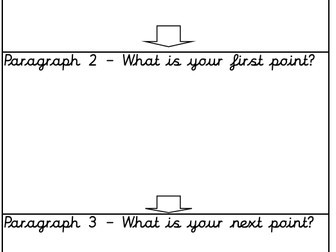
This resource is a planning template for writing a persuasive speech aimed at helping pupils structure and enhance their ideas. It provides clear prompts and examples of persuasive techniques, making it suitable for Upper Key Stage 2 learners. The template includes: Persuasive techniques with examples, such as: Asking rhetorical questions. Using exaggeration for effect. Supporting ideas with facts or statistics. Creating impact with a group of three adjectives. Appealing to emotions. Repeating phrases with pronouns for emphasis. Structured paragraph prompts to guide speech organisation: Introduction – who you are and your purpose. First key point. Second key point. Third key point. Closing statement – the lasting message for the audience. This scaffold encourages pupils to combine effective persuasive techniques with a clear structure, supporting both the writing process and oral delivery of their speech.