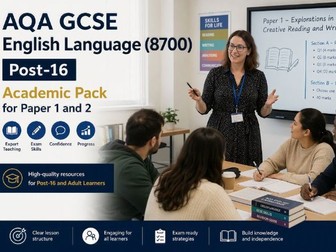
A 30-week Post-16 AQA GCSE English Language resit course with a full Scheme of Learning and detailed weekly lesson plans
It covers Paper 1, Paper 2, revision, intervention, and final mocks, using a clear teach-model-scaffold-practice-assess-improve approach designed to build confidence, exam skills, and independence
The Bully is a complete AQA GCSE English Language Paper 1 teaching and assessment resource built around a gripping psychological drama extract. It helps students strengthen key exam skills through a fictional narrative that explores bullying as quiet, manipulative, and psychologically controlling rather than openly aggressive.
At the centre of the resource are the characters Amara and Lewis, whose relationship allows students to explore deeper ideas such as power, intimidation, perception, social influence, and control. This makes the pack both engaging and academically rich, while still remaining accessible through clear scaffolding and structured support.
Student Workbook with:
quick retrieval and comprehension tasks
language analysis using key quotations
structure mapping activities
evaluation planning for Question 4
creative writing planning and drafting support
Mock Exam Paper Booklet with:
Section A (Questions 1–4, 40 marks)
Section B creative writing task (40 marks)
realistic timings and AQA-style structure
Teacher Handbook with:
lesson objectives and success criteria
a structured 90-minute lesson sequence
model Grade 9 responses for Questions 2, 3 and 4
mark guidance linked to assessment objectives
misconceptions, feedback strategies, and differentiation
Elevate English with Ama is a 4-week programme made up of 8 sessions, with each session lasting 60 minutes. The course focuses on reading, writing, analysis, and building confidence in English. It is designed for GCSE English learners and students preparing to resit the exam. The approach includes clear modelling, guided practice, and structured feedback to help learners improve step by step.
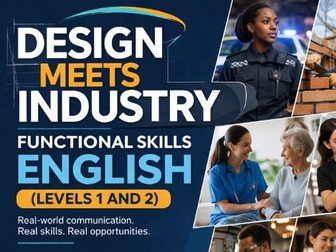
Design Meets Industry is a six-week Functional Skills English scheme integrating vocational design with reading, writing, speaking, and listening to prepare learners for real workplace communication.
This six-week Functional Skills English scheme, Design Meets Industry, has been carefully structured to integrate vocational design concepts with core English communication skills. It offers a purposeful and engaging learning journey where students apply literacy skills within realistic, industry-related contexts, ensuring learning is relevant, practical, and directly connected to workplace expectations.
Rather than teaching English as an isolated subject, this scheme embeds literacy into meaningful vocational scenarios, allowing learners to develop confidence and competence through applied learning. Students build essential communication skills by working within the dynamic context of fashion, product design, and industry innovation areas that naturally encourage creativity, critical thinking, and professional communication.
Across the six weeks, learners explore the relationship between design, function, and communication, using industry-focused tasks to develop and strengthen their abilities in reading, writing, speaking, and listening.This comprehensive six-week Scheme of Work (SoW) for Functional Skills English at Levels 1 and 2 is designed to enhance learners’ abilities in reading, writing, and speaking & listening. The program places a strong emphasis on innovation within design and industry, ensuring that students engage with contemporary and relevant content.
It incorporates differentiation strategies to cater to diverse learning needs, promotes Equality & Diversity (E&D), and establishes clear connections to employability skills. Each week features specific assessment milestones to track progress and achievement. The activities are varied and dynamic, including collaborative design projects that encourage teamwork, analytical reading tasks that develop critical thinking, persuasive writing assignments that enhance communication skills, and live commentary performances that foster public speaking and presentation abilities.
The focus of this lesson is on equipping participants with the skills to effectively navigate various situations, even in the absence of formal English qualifications
This is a 60-minute Innovation lesson focused on the realities of possessing English qualifications such as GCSE, Functional, ESOL, and more. The primary topic of discussion is ignorance, as many individuals, including the youth, believe that obtaining English qualifications is unnecessary for employment. They clearly lack understanding of the origins and benefits of these qualifications. This will bring a hot-seated debate discussion where learners can express their opinions.
The concluding theme pertains to the 60-minute Application lesson. Arrogance: learners articulate in their own terms the reasons why English qualifications are unnecessary for their chosen careers.


 Quick View