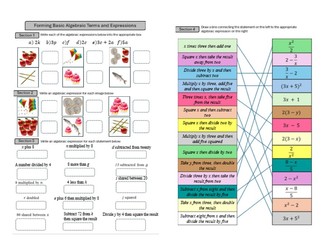
A worksheet suitable for mixed ability or lower level groups as a way of introducing forming algebraic terms and expressions. The engaging sheet contains picture matching activities, written questions and a definition match which covers notions such as Four apples can be represented by 4a up to forming an algebraic expression to represent ‘Subtract x from eight and then divide the result by five’. Full set of answers also included
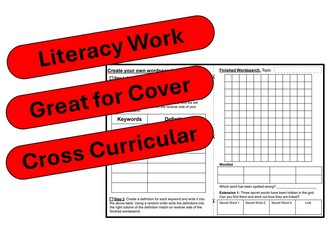
This is a one sheet activity that guides pupils through the steps for creating their own wordsearch. It can be used for any subject and therefor would be excellent for schools or pupils to use as emergency cover work or a back up independent activity.
The sheet has clear step by step instructions with one half being used for planning and the other half is the end result. As well as a traditional wordsearch the end result includes extra activities where pupils must identify the mis-spelled word, find 3 secret words and their link and complete a definition match.
This is an excellent literacy activity to support and curriculum and scheme of work.
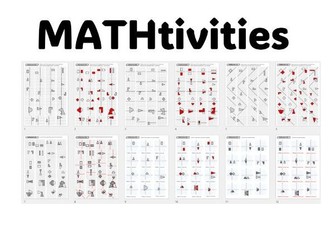
A selection of worksheets focussing on drill activities for identifying and calculating angles in parallel lines. Worksheets get progressively harded adding a level of challenge.
The sheets are designed to be quick fire drills allowing students to answer plenty of questions in a short space of time to reinforce learning of the basics of the topics.
Sheets A,B and C
Pupils are required to identify what angles are depicted i.e vertically opposite co-interior, alternate or corresponding
Sheet D
Pupils are to draw in the arc which relates to the type of angle stated
Sheet E and F
Students must state the size of the angle identified by the arc giving a reason.
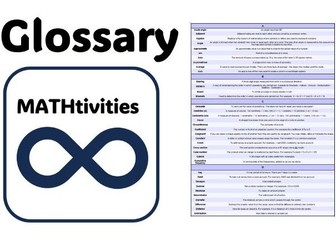
This is a glossary of key maths words. Excellent to help EAL students and support literacy. An excellent opportunity to support those with a low reading age who need help accessing maths topics.
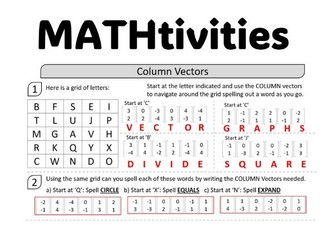
This is an excellent activity based sheet for introduction and practicing of column vectors. It contains a mixture if activities where pupils must either read/follow or identify column vectors and navigate around a grid of letters, numbers and operational symbols. Activities get progressively harder and answers are included.
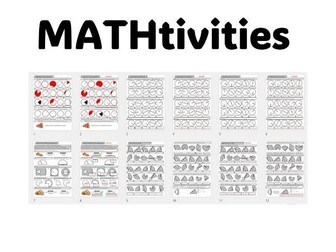
A comprehensive selection of 7 worksheets excellent for drilling reflection. Excellent resource for introducing reflection at KS2, KS3 or for lower ability KS4 groups.
Worksheets are as follows:
A) Reflect shapes in a given Vertical mirror line (Includes complex and overlapping shapes)
B) Reflect shapes in a given Horizontal mirror line (Includes complex and overlapping shapes)
C) Reflect shapes in a given Diagonal mirror line (Includes complex and overlapping shapes)
D) Draw in a selection of horizontal and vertical mirror lines
E) Reflect Shapes in either the x or y axis
F) Describe the reflection (Either x or y axis)
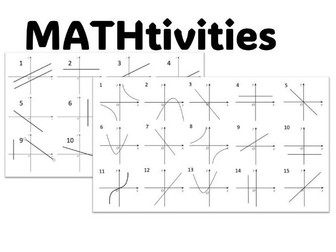
Matching activity where pupils must match the equations to the graph sketches. Develops understanding of gradient, intercept, parallel lines, shape of graph etc. Students need to use reasoning skills i.e. graph A has a positive gradient and intercepts below the x-axis therefor must be y=4x-2.
The first sheet is linear lines only and the second sheet is a mix of linear, quadratic, cubic and reciprocal. Answers included.
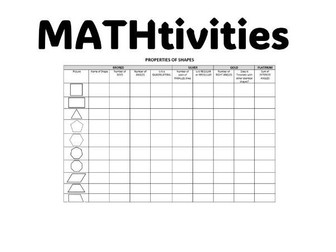
A differentiated resource requiring pupils to complete a table of a wide range of properties such as number of angles, numbers of pairs of parallel lines, number of sides, right angles etc for a large amount of shapes. Pupils are given a diagram and then complete the sheet which is differentiate by way of Level 1 Bronze tasks (name of shape) to Level 4 Platinum (sum of interior angles)
There is a section of extra activities and answers included.
An extensive collection of worksheets covering many lessons in relation to circles.
Each worksheet has answers and is built with a scaled progression structure in mind and covers many different question types per topic.
Collection is a follows.
A) CIRCLE KEYWORDS: Students must correctly identify and draw arcs, chords, segments etc.
B) CIRCUMFERENCE: Calculate circumference in terms of Pi, to 3dp and reverse questions finding radius or diameter when given circumference.
C) AREA OF A CIRCLE: Calculate area to 3dp, in terms if Pi and reverse questions finding radius or diameter if given the area.
D) MIXED CIRCLE QUESTIONS: Apply knowledge of circles (Parts, area and circumference) to other topics such as best buy, semi circles, basic perimeter of sectors, shaded area and worded questions.
E) ARC LENGTH: Calculate arc length to 3dp and terms of Pi, reverse questions to find missing angle and radius, and perimeter of sectors.
F) AREA OF SECTOR: Calculate area of sector to 3dp and terms of Pi, reverse questions both in decimals and in terms of Pi.
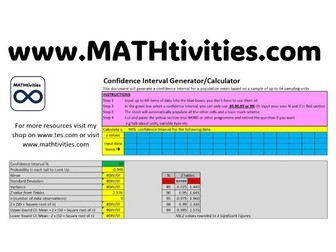
This excel document will automatically calculator a confidence interval from a set of inputted listed data (Upto 64 items)
The document will calculate an estimate for the population mean based on the sample mean. Users must simply input their own data and select a confidence level.
The spreadsheet then calculates the upper and lower bound as well as clearly identifying other values such as variance and standard deviation as well as identifying stages of working out.
As well as detailed answers a mark scheme suitable for AQA Mathematical Studies AQA Core Maths is automatically generated.
It is incredibly useful for creating your own questions and answers without needing to perform your own time consuming hand calcualtions. It also allows you to quickly adapt sample data in order to generate questions which fit your requirements or easily create extension questions such as given the confidence interval calculate the missing value for N or standard deviation
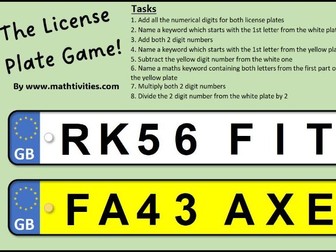
A quick starter activity requiring pupils to answer questions based on a randomly generated set of car license plates.
Mixing fundamental numeracy and literacy this quick activity is useful for either a starter or form time activity.
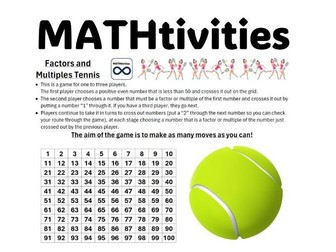
This is a fun game for 1-3 players where groups (or individuals) must try and create the longest chain possible of factors and/or multiples.
It’s an engaging activity which gets pupils to only think about factors and multiples but strategise over tactics and think about what makes numbers useful or not within the context of the game.
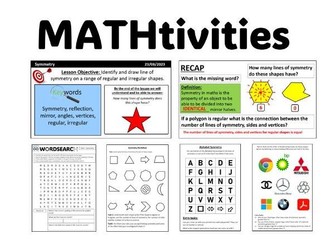
Big bundle of resources for symmetry. Two Complete sets of lesson slides for symmetry and rotational symmetry and accompanying worksheets .
Animated Powerpoint lesson slides for symmetry lesson. Including title slides, definitions, demonstrations and quick tasks.
Alphabet Symmetry worksheet and solution.
Symmetry worksheet and solution.
Animated Powerpoint lesson slides for rotational symmetry lesson. Including title slides, definitions, demonstrations and quick tasks.
Rotational symmetry worksheet and solution.
Symmetry keywords wordsearch.
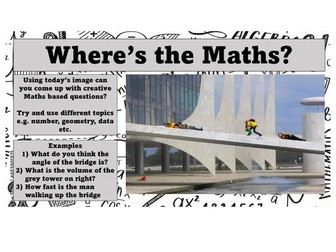
This is a creative thinking based starter. Pupils invent questions, they can be open ended if they wish, using the picture as inspiration.
I have found once pupils get the hang of this activity it generates some outstanding inventive and creative thinking. It has also enabled some amazing discussions both Maths based as well as cross curricular and even PSHCE. It has really helped to develop relationships with my groups. Use it once a week and you have a years supply in one document!
The questions don’t have to have definitive answers, but pupils can put values in if they wish, or as the teacher you can add values during the discussion stage. For example if a pupil asks what the area of the window is you can make up values and ask pupils to answer.
Images have been taken from the Guardians open to the public photo library.
It’s also an opportunity to infuse cross curricular or PSHCE content into your lessons depending on the photo.
You can use google image search if you wish to find further information on each image.
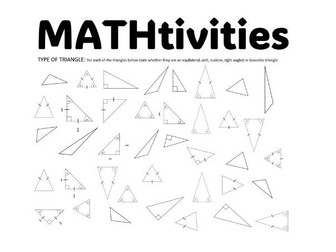
A straight forward but extensive worksheet where students must deduce what type of triangle is denoted in the diagram by considering angles, number of equal sides etc.
Suitable as an introduction to working with triangles or as a recap for heading into topics such as angles in triangles or trigonometry.
Sheet provided as PDF or Powerpoint so can reveal answer one at a time.
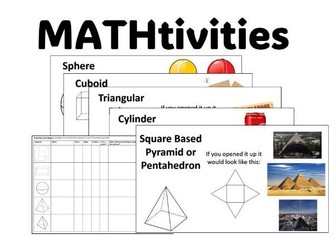
Activity based worksheet where pupils must investigate a set of cue cards to collect information required to complete sheet. Aspects include names, nets, vertices, real life examples etc.
Excellent for introducing names of shapes and developing thinking around concepts such as prisms or real life applications.
Full answers and cue cards are included.


 Quick View