 Quick View
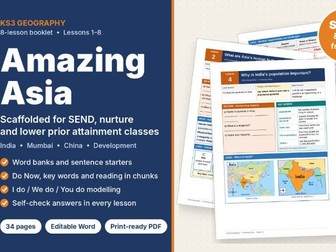
Amazing Asia: KS3 SEND/LPA Geography Booklet
Scaffolded KS3 Geography booklet on Asia for SEND, nurture and LPA classes. 8 ready-to-teach lessons: India’s population, Mumbai, China and development.
This 34-page lesson booklet covers a whole Asia unit, written for students who need extra support. It comes as an editable Word file and a print-ready PDF. Every lesson follows the same routine, so students know what comes next and can work more independently.
Each lesson includes:
A lesson banner with Last lesson / Today I am learning to… / Next lesson
A Do Now retrieval starter with a key words box
Short reading split into chunks, with key words in bold, plus maps, diagrams or tables
Checks for understanding: word banks, circle-the-answer tables and tick boxes
Modelled tasks: I do / We do / You do and “explain it 3 times” chains
Writing frames with a “Say it first” prompt, sentence starters and lined space
Self-check answers students mark in green pen, and a “How did I do?” confidence check
Lessons:
What are the countries of Asia? Locating six key countries and using compass directions
What are Asia’s human features? Human vs physical features, megacities and a country fact file
How do Asian countries compare? Development indicators for Japan, Bangladesh and Afghanistan
Why is India’s population important? Where India is, reading population pyramids, India vs China
India’s population: challenge or opportunity? Sorting facts, chains of reasoning and a scaffolded letter to the Prime Minister of India
Why do people move to Mumbai? Push and pull factors and a structured paragraph
What are the opportunities and challenges in Mumbai? Dharavi, using numbers as evidence, a note-taking frame for a documentary and a short article
What is China like? Location, and sorting physical and human features
Also included: a cover page, a how-to-use page (Read, Look, Say, Write, Check, Ask), a learning journey tracker, a glossary of the unit’s key words and an end-of-unit review quiz.
Ideal for: Year 7 and Year 8 classes, SEND and nurture groups, lower prior attainment sets, interventions and cover lessons. The self-check answers mean students can work on their own. Lesson 7’s note-taking task works with any short documentary clip about Mumbai or Dharavi (clip not included).
Curriculum links: KS3 National Curriculum locational knowledge (Asia, including China and India), place knowledge, human geography (population, urbanisation, development) and geographical skills (maps, graphs and data).