Cambridge IGCSE Computer Science (0478/0984) – Programming PowerPoint Teaching Pack
A comprehensive collection of fully editable PowerPoint lessons covering Cambridge IGCSE Computer Science programming and algorithm design.
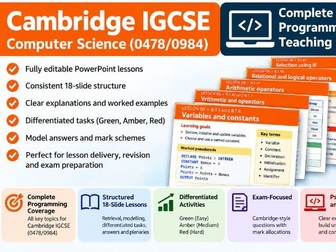
Each lesson follows a consistent 18-slide structure, including:
• Retrieval starters with answers
• Clear learning objectives and key terminology
• Teacher modelling with pseudocode and Python examples
• Differentiated tasks: Green (Easy), Amber (Medium) and Red (Hard)
• Exam-style questions with mark allocations
• Model answers and mark schemes
• Plenaries and confidence assessments
Topics include variables, data types, operators, selection, iteration, arrays, functions, procedures, file handling and program development.
Designed for Year 10 and Year 11, these classroom-ready resources support mixed-ability and EAL learners through clear explanations, scaffolded activities and progressive challenges.
Ideal for lesson delivery, independent practice, revision and exam preparation.
Cambridge IGCSE Computer Science – Algorithm Design & Problem-Solving
A complete 20-lesson Cambridge IGCSE Computer Science Algorithm Design and Problem-Solving teaching pack, containing 130+ pages of student and teacher resources.
Designed as a full teaching sequence, the pack develops students from the fundamentals of problem-solving through to pseudocode, flowcharts, testing and exam-style algorithm design.
What’s Included?
• 84-page Student Workbook
• 48-page Teacher Answer Guide
• 20 structured lessons
• 60+ student task sets
• Editable Word versions
• Print-ready PDF versions
• Retrieval starters and plenaries
• Worked examples and guided practice
• Pseudocode and algorithm-writing activities
• Flowchart tasks with dedicated drawing space
• Trace tables and algorithm tracing
• Testing and test data activities
• Python application where appropriate
• Exam-style questions
• Model answers and solutions
• Increasing levels of challenge throughout
Topics Covered
Students develop skills in problem analysis, decomposition, algorithm design, sequence, selection, iteration, pseudocode, flowcharts, trace tables, testing, debugging and programming solutions.
The accompanying teacher guide provides answers, model algorithms, pseudocode solutions, Python examples, expected outputs, flowcharts and marking guidance.
Ideal for classroom teaching, homework, revision, intervention, cover lessons and independent study.
ZIP Download: 84-page Student Workbook (Word + PDF) and 48-page Teacher Answer Guide (Word + PDF).
20 lessons | 130+ pages | Student Workbook + Teacher Answers | Editable & Print-Ready
Cambridge IGCSE Computer Science 0478 Programming pack: 22 lessons with exam-style questions, Python tasks, editable worksheets and teacher answers.
Teach Topic 8 Programming with a comprehensive pack designed around the 2026–2028 Cambridge IGCSE Computer Science syllabus. Covering programming concepts, arrays and file handling, this resource combines structured written practice with practical programming activities.
The pack includes:
77-page student booklet containing 22 structured lessons.
46-page teacher answer guide with model answers, suggested mark allocations and teaching notes.
66 differentiated main task sets, organised into Green/Easy, Amber/Medium and Red/Hard.
Printable PDFs and editable Word documents for both booklets.
Python computer resources for every lesson, including runnable worked examples, practical starter files and digital response templates.
Separate teacher solutions, including completed Python programs and model pseudocode.
A final 15-mark programming scenario, reference pages, a progress record and additional answer space.
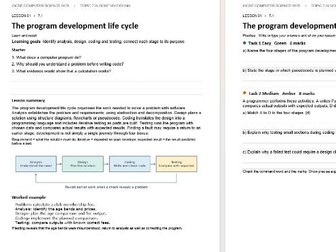
Each lesson follows a consistent structure: a retrieval starter, clear lesson summary, visual diagram, worked example, three progressively challenging tasks, student help and a plenary. This supports independent learning while providing opportunities to check understanding throughout the lesson.
Students practise identifying, explaining, tracing, correcting and writing code. Main tasks can be completed on paper or digitally, with practical routes allowing students to implement and test their ideas in Python after planning their Cambridge pseudocode.
The lessons cover variables and constants; data types; input, output and sequence; arithmetic, relational and logical operators; IF and CASE selection; count-controlled, pre-condition and post-condition loops; totalling and counting; string handling; nested statements; procedures, functions and parameters; local and global variables; library routines; maintainable programs; one-dimensional and two-dimensional arrays; and reading and writing text files.
Suitable for Year 10 and Year 11 IGCSE classes, the pack can be used for a sequence of lessons, targeted revision, homework, tutoring or independent study. Suggested lesson timings support planning, while the editable documents allow teachers to adapt activities to their classes.
The resource contains original exam-style classroom questions with suggested marks. It is an independently produced teaching resource, not an official Cambridge publication.


 Quick View