George and the Dragon – Year 2 English Past Tense & Recount | 5 Lessons + Worksheets Week 2Quick View
JenBayley

George and the Dragon – Year 2 English Past Tense & Recount | 5 Lessons + Worksheets Week 2

(0)
A complete week of Year 2 English lessons based around George and the Dragon by Chris Wormell, with accompanying children’s worksheets included. This KS1 writing sequence develops children’s understanding of past-tense verbs before applying their learning to sentences, oral explanations and the sequencing of events from the story. Across the five lessons, children: change regular verbs into the past tense, including using the -ed ending write complete sentences using past-tense verbs, alongside capital letters, finger spaces and full stops recognise and use irregular past-tense verbs, including went, saw, ran, flew and came orally explain ideas using the conjunctions because and but sequence events that have already happened to build towards a simple recount The lessons follow a consistent, child-friendly structure and include: retrieval practice explicit vocabulary teaching visual and symbol-supported scaffolding I Do, We Do, You Do modelling oral rehearsal before writing regular and irregular verb activities sentence construction conjunction work using because and but sequencing activities deeper-learning/challenge questions end-of-lesson learning reviews accompanying children’s worksheets and independent activities The resource is particularly suitable for Year 2 / KS1 and provides substantial visual support for EAL pupils, developing writers and children who benefit from additional scaffolding. Key skills covered: past tense • regular verbs • -ed endings • irregular verbs • sentence construction • capital letters • full stops • conjunctions • because • but • sequencing • recount writing Please note: A copy of George and the Dragon by Chris Wormell is required to teach the sequence.
Year 2 DT Castles – Design & Build a Strong, Sturdy and Stable Cardboard CastleQuick View
JenBayley

Year 2 DT Castles – Design & Build a Strong, Sturdy and Stable Cardboard Castle

(0)
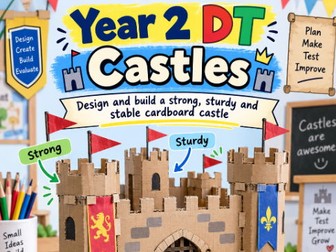
A practical Year 2 Design and Technology resource in which children design and build their own cardboard castle, with a focus on making structures strong, sturdy and stable. Children work through the DT process of designing, making and evaluating as they plan their castle, select suitable materials and joining techniques, construct their structure and consider how it could be strengthened or improved. The project is ideal for a castles topic and provides an engaging context for teaching KS1 structures. Children can explore: what makes a structure strong, stiff and stable how different shapes and construction techniques affect strength ways to join cardboard securely how tabs, folds, layers and supports can strengthen a structure how to design a purposeful product before making selecting suitable tools and materials testing their finished castle evaluating their design against simple success criteria identifying changes that would make their structure stronger or more stable The resource links directly to the KS1 Design and Technology National Curriculum in England. At Key Stage 1, pupils should be taught to design purposeful products, communicate their ideas through drawing and modelling, select appropriate tools and materials, evaluate their products against design criteria and “build structures, exploring how they can be made stronger, stiffer and more stable.” This makes the project particularly suitable for Year 2 structures work, while also providing opportunities for problem solving, creativity and collaborative discussion. Key skills and vocabulary: design • structure • strong • sturdy • stable • stiff • join • strengthen • cardboard • tabs • folds • evaluate • improve Suitable for: Year 2 • KS1 • Design and Technology • Structures • Castles • Construction • Topic work
Family Art Club – Complete Session Slides for Primary Schools | KS1 & KS2Quick View
JenBayley

Family Art Club – Complete Session Slides for Primary Schools | KS1 & KS2

(0)
A set of ready-to-use Family Art Club presentation slides designed to support fun, creative art sessions for children and their parents/carers. These slides are ideal for schools running an after-school family art club, parent engagement sessions or creative family workshops. They provide a clear structure for each session and help make activities easy to explain and enjoyable for both adults and children. The resource can be used across KS1 and KS2 and is suitable for mixed-age family groups. Rock painting Dot day Painting with scissors - Henri Matisse Van Gogh Starry night Jackson Pollock splatter painting Not a box Antoinette Portis Banksy The slides can support sessions involving a range of creative activities such as: painting and drawing collage and mixed media craft activities artist-inspired artwork collaborative parent-and-child pieces The emphasis is on spending quality time together, being creative and enjoying art without pressure. Perfect for teachers, art leads and schools looking to develop family engagement through creative activities. Suitable for: Primary schools • KS1 • KS2 • Family Art Club • Parent workshops • After-school clubs • Art enrichment
George and the Dragon – Year 2 English Nouns & Expanded Noun Phrases | 5 Lessons + Worksheets Week 3Quick View
JenBayley

George and the Dragon – Year 2 English Nouns & Expanded Noun Phrases | 5 Lessons + Worksheets Week 3

(0)
A complete week of Year 2 English lessons based around George and the Dragon by Chris Wormell, with accompanying children’s worksheets included. This ready-to-teach KS1 writing sequence develops children’s understanding of nouns, adjectives and expanded noun phrases before supporting them to apply these skills within complete sentences and a short independent paragraph. Across the five lessons, children: identify common nouns and use them accurately in simple sentences choose suitable adjectives and build expanded noun phrases use expanded noun phrases within complete past-tense sentences join two complete ideas using the conjunction and apply their previous learning independently to write a short descriptive paragraph designed to entertain the reader check and improve their writing using an author’s checklist The sequence builds carefully from word-level grammar into sentence construction and finally independent writing, making it particularly useful for children who need grammar taught explicitly before being asked to apply it. Included in the resource: five complete teaching presentations accompanying children’s worksheets/independent activities retrieval practice explicit vocabulary teaching noun and adjective activities expanded noun phrase work past-tense sentence writing conjunction work using and visual writing prompts oral rehearsal opportunities I Do, We Do, You Do modelling deeper-learning/challenge questions partner checking and editing independent paragraph writing end-of-lesson reflection and review The resource uses a highly visual and scaffolded approach, making it particularly suitable for Year 2 / KS1, including EAL pupils, developing writers and children who benefit from additional language and visual support. Key skills covered: common nouns • adjectives • expanded noun phrases • past-tense verbs • simple sentences • conjunction and • capital letters • finger spaces • full stops • paragraph writing • editing Please note: A copy of George and the Dragon by Chris Wormell is required to teach the sequence.
George and the Dragon by Chris Wormell – Year 2 English Writing Unit | 5 Lessons + Worksheets Week 1Quick View
JenBayley

George and the Dragon by Chris Wormell – Year 2 English Writing Unit | 5 Lessons + Worksheets Week 1

(0)
A complete week of Year 2 English lessons based around George and the Dragon by Chris Wormell, with accompanying children’s worksheets included. This engaging KS1 writing sequence develops children’s confidence in constructing accurate sentences through a highly visual and carefully scaffolded approach. Across the week, children: use clues to make sensible predictions and explain their ideas in full sentences write simple sentences using capital letters, finger spaces and full stops identify and use verbs to explain what a character is doing edit and improve simple sentences by checking punctuation and sentence structure apply their learning independently to write accurate sentences about the story The lessons include clear I do, We do, You do modelling, retrieval practice, vocabulary teaching, visual prompts, sentence stems, opportunities for oral rehearsal, deeper-learning questions and end-of-lesson reflection. Included in the resource: five complete lesson presentations children’s worksheets/independent activities visual vocabulary support sentence-writing scaffolds editing activities retrieval questions challenge/deeper-learning tasks opportunities for partner talk and oral rehearsal differentiated support suitable for developing writers This resource would work particularly well for Year 2 / KS1, including classes with EAL pupils or children who benefit from additional visual and language support. Key writing skills covered: simple sentences • capital letters • full stops • finger spaces • verbs • oral rehearsal • prediction • editing • sentence improvement Please note: A copy of George and the Dragon by Chris Wormell is required to teach the sequence.
KS1 Makaton ClubQuick View
JenBayley

KS1 Makaton Club

(0)
Weekly slides used for an after school Makaton club for KS1 children. 1 Basic greetings / signs 2 Animals 3 Feelings / Fruit & Vegetables 4 Colours 5 Transport 6 Weather 7 In school / Classroom All slides include a retrieval of previous week.
Design and Technology Making and baking Bread KS1Quick View
JenBayley

Design and Technology Making and baking Bread KS1

(0)
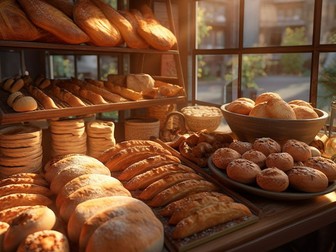
A series of 5 design and technology lessons aimed at Year 2 children exploring bread production. This was run alongside our learning on the Great Fire of London. Lesson 1: Tasting existing bread products and exploring packaging. Lesson 2: Discovering what a bakery is and does. Lesson 3: Creating a design criteria for our own product. Lesson 4: Baking bread (we had a visit from ASDA’s community champion in our area who ran this). Lesson 5: Evaluating bread. Resources used in lessons also included alongside powerpoints. Powerpoints include retrieval, key vocabulary, discovery slides as a hook and follow an I do, we do, you do approach ending with a deeper learning/challenge slide.