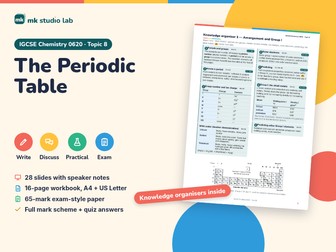
IGCSE Chemistry 0620 The Periodic TableQuick View
markkim0221

IGCSE Chemistry 0620 The Periodic Table

(0)
Groups, periods, Group I, Group VII, transition elements and noble gases in four lessons: slides, a 16-page workbook and a 65-mark paper. For the 0620 syllabus examined 2026–2028, this pack covers all 15 statements of Topic 8 (The Periodic Table): 13 Core and 2 Supplement. Trends are worded as in the syllabus, and every melting point, boiling point and density in the slides, tables and charts is a real value from the PubChem Periodic Table (NCBI), checked in code against a stored copy of the source. Extended items carry an [E] tag, so one set of files suits a mixed class. What you get A 28-slide editable PowerPoint (16:9) in four lessons: arrangement of the table and electronic configuration; Group I; Group VII; transition elements and noble gases. Syllabus codes on each content slide, notes, three checkpoints and an exit ticket. A 16-page workbook in A4 and US Letter PDFs with identical page numbers: coverage map, two knowledge organisers, three ten-question retrieval quizzes with answers, a 65-mark exam-style paper (6 multiple-choice marks and 59 structured marks, about 75 minutes), full marking guidance (ALLOW, IGNORE, NOT) and teacher notes. Bar charts and tables drawn from real data, including the exceptions the data show (potassium is less dense than sodium), so students predict from evidence. Every equation is balanced with state symbols, and every halogen displacement result follows the reactivity order, checked in code. Accessible colour Colours are given in words; diagrams use labelled grey shades. Topics covered Periods and groups; metallic to non-metallic character across a period; charges on ions from group number; outer-shell electrons and group number; noble gas electronic configuration and unreactivity; Group I physical properties, reactions with water and trends; predicting properties of other Group I elements; Group VII as diatomic non-metals, their appearance at room temperature and trends; halogen displacement reactions; predicting properties of other Group VII elements; transition elements: high density, high melting point, coloured compounds, catalysts; noble gases. [E] Predicting properties from position; variable oxidation numbers. Using it Core route: 59 of the 65 marks (skip the [E] parts, listed on the paper). Strong safety notes: Group I with water is a teacher demonstration only (small pieces, safety screen); halogens are handled in a fume cupboard. For Cambridge IGCSE Chemistry 0620, ages 14–16. Cambridge IGCSE is a trademark of Cambridge University Press & Assessment. This resource is independently produced and is not endorsed by or affiliated with Cambridge University Press & Assessment. The mark scheme follows IGCSE conventions but is not an official Cambridge mark scheme. Licence: Tes Teaching Resource Licence. For classroom use by the purchasing teacher; please do not redistribute, resell, or upload to shared drives or public websites. From MK Studio Lab.
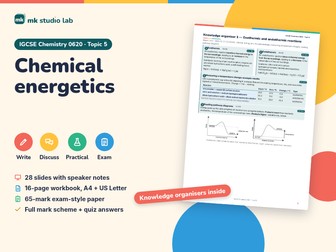
IGCSE Chemistry 0620 Chemical EnergeticsQuick View
markkim0221

IGCSE Chemistry 0620 Chemical Energetics

(0)
Exothermic and endothermic reactions, pathway diagrams and bond-energy calculations in four lessons: slides, a 16-page workbook and a 65-mark paper. For the 0620 syllabus examined 2026–2028, this pack covers all 8 statements of Topic 5 (Chemical energetics): 3 Core and 5 Supplement. Each statement is quoted from the syllabus, and Extended items carry an [E] tag, so one set of files suits a mixed class. What you get A 28-slide editable PowerPoint (16:9) in four lessons: thermal energy and the surroundings, with a temperature-change practical; reading pathway diagrams, ΔH and activation energy; drawing pathway diagrams and bond breaking and making; bond-energy calculations and review. Syllabus codes on each content slide, speaker notes, three checkpoints, a practice task and an exit ticket. A 16-page workbook in A4 and US Letter PDFs with identical page numbers: coverage map, two knowledge organisers, three ten-question retrieval quizzes with answers, a 65-mark exam-style paper (6 multiple-choice marks and 59 structured marks, about 75 minutes), full marking guidance (ALLOW, IGNORE, NOT) and teacher notes. Worked bond-energy calculations laid out line by line (bonds broken, bonds made, break minus make), using bond energies given in the question, as exam papers supply them. Pathway diagrams drawn in code: exothermic products below the reactants, endothermic above, with ΔH and Ea arrows in the right places. Every sum, sign and diagram is checked by a script. Accessible colour Diagrams use labelled grey shades; no meaning depends on colour. Topics covered Exothermic reactions transferring thermal energy to the surroundings; endothermic reactions taking it in; temperature changes; interpreting reaction pathway diagrams. [E] The enthalpy change, ΔH, and its sign; activation energy, Ea; drawing and labelling pathway diagrams; bond breaking and bond making; calculating ΔH from bond energies. Using it Core route: 27 of the 65 marks (most of Topic 5 is Supplement; the [E] parts to skip are listed on the paper). Safety notes for the class practical (dilute solutions, eye protection); the gas reactions are calculation examples only. For Cambridge IGCSE Chemistry 0620, ages 14–16. Cambridge IGCSE is a trademark of Cambridge University Press & Assessment. This resource is independently produced and is not endorsed by or affiliated with Cambridge University Press & Assessment. The mark scheme follows IGCSE conventions but is not an official Cambridge mark scheme. Licence: Tes Teaching Resource Licence. For classroom use by the purchasing teacher; please do not redistribute, resell, or upload to shared drives or public websites. From MK Studio Lab.
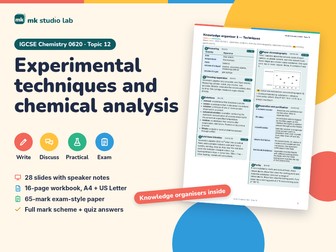
IGCSE Chemistry 0620 Tests for Ions and GasesQuick View
markkim0221

IGCSE Chemistry 0620 Tests for Ions and Gases

(0)
Apparatus, chromatography, separation and the tests for ions, gases and water in four lessons: slides, a 16-page workbook and a 65-mark paper. For the 0620 syllabus examined 2026–2028, this pack covers all 16 statements of Topic 12 (Experimental techniques and chemical analysis): 14 Core and 2 Supplement, plus the water tests from 10.1 C1. Built for the practical papers: test reagents and results are quoted word for word from the syllabus qualitative-analysis notes. Extended items carry an [E] tag, so one set of files suits a mixed class. What you get A 28-slide editable PowerPoint (16:9) in four lessons: measuring and titration; chromatography, filtration, crystallisation and distillation; tests for anions and aqueous cations; tests for gases, flame tests and tests for water. Syllabus codes on each content slide, notes, three checkpoints and an exit ticket. A 16-page workbook in A4 and US Letter PDFs with identical page numbers: coverage map, two knowledge organisers, three ten-question retrieval quizzes with answers, a 65-mark exam-style paper (6 multiple-choice marks and 59 structured marks, about 75 minutes), full marking guidance (ALLOW, IGNORE, NOT) and teacher notes. Chromatograms drawn to scale: every Rf value is recomputed in code from the drawn distances, lies between 0 and 1, and every spot sits below the solvent front. Every precipitate colour, gas test and anion test result is checked in code against the syllabus tables. Accessible colour Colours are given in words; diagrams use labelled grey shades. Topics covered Measuring apparatus and choosing it; solvent, solute, solution, saturated solution, residue and filtrate; acid–base titration with an indicator; paper chromatography and reading a chromatogram; filtration, crystallisation, simple and fractional distillation; choosing a separation method; purity from melting and boiling points; tests for seven anions; aqueous cations with sodium hydroxide and ammonia; tests for ammonia, carbon dioxide, chlorine, hydrogen, oxygen and sulfur dioxide; flame tests; tests for water. [E] Locating agents and Rf values. Using it Core route: almost all of this topic is Core, so the Core route is 61 of the 65 marks (skip the two [E] parts). Strong safety notes cover flame tests, ammonia and acids, testing chlorine with damp litmus, silver nitrate, barium chloride and heating during distillation. For Cambridge IGCSE Chemistry 0620, ages 14–16. Cambridge IGCSE is a trademark of Cambridge University Press & Assessment. This resource is independently produced and is not endorsed by or affiliated with Cambridge University Press & Assessment. The mark scheme follows IGCSE conventions but is not an official Cambridge mark scheme. Licence: Tes Teaching Resource Licence. For classroom use by the purchasing teacher; please do not redistribute, resell, or upload to shared drives or public websites. From MK Studio Lab.
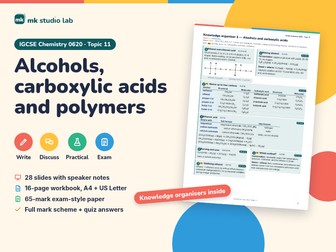
IGCSE Chemistry 0620 Alcohols, Acids and PolymersQuick View
markkim0221

IGCSE Chemistry 0620 Alcohols, Acids and Polymers

(0)
Ethanol, ethanoic acid, esters and polymers in four lessons: editable slides, a 16-page workbook and a 65-mark paper for 0620 Topic 11. For the 0620 syllabus examined 2026–2028, this second of two Topic 11 packs covers 24 statements from 11.2 and 11.6 to 11.8 (naming, alcohols, carboxylic acids, polymers): 11 Core and 13 Supplement. Fuels, alkanes and alkenes are in Chem Pack 7. Extended items carry an [E] tag, so one set of files suits a mixed class. What you get A 28-slide editable PowerPoint (16:9) in four lessons: names and displayed formulae of alcohols, acids and esters; making ethanol, its combustion and uses, the reactions of ethanoic acid, oxidation and esterification; polymers, poly(ethene), plastics and their environmental challenges; condensation polymers, nylon, PET and proteins. Syllabus codes on each content slide, notes, three checkpoints and an exit ticket. A 16-page workbook in A4 and US Letter PDFs with identical page numbers: coverage map, two knowledge organisers, three ten-question retrieval quizzes with answers, a 65-mark exam-style paper (6 multiple-choice marks and 59 structured marks, about 70 minutes), full marking guidance (ALLOW, IGNORE, NOT) and teacher notes. Displayed formulae drawn one consistent way, with bond counts checked in code, including C=O and O–H; nylon, PET and proteins use the syllabus box notation. Accessible colour Colours are given in words; diagrams use labelled grey shades. Topics covered Names and displayed formulae of ethanol and ethanoic acid; fermentation and the catalytic addition of steam to ethene; complete combustion of ethanol; ethanol as a solvent and a fuel; ethanoic acid with metals, bases and carbonates; polymers and monomers; poly(ethene) by addition polymerisation; plastics, their disposal and the environmental challenges. [E] Naming unbranched alcohols and acids up to four carbons; esters; comparing the two ways of making ethanol; oxidising ethanol; esterification; repeat units; addition and condensation polymerisation; nylon and PET; recycling PET; proteins as natural polyamides. Using it Core route: this topic is mostly Supplement, so the Core route is short: multiple-choice items 1–4 with the Core parts of the structured questions, 33 of the 65 marks. Safety notes cover ethanol (highly flammable), acidified potassium manganate(VII), making an ester (teacher-led, hot water bath, no naked flame) and fermentation hygiene. For Cambridge IGCSE Chemistry 0620, ages 14–16. Cambridge IGCSE is a trademark of Cambridge University Press & Assessment. This resource is independently produced and is not endorsed by or affiliated with Cambridge University Press & Assessment. The mark scheme follows IGCSE conventions but is not an official Cambridge mark scheme. Licence: Tes Teaching Resource Licence. For classroom use by the purchasing teacher; please do not redistribute, resell, or upload to shared drives or public websites. From MK Studio Lab.
IGCSE Chemistry Alkanes, Alkenes and CrackingQuick View
markkim0221

IGCSE Chemistry Alkanes, Alkenes and Cracking

(0)
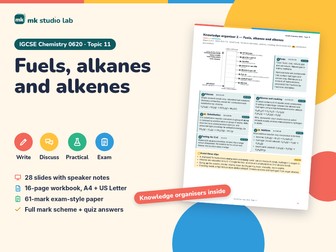
Displayed formulae, fuels, alkanes, cracking and alkenes in four lessons: editable slides, a 16-page workbook and a 61-mark paper for 0620 Topic 11. For the 0620 syllabus examined 2026–2028, this first of two Topic 11 packs covers 29 statements from 11.1 to 11.5 (formulae and terminology, naming, fuels, alkanes, alkenes): 21 Core and 8 Supplement. Alcohols, carboxylic acids and polymers come in Chem Pack 8. Extended items carry an [E] tag, so one set of files suits a mixed class. What you get A 28-slide editable PowerPoint (16:9) split into four lessons: displayed and general formulae, functional groups, homologous series, naming and isomers; fossil fuels, petroleum and fractional distillation; alkanes, combustion, substitution and cracking; the bromine water test and addition reactions. Syllabus codes on each content slide, teaching points in the notes, three checkpoints and an exit ticket. A 16-page workbook in A4 and US Letter PDFs with identical page numbers: coverage map, two knowledge organisers, three ten-question retrieval quizzes with answers, a 61-mark exam-style paper (6 multiple-choice marks and 55 structured marks, about 70 minutes), full marking guidance (ALLOW, IGNORE, NOT), and teacher notes. Displayed formulae drawn one consistent way, bond counts checked in code (4 per C, 1 per H, 2 per O). Labelled diagrams of the fractionating column, cracking and the bromine test; chart data are invented. Accessible colour Colours are given in words; diagrams use labelled grey shades. Topics covered Displayed formulae; general formulae of alkanes, alkenes, alcohols and carboxylic acids; functional groups and homologous series; saturated and unsaturated compounds; naming by name ending; coal, natural gas and petroleum; fractional distillation, trends up the column and the uses of the fractions; alkane bonding and complete combustion; cracking conditions, products and reasons; the aqueous bromine test. [E] Structural formulae and structural isomers up to C4; the general characteristics of a homologous series; substitution by chlorine in ultraviolet light; addition of bromine, hydrogen and steam to alkenes. Using it Core route: multiple-choice items 1–4 with the Core parts of the structured questions, 41 of the 61 marks. Safety notes cover cracking (suck-back and the hot catalyst), dilute bromine water, chlorine with alkanes (show a video) and fractional distillation (a CLEAPSS demonstration or a video). For Cambridge IGCSE Chemistry 0620, ages 14–16. Cambridge IGCSE is a trademark of Cambridge University Press & Assessment. This resource is independently produced and is not endorsed by or affiliated with Cambridge University Press & Assessment. The mark scheme follows IGCSE conventions but is not an official Cambridge mark scheme. Licence: Tes Teaching Resource Licence. For classroom use by the purchasing teacher; please do not redistribute, resell, or upload to shared drives or public websites. From MK Studio Lab.
IGCSE Chemistry 0620 Metals and ReactivityQuick View
markkim0221

IGCSE Chemistry 0620 Metals and Reactivity

(0)
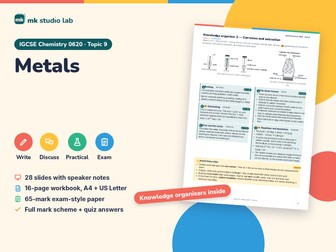
Metals, alloys, reactivity, rusting and extraction in four lessons: editable slides, 16-page workbook and 65-mark paper for 0620 Topic 9. Built for the 0620 syllabus examined 2026–2028, the pack covers all 23 statements in Topic 9 Metals (9.1 properties, 9.2 uses, 9.3 alloys, 9.4 reactivity series, 9.5 corrosion, 9.6 extraction): 16 Core and 7 Supplement. Extended-only material carries an [E] tag on each slide, page and question, so mixed classes can share one set of files. Inside the pack A 28-slide editable PowerPoint (16:9) in four lessons: properties, uses and alloys; the reactivity series and displacement; rusting and its prevention; ores, the blast furnace and aluminium. Syllabus codes on each content slide; teaching points and answers in the notes; three checkpoints, an exit ticket and an answer slide. A 16-page workbook supplied as A4 and US Letter PDFs with matching page numbers: contents and coverage map, two knowledge-organiser sheets, three ten-question retrieval quizzes with answers, a 65-mark exam-style paper (6 multiple-choice and 59 structured marks, about 75 minutes), a mark scheme with ALLOW, IGNORE and NOT guidance, and teacher notes. Labelled diagrams: metal and alloy lattices, rusting tubes, galvanised iron, the blast furnace and the aluminium cell; charts and tables use illustrative data. Accessible colour Colours are named in words, and every diagram uses labelled grey shades. Topics in detail Properties of metals; uses of aluminium and copper; alloys, brass and stainless steel, and spotting an alloy in a diagram; the order of the reactivity series; reactions with cold water, steam and dilute hydrochloric acid; working out an order from results; the conditions for rusting and barrier methods; obtaining metals from ores; iron from hematite in the blast furnace; bauxite and electrolysis. [E] why alloys are harder; displacement and the tendency to form positive ions; the oxide layer on aluminium; galvanising and sacrificial protection; blast furnace symbol equations; cryolite, carbon anodes and half-equations for aluminium extraction. Teaching notes Use the quizzes as starters or homework and the paper as an end-of-topic test. Core route: multiple-choice items 1–4 with the Core parts of each structured question, 45 of the 65 marks. Safety notes cover reactive metals with water (teacher demonstration), magnesium with steam, acids, silver nitrate and hydrogen, with CLEAPSS pointers. For Cambridge IGCSE Chemistry 0620, ages 14–16. Cambridge IGCSE is a trademark of Cambridge University Press & Assessment. This resource is independently produced and is not endorsed by or affiliated with Cambridge University Press & Assessment. The mark scheme follows IGCSE conventions but is not an official Cambridge mark scheme. Licence: Tes Teaching Resource Licence. For classroom use by the purchasing teacher; please do not redistribute, resell, or upload to shared drives or public websites. From MK Studio Lab.
IGCSE Chemistry 0620 Electrochemistry PackQuick View
markkim0221

IGCSE Chemistry 0620 Electrochemistry Pack

(0)
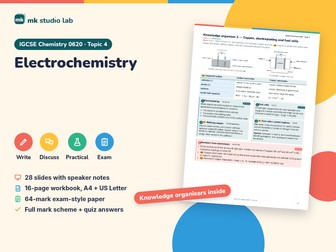
Electrolysis, half-equations, electroplating and fuel cells in four lessons: editable slides, 16-page workbook and 64-mark paper for 0620 Topic 4. Written for the 0620 syllabus examined 2026–2028, the pack teaches all 13 statements of Topic 4 Electrochemistry (4.1 Electrolysis and 4.2 Hydrogen–oxygen fuel cells): 8 Core and 5 Supplement. An [E] label marks Extended-only work on every slide, page and question, so Core and Extended groups can share one set of files. What you get Editable 16:9 PowerPoint, 28 slides, planned as four lessons: electrolysis and molten compounds; charge transfer, half-equations and aqueous solutions; copper and electroplating; fuel cells and a review. Statement codes on every content slide; teaching points and answers in the notes; three checkpoints, an exit ticket and an answer slide. 16-page workbook as A4 and US Letter PDFs with the same page numbers: contents and coverage map, a two-sheet knowledge organiser, three ten-question retrieval quizzes with answers, a 64-mark exam-style paper (6 multiple choice, 58 structured, about 75 minutes), a mark scheme with ALLOW, IGNORE and NOT, and teacher notes. Labelled cell diagrams (molten lead(II) bromide, brine, dilute sulfuric acid, copper(II) sulfate with carbon or copper electrodes, refining, plating, fuel cell); gas columns drawn from illustrative data. Accessible colour Colours are written as words; diagrams use labelled grey shades. Content covered What electrolysis is; anode, cathode and electrolyte; why the ions must be molten or dissolved; products and observations for molten lead(II) bromide, concentrated aqueous sodium chloride and dilute sulfuric acid; predicting products of molten binary compounds; why and how objects are electroplated; the hydrogen–oxygen fuel cell. [E] how charge moves in the wires and the electrolyte; ionic half-equations for oxidation and reduction; dilute and concentrated halide solutions; copper(II) sulfate with carbon and with copper electrodes, and refining copper as an application; fuel cells compared with petrol engines. Using it Quizzes suit starters or homework; the paper suits an end-of-topic test. Core route: multiple-choice items 1–4, Questions 1–3 and Question 4 (a) to (d), 38 of the 64 marks. Teacher notes cover practical safety for low-voltage electrolysis, chlorine, the lead(II) bromide teacher demonstration, copper(II) sulfate, hydrogen and fuel-cell kits, with CLEAPSS pointers. Suitable for Cambridge IGCSE Chemistry 0620, ages 14–16. Cambridge IGCSE is a trademark of Cambridge University Press & Assessment. This resource is independently produced and is not endorsed by or affiliated with Cambridge University Press & Assessment. The mark scheme follows IGCSE conventions but is not an official Cambridge mark scheme. Licence: Tes Teaching Resource Licence. For classroom use by the purchasing teacher; please do not redistribute, resell, or upload to shared drives or public websites. From MK Studio Lab.
IGCSE Chemistry 0620 Chemical Reactions PackQuick View
markkim0221

IGCSE Chemistry 0620 Chemical Reactions Pack

(0)
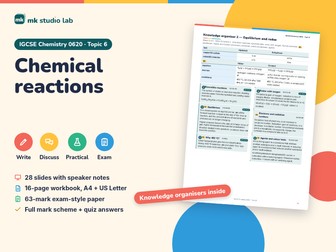
Rates, equilibrium, the Haber and Contact processes and redox in four lessons: editable slides, 16-page workbook and 63-mark paper for 0620 Topic 6. Written for the 0620 syllabus examined 2026–2028, the pack teaches all 33 statements of Topic 6 Chemical reactions (6.1 to 6.4): 12 Core and 21 Supplement. An [E] label marks Extended-only work on every slide, page and question, so Core and Extended groups can share one set of files. What you get Editable 16:9 PowerPoint, 28 slides, planned as four lessons: changes and rates; collision theory and reversible reactions; equilibrium in industry and redox with oxygen; electrons, oxidation numbers and agents. Statement codes on every content slide; teaching points and answers in the notes; three checkpoints, an exit ticket and an answer slide. 16-page workbook as A4 and US Letter PDFs with the same page numbers: contents and coverage map, a two-sheet knowledge organiser, three ten-question retrieval quizzes with answers, a 63-mark exam-style paper (6 multiple choice, 57 structured, about 75 minutes), a mark scheme with ALLOW, IGNORE and NOT, and teacher notes. Rate graphs drawn from illustrative data, with a worked tangent and comparison curves; an energy profile with and without a catalyst; Haber and Contact flow diagrams. Accessible colour Colours are written as words; diagrams use labelled grey shades, and every graph line is labelled. Content covered Physical and chemical change; the effect of concentration, pressure, surface area, temperature and catalysts on rate; following a reaction by gas volume or loss in mass; mean rates from tables and graphs; reversible reactions and hydrated salts; redox as gain and loss of oxygen; Roman numerals in names. [E] collision theory and activation energy; tangent gradients; equilibrium and how conditions move it; the Haber and Contact processes and why their conditions are chosen; oxidation and reduction by electrons and oxidation numbers; acidified potassium manganate(VII) and potassium iodide; oxidising and reducing agents. Using it Quizzes suit starters or homework; the paper suits an end-of-topic test. Core route: multiple-choice items 1–4, Questions 1–3 and Question 4 (a) to (e), 34 of the 63 marks. Teacher notes cover practical safety for gas collection, hydrogen, hydrogen peroxide, heating hydrated salts, cobalt(II) chloride paper and the redox tests, with bench concentrations and CLEAPSS pointers. Suitable for Cambridge IGCSE Chemistry 0620, ages 14–16. Cambridge IGCSE is a trademark of Cambridge University Press & Assessment. This resource is independently produced and is not endorsed by or affiliated with Cambridge University Press & Assessment. The mark scheme follows IGCSE conventions but is not an official Cambridge mark scheme. Licence: Tes Teaching Resource Licence. For classroom use by the purchasing teacher; please do not redistribute, resell, or upload to shared drives or public websites. From MK Studio Lab.
IGCSE Chemistry 0620 acids, bases and saltsQuick View
markkim0221

IGCSE Chemistry 0620 acids, bases and salts

(0)
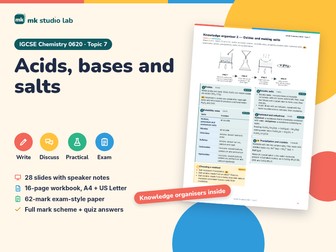
Acids, alkalis, indicators, pH, oxides and making salts in four lessons, with editable slides, a 16-page workbook and a 62-mark paper for 0620 Topic 7. Built around the 0620 syllabus examined 2026–2028, this pack covers all 20 statements in Topic 7 Acids, bases and salts (7.1 to 7.3): 12 Core and 8 Supplement. Extended-only material carries an [E] label on each slide, page and question, and Core students follow a clear route through the same files. What you get Editable 16:9 PowerPoint with 28 slides planned as four lessons: acids and alkalis; ions, pH and acid strength; oxides; solubility and making salts. Every content slide shows its syllabus statement code, and the speaker notes give teaching points and answers. Three checkpoints, an exit ticket, exam tips and a slide of answers are included. 16-page workbook supplied as A4 and US Letter PDFs with matching page numbers: contents and coverage map, a two-sheet knowledge organiser, three ten-question retrieval quizzes with answers, a 62-mark exam-style paper (6 marks multiple choice, 56 marks structured, about 75 minutes), a point-by-point mark scheme with ALLOW, IGNORE and NOT, and teacher notes. Diagrams drawn for this pack: indicator colours, the pH scale, strong and weak acids, types of oxide, salt preparation, titration and hydrated salts. Accessible colour Every indicator and universal indicator colour is written as a word. Diagrams show colours as grey shades with the word printed beside each, so nothing depends on seeing colour. Content covered Reactions of acids with metals, bases and carbonates; litmus, thymolphthalein and methyl orange; bases, alkalis and ammonium salts; H+ and OH- ions and neutralisation; comparing solutions with universal indicator paper; acidic and basic oxides; solubility rules; soluble salts by titration or with an excess of metal, insoluble base or carbonate; hydrated and anhydrous substances. [E] proton donors, strong and weak acids, amphoteric oxides, precipitation and water of crystallisation, with M_r and yield calculations. Using it Use the quizzes as starters, homework or spaced retrieval and the paper as an end-of-topic test. Core route: multiple-choice items 1–4, Questions 1–3 and Question 4 (a) to (g), 37 of the 62 marks. Teacher notes give practical safety for indicators, ammonium salts, making and crystallising a salt, titration and precipitation, with concentrations and CLEAPSS pointers. Suitable for Cambridge IGCSE Chemistry 0620, ages 14–16. Cambridge IGCSE is a trademark of Cambridge University Press & Assessment. This resource is independently produced and is not endorsed by or affiliated with Cambridge University Press & Assessment. The mark scheme follows IGCSE conventions but is not an official Cambridge mark scheme. Licence: Tes Teaching Resource Licence. For classroom use by the purchasing teacher; please do not redistribute, resell, or upload to shared drives or public websites. From MK Studio Lab.
IGCSE Chemistry 0620 stoichiometry and molesQuick View
markkim0221

IGCSE Chemistry 0620 stoichiometry and moles

(0)
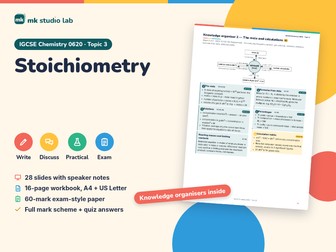
Formulae, equations, relative masses and mole calculations in four lessons, with editable slides, a 16-page workbook and a 60-mark paper for 0620 Topic 3. Built around the 0620 syllabus examined 2026–2028, this pack covers every one of the 19 statements in Topic 3 Stoichiometry (3.1 to 3.3). Most of the topic is Supplement, so Extended-only material carries an [E] label on each slide, page and question, and Core students can follow a clear route through the same files. What you get Editable 16:9 PowerPoint with 28 slides planned as four lessons: formulae and balancing; comparing masses; counting in moles; solutions, titrations and yields. Every content slide shows its syllabus statement code, and the speaker notes give teaching points and answers. Three checkpoints, an exit ticket, exam tips and a slide of answers are included. 16-page workbook supplied as A4 and US Letter PDFs with matching page numbers: contents and coverage map, a two-sheet knowledge organiser, three ten-question retrieval quizzes with answers, a 60-mark exam-style paper (6 marks multiple choice, 54 marks structured, about 75 minutes), a point-by-point mark scheme with ALLOW, IGNORE and NOT, and teacher notes. Diagrams drawn for this pack: molecular models, an ionic lattice, a particle picture of a balanced equation, the carbon-12 scale, a mole map and titration apparatus. Calculations covered M_r and formula mass; masses in simple proportion for Core; [E] moles from mass, particles and gas volume at r.t.p. (24 dm3 per mole); reacting masses and gas volumes; concentration in g/dm3 and mol/dm3; titrations including a 1 : 2 acid–alkali ratio; limiting reactants; empirical and molecular formulae; percentage yield, composition by mass and purity. Worked answers are to 3 significant figures, and the mark scheme shows where error carried forward applies. Using it Use the quizzes as starters, homework or spaced retrieval and the paper as an end-of-topic test. Core route: multiple-choice items 1–4 plus Questions 1–3, 28 of the 60 marks. Relative atomic masses come from the syllabus Periodic Table. Titration readings and sample masses are invented and marked as illustrative. Teacher notes cover practical safety for a titration, the magnesium oxide crucible experiment and collecting a gas in a syringe. Suitable for Cambridge IGCSE Chemistry 0620, ages 14–16. Cambridge IGCSE is a trademark of Cambridge University Press & Assessment. This resource is independently produced and is not endorsed by or affiliated with Cambridge University Press & Assessment. The mark scheme follows IGCSE conventions but is not an official Cambridge mark scheme. Licence: Tes Teaching Resource Licence. For classroom use by the purchasing teacher; please do not redistribute, resell, or upload to shared drives or public websites. From MK Studio Lab.
IGCSE Chemistry atoms and bonding 0620Quick View
markkim0221

IGCSE Chemistry atoms and bonding 0620

(0)
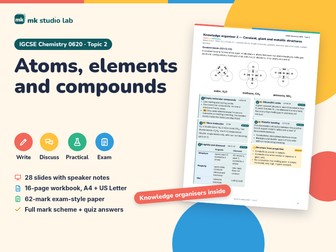
Atoms, isotopes, ions and all three bond types over four lessons, with editable slides, a 16-page workbook and an exam-style paper for 0620 Topic 2. Teaches all 29 statements in Topic 2 Atoms, elements and compounds (2.1 to 2.7) from the 0620 syllabus examined 2026–2028. Supplement content is labelled [E], so Core and Extended students use the same files. What you get Editable PowerPoint: 28 slides (16:9) in four lessons, statement codes on every slide, answers in the speaker notes, three checkpoints, a data task, an exit ticket and an answers slide. 16-page workbook as A4 and US Letter PDFs with identical page numbers. Two-sheet knowledge organiser, three ten-question retrieval quizzes with answers, and a 62-mark exam-style paper (6 marks multiple choice, 56 marks structured, about 75 minutes) with a full mark scheme. Diagrams drawn for the pack: electron shells, isotopes, ion formation, dot-and-cross diagrams for ionic compounds and all eleven syllabus molecules, an ionic lattice, graphite, diamond, silicon(IV) oxide and metallic bonding. Using it Teach from the deck and print whichever paper size suits you. Set the quizzes as starters, homework or spaced retrieval and the paper as an end-of-topic test. Core route: Section A 1–4 plus Section B Questions 1–4, 40 of the 62 marks. Isotope abundances are rounded and labelled; the substances in the data task are invented with illustrative values. Teacher notes cover practical safety: low-voltage conductivity tests, no melting of ionic compounds in class. The mark scheme uses ALLOW, IGNORE and NOT but is not an official Cambridge mark scheme. Suitable for Cambridge IGCSE Chemistry 0620, ages 14–16. Cambridge IGCSE is a trademark of Cambridge University Press & Assessment. This resource is independently produced and is not endorsed by or affiliated with Cambridge University Press & Assessment. Licence: Tes Teaching Resource Licence. For classroom use by the purchasing teacher; please do not redistribute, resell, or upload to shared drives or public websites. From MK Studio Lab.
IGCSE Biology excretion, kidneys and drugsQuick View
markkim0221

IGCSE Biology excretion, kidneys and drugs

(0)
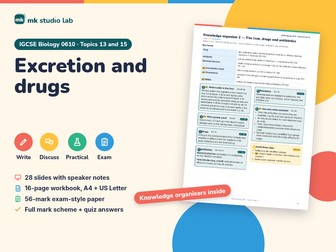
Kidneys, the liver and antibiotics in four lessons: slides and a 16-page workbook for Cambridge IGCSE Biology 0610 Topics 13 and 15. Covers every statement in Topic 13 Excretion in humans (13.1) and Topic 15 Drugs (15.1), as set out in the Cambridge IGCSE Biology 0610 specification for the 2026–2028 exams. Extended-only material is marked [E], so Core and Extended students share the same files. Inside the pack Editable PowerPoint, 28 slides (16:9), four lessons, with statement codes on every slide, answers in the speaker notes, three checkpoints, an exit ticket and an answers slide. 16-page student workbook as A4 and US Letter PDFs with matching page numbers. Two-sheet knowledge organiser, three ten-question retrieval quizzes with answers, and a 56-mark exam-style paper (6 marks of multiple choice, 50 marks of structured questions, about 70 minutes) with a full mark scheme. Original diagrams: urinary system, kidney section, simplified nephron, deamination, bacteria versus viruses, resistant bacteria. How to use it Teach from the deck and print the paper size you need. Use the quizzes for starters, homework or spaced revision, and the paper as an end-of-topic test. Core route: Section A items 1–4 and, from Section B, all of 1, all of 2, all of 5 and 6(a)–©, worth 34 of the 56 marks. Students plot urine volumes, read a concentration table and interpret a bacterial culture graph. Every value is made up for classroom use and flagged as illustrative. No urine testing or bacterial culturing is needed, and no recreational drugs are named. The mark scheme uses ALLOW, IGNORE and NOT but is not an official Cambridge mark scheme. For Cambridge IGCSE Biology 0610 (the 0970 content is the same), ages 14–16. Cambridge IGCSE is a trademark of Cambridge University Press & Assessment. This resource is independently produced and is not endorsed by or affiliated with Cambridge University Press & Assessment. Licence: Tes Teaching Resource Licence. For classroom use by the purchasing teacher; please do not redistribute, resell, or upload to shared drives or public websites. From MK Studio Lab.
IGCSE Biology classification and keys 0610Quick View
markkim0221

IGCSE Biology classification and keys 0610

(0)
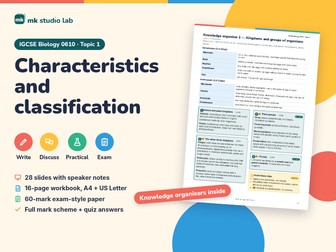
Living things, naming, keys and the five kingdoms across four lessons: a slide deck and 16-page workbook for Cambridge IGCSE Biology 0610 Topic 1. Teaches all fifteen statements in Topic 1 Characteristics and classification of living organisms (1.1, 1.2 and 1.3) from the 0610 syllabus examined 2026–2028. Supplement content is labelled [E], so Core and Extended students use the same files. What you get Editable PowerPoint: 28 slides (16:9) in four lessons, statement codes on every slide, answers in the speaker notes, three checkpoints, an exit ticket and an answers slide. 16-page workbook as A4 and US Letter PDFs, page numbers identical in both. Two-sheet knowledge organiser, three ten-question retrieval quizzes with answers, and a 60-mark exam-style paper (6 marks multiple choice, 54 marks structured, about 75 minutes) with a full mark scheme. Diagrams drawn for the pack: characteristics, binomial names, keys, arthropod groups, ferns and flowering plants, monocot and dicot features, a virus, a tree of shared ancestors. Using it Teach from the deck and print whichever paper size suits you. Set the quizzes as starters, homework or spaced recall and the paper as an end-of-topic test. Core route: Section A items 1–4 and all of Section B Questions 1–4, 40 of the 60 marks. All key organisms are invented and labelled so; the DNA sequences are invented and marked as illustrative data. No real statistics are used and nothing is cultured. The mark scheme uses ALLOW, IGNORE and NOT but is not an official Cambridge mark scheme. Suitable for Cambridge IGCSE Biology 0610 (0970 has the same content), ages 14–16. Cambridge IGCSE is a trademark of Cambridge University Press & Assessment. This resource is independently produced and is not endorsed by or affiliated with Cambridge University Press & Assessment. Licence: Tes Teaching Resource Licence. For classroom use by the purchasing teacher; please do not redistribute, resell, or upload to shared drives or public websites. From MK Studio Lab.
IGCSE Biology human impact and biotechnologyQuick View
markkim0221

IGCSE Biology human impact and biotechnology

(0)
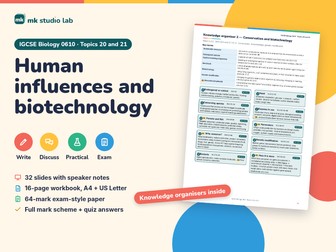
Four lessons of slides plus a 16-page workbook for Cambridge IGCSE Biology 0610 Topics 20 and 21: human influences, conservation and biotechnology. Every learning outcome in Topic 20 Human influences on ecosystems (20.1–20.4) and Topic 21 Biotechnology and genetic modification (21.1–21.3) is covered, written for the Cambridge IGCSE Biology 0610 syllabus examined in 2026, 2027 and 2028. Extended-only content is tagged [E], so Core and Extended students can work from the same files. What you get A four-lesson PowerPoint, 32 slides (16:9), with statement codes on each slide, answers in the speaker notes, three checkpoints, an exam-slips slide, an exit ticket and an answers slide. Student workbook of 16 pages, printable on A4 or US Letter with matching page numbers. A two-sheet knowledge organiser, three ten-question retrieval quizzes with answers, and a 64-mark exam-style paper (multiple choice worth 6, structured questions worth 58, roughly 75 minutes) with a full mark scheme. Diagrams drawn for this pack: deforestation on a hillside, eutrophication, the enhanced greenhouse effect, a river oxygen graph, a washing-powder investigation, a fermenter and the steps of genetic modification. Using it Teach the four lessons from the deck, and print whichever paper size suits you. Set the quizzes as starters, homework or spaced revision, and the paper as an end-of-topic test. Core route: Section A items 1–4 and, from Section B, all of 1, all of 2, 3(a)–(b), all of 4, 5(a)–©, all of 6, 7(a)–(b) and 8(a)–(b), giving 46 of the 64 marks. Students read a river oxygen graph and use a washing-powder results table. Every number is made up for teaching and marked as illustrative; no real-world statistics are presented. Teacher notes cover enzyme allergy and safety for the washing-powder practical. The mark scheme follows IGCSE conventions (ALLOW, IGNORE, NOT) but is not an official Cambridge mark scheme. Intended for Cambridge IGCSE Biology 0610 (the 0970 content is the same), ages 14–16. Cambridge IGCSE is a trademark of Cambridge University Press & Assessment. This resource is independently produced and is not endorsed by or affiliated with Cambridge University Press & Assessment. Licence: Tes Teaching Resource Licence. For classroom use by the purchasing teacher; please do not redistribute, resell, or upload to shared drives or public websites. From MK Studio Lab.
IGCSE Biology reproduction: plants and humansQuick View
markkim0221

IGCSE Biology reproduction: plants and humans

(0)
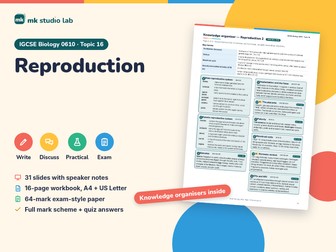
Slides for four lessons and a 16-page workbook covering Cambridge IGCSE Biology 0610 Topic 16: reproduction in plants and humans. This IGCSE Biology pack covers all of Topic 16 Reproduction (16.1 Asexual reproduction, 16.2 Sexual reproduction, 16.3 Sexual reproduction in plants, 16.4 Sexual reproduction in humans, 16.5 Sex hormones in humans, 16.6 Sexually transmitted infections), written to the Cambridge IGCSE Biology 0610 syllabus for examination in 2026, 2027 and 2028. Every Supplement (Extended) item is flagged, so one set of files serves Core and Extended students together. In the download A 31-slide PowerPoint (16:9) for four lessons, with statement codes on every slide, answers in the speaker notes, three checkpoint tasks, an exam-tips slide, an exit ticket and a slide of answers. A 16-page workbook for students, supplied as A4 and as US Letter with matching page numbers. A two-page knowledge organiser, three 10-question retrieval quizzes with answers, and a 64-mark exam-style paper (6 marks of multiple choice in Section A and 58 marks of structured questions in Section B), about 75 minutes, with a full mark scheme. Original diagrams, including flower structure, pollination, germination, the human reproductive systems, sperm and egg cells, the fetus and the menstrual cycle. Human diagrams are simple, clinical line drawings. How to use it Teach four lessons from the deck. Choose A4 or US Letter to suit your printer; page numbers are the same in both. Use the quizzes as starters, homework or spaced revision, and the paper as an end-of-topic test or mock section. Core-only students can sit Section A items 1–4 and, from Section B, 1(a)–(b), all of 2, all of 4, all of 5, 6(a)–(b), 7(a)–(b) and all of 8: 44 of the 64 marks. Supplement questions are marked [E]. Students analyse a germination investigation, calculate a percentage and interpret a uterus-lining graph. All data values are illustrative. Teacher notes cover sensitive content and practical safety. The mark scheme follows familiar IGCSE conventions but is not an official Cambridge mark scheme. Written for Cambridge IGCSE Biology 0610 classes (the content also matches 0970), ages 14–16. Cambridge IGCSE is a trademark of Cambridge University Press & Assessment. This resource is independently produced and is not endorsed by or affiliated with Cambridge University Press & Assessment. Licence: Tes Teaching Resource Licence. For classroom use by the purchasing teacher; please do not redistribute, resell, or upload to shared drives or public websites. From MK Studio Lab.
IGCSE Biology variation, selection, ecologyQuick View
markkim0221

IGCSE Biology variation, selection, ecology

(0)
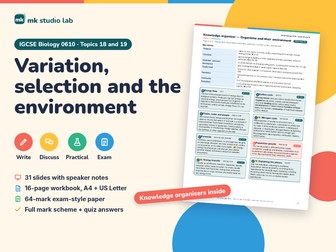
A four-lesson slide deck and 16-page workbook for Cambridge IGCSE Biology 0610 Topics 18 and 19: variation, selection and ecology. This IGCSE Biology pack covers Topic 18 Variation and selection (18.1 Variation, 18.2 Adaptive features, 18.3 Selection) and Topic 19 Organisms and their environment (19.1 Energy flow, 19.2 Food chains and food webs, 19.3 Nutrient cycles, 19.4 Populations), written to the Cambridge IGCSE Biology 0610 syllabus for examination in 2026, 2027 and 2028. Core and Supplement (Extended) content is labelled throughout, so the same files can be used with a mixed class. What is included A 31-slide PowerPoint (16:9) for four lessons, with a specification reference on every slide, teacher answers in the speaker notes, three checkpoint tasks, an exam-tips slide, an exit ticket and an answers slide. A 16-page student workbook in A4, plus a matching US Letter version with the same page numbers. A two-page knowledge organiser, three 10-question retrieval quizzes with answers, and a 64-mark exam-style question pack (Section A, 6 multiple-choice marks; Section B, 58 structured marks), with a suggested time of about 75 minutes, plus a full mark scheme. Original diagrams drawn for this pack, including variation charts, natural selection, a food chain and food web, pyramids, the carbon and nitrogen cycles, and a sigmoid population growth curve. How to use it Use the slide deck as the backbone of four lessons. Print the A4 workbook in the UK, or the US Letter file in international schools; the page numbers match. The quizzes work as low-stakes starters, homework or spaced revision. The 64-mark paper can be used as an end-of-topic test, homework or a mock section. Core-only candidates can be set Section A questions 1–4 and Section B questions 1(a)–(e), 2(a)–©, 3©, 4, 6(a) and 7(a)–©, together worth 38 of the 64 marks. Questions that use Supplement content are marked [E]. Students draw a histogram from sampled leaf lengths, read a population growth curve, interpret a food web and a resistance graph, and calculate the efficiency of energy transfer. All data values are illustrative. The mark scheme uses familiar IGCSE conventions. It is not an official Cambridge mark scheme. This pack is for teachers of Cambridge IGCSE Biology 0610 (and the 0970 UK-only equivalent) working with students aged 14–16. Cambridge IGCSE is a trademark of Cambridge University Press & Assessment. This resource is independently produced and is not endorsed by or affiliated with Cambridge University Press & Assessment. Specification references are to the Cambridge IGCSE Biology 0610 syllabus for examination in 2026, 2027 and 2028. Licence: Tes Teaching Resource Licence. For classroom use by the purchasing teacher; please do not redistribute, resell, or upload to shared drives or public websites. From MK Studio Lab.
IGCSE Biology cells, diffusion and osmosisQuick View
markkim0221

IGCSE Biology cells, diffusion and osmosis

(0)
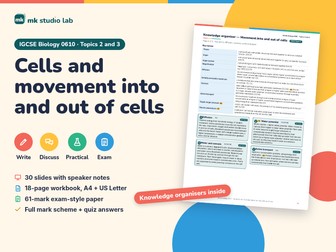
A four-lesson slide deck and 18-page workbook for Cambridge IGCSE Biology 0610 Topics 2 and 3: cells, diffusion, osmosis and active transport. This IGCSE Biology pack covers Topic 2 Organisation of the organism (2.1 Cell structure and organisation, 2.2 Size of specimens) and Topic 3 Movement into and out of cells (3.1 Diffusion, 3.2 Osmosis, 3.3 Active transport), written to the Cambridge IGCSE Biology 0610 syllabus for examination in 2026, 2027 and 2028. Core and Supplement (Extended) content is labelled throughout, so the same files can be used with a mixed class. What is included A 30-slide PowerPoint (16:9) for four lessons, with a specification reference on every slide, teacher answers in the speaker notes, three checkpoint tasks, an exam-tips slide, an exit ticket and an answers slide. An 18-page student workbook in A4, plus a matching US Letter version with the same page numbers. A two-page knowledge organiser, two lesson worksheets, three 10-question retrieval quizzes with answers, and a 61-mark exam-style question pack (Section A, 6 multiple-choice marks; Section B, 55 structured marks), with a suggested time of 70 minutes, plus a full mark scheme. Original diagrams drawn for this pack, including plant, animal and bacterial cells, specialised cells, diffusion, and turgid, flaccid and plasmolysed cells. How to use it Use the slide deck as the backbone of four lessons. Print the A4 workbook in the UK, or the US Letter file in international schools; the page numbers match. The quizzes work as low-stakes starters, homework or spaced revision. The 61-mark paper can be used as an end-of-topic test, homework or a mock section. Core-only candidates can be set Section A questions 1–4 and Section B questions 1, 2, 3(a)–(b), 4, 5 and 7(a)–(b), together worth 45 of the 61 marks. Questions that use Supplement content are marked [E]. The slides and paper use practical contexts: magnification and drawing of specimens, an agar-cube diffusion investigation, dialysis tubing, and potato tissue in sucrose solutions. All data values are illustrative. The mark scheme uses familiar IGCSE conventions. It is not an official Cambridge mark scheme. This pack is for teachers of Cambridge IGCSE Biology 0610 (and the 0970 UK-only equivalent) working with students aged 14–16. Cambridge IGCSE is a trademark of Cambridge University Press & Assessment. This resource is independently produced and is not endorsed by or affiliated with Cambridge University Press & Assessment. Specification references are to the Cambridge IGCSE Biology 0610 syllabus for examination in 2026, 2027 and 2028. Licence: Tes Teaching Resource Licence. For classroom use by the purchasing teacher; please do not redistribute, resell, or upload to shared drives or public websites. From MK Studio Lab.
IGCSE Biology biological molecules and enzymesQuick View
markkim0221

IGCSE Biology biological molecules and enzymes

(0)
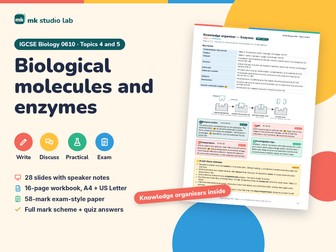
A four-lesson slide deck and 16-page workbook for Cambridge IGCSE Biology 0610 Topics 4 and 5: biological molecules, food tests, DNA and enzymes. Topic 4 Biological molecules (4.1) and Topic 5 Enzymes (5.1) are taught together here, following the Cambridge IGCSE Biology 0610 syllabus for examination in 2026, 2027 and 2028. Core and Supplement (Extended) content is labelled throughout, so the same files can be used with a mixed class. What is included A 28-slide PowerPoint (16:9) for four lessons, with a specification reference on every slide, teacher answers in the speaker notes, three checkpoint tasks, practical and investigation slides, an exam-tips slide, an exit ticket and an answers slide. A 16-page student workbook in A4, plus a matching US Letter version with the same page numbers. A knowledge organiser, three 10-question retrieval quizzes with answers, and a 58-mark exam-style question pack (Section A, 6 multiple-choice marks; Section B, 52 structured marks), with a suggested time of 65 minutes, plus a full mark scheme. Original diagrams drawn for this pack, including food tests, DNA, enzyme action and an amylase investigation. How to use it Use the slide deck as the backbone of four lessons. Print the A4 workbook in the UK, or the US Letter file in international schools; the page numbers match. The quizzes work as low-stakes starters, homework or spaced revision. The 58-mark paper can be used as an end-of-topic test, homework or a mock section. Core-only candidates can be set Section A questions 1–4 and Section B questions 1, 2, 4, 5 and 7(a)–(b), together worth 40 of the 58 marks. Questions that use Supplement content are marked [E]. The mark scheme uses familiar IGCSE conventions. It is not an official Cambridge mark scheme. This pack is for teachers of Cambridge IGCSE Biology 0610 (and the 0970 UK-only equivalent) working with students aged 14–16. Cambridge IGCSE is a trademark of Cambridge University Press & Assessment. This resource is independently produced and is not endorsed by or affiliated with Cambridge University Press & Assessment. Specification references are to the Cambridge IGCSE Biology 0610 syllabus for examination in 2026, 2027 and 2028. Licence: Tes Teaching Resource Licence. For classroom use by the purchasing teacher; please do not redistribute, resell, or upload to shared drives or public websites. From MK Studio Lab.
IGCSE Biology human nutrition and immunityQuick View
markkim0221

IGCSE Biology human nutrition and immunity

(0)
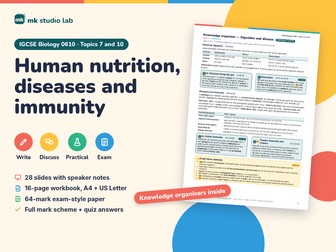
Five lessons on diet, digestion, absorption, pathogens and immunity for Cambridge IGCSE Biology 0610 Topics 7 and 10, with slides and a 16-page workbook. This IGCSE Biology pack covers all of Topic 7 Human nutrition (7.1 Diet, 7.2 Digestive system, 7.3 Physical digestion, 7.4 Chemical digestion and 7.5 Absorption) and Topic 10 Diseases and immunity (10.1), written to the Cambridge IGCSE Biology 0610 syllabus for examination in 2026, 2027 and 2028. Core and Supplement (Extended) content is labelled throughout, so the same files can be used with a mixed class. What is included A 28-slide PowerPoint (16:9) for five lessons, with a specification reference on every slide, teacher answers in the speaker notes, three checkpoint tasks, a model-gut practical slide, an exam-tips slide, an exit ticket and an answers slide. A 16-page student workbook in A4, plus a matching US Letter version with the same page numbers. A knowledge organiser, three 10-question retrieval quizzes with answers, and a 64-mark exam-style question pack (Section A, 6 multiple-choice marks; Section B, 58 structured marks), with a suggested time of about 70 minutes, plus a full mark scheme. Original diagrams drawn for this pack, including the digestive system, teeth, a villus, a model gut, antibodies and vaccination. How to use it Use the slide deck as the backbone of five lessons. Print the A4 workbook in the UK, or the US Letter file in international schools; the page numbers match. The quizzes work as low-stakes starters, homework or spaced revision. The 64-mark paper can be used as an end-of-topic test, homework or a mock section. Core-only candidates can be set Section A questions 1–4 and Section B questions 1, 2, 3, 4(a)–©, 5 and 7, together worth 45 of the 64 marks. Questions that use Supplement content are marked [E]. The mark scheme uses familiar IGCSE conventions. It is not an official Cambridge mark scheme. This pack is for teachers of Cambridge IGCSE Biology 0610 (and the 0970 UK-only equivalent) working with students aged 14–16. Cambridge IGCSE is a trademark of Cambridge University Press & Assessment. This resource is independently produced and is not endorsed by or affiliated with Cambridge University Press & Assessment. Specification references are to the Cambridge IGCSE Biology 0610 syllabus for examination in 2026, 2027 and 2028. Licence: Tes Teaching Resource Licence. For classroom use by the purchasing teacher; please do not redistribute, resell, or upload to shared drives or public websites. From MK Studio Lab.
IGCSE Biology transport and gas exchangeQuick View
markkim0221

IGCSE Biology transport and gas exchange

(0)
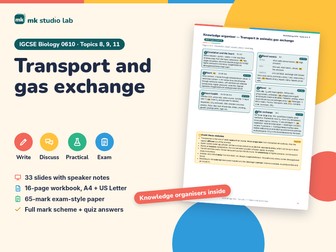
A four-lesson slide deck and 16-page workbook for Cambridge IGCSE Biology 0610 Topics 8, 9 and 11: plant transport, the heart, blood and breathing. This IGCSE Biology pack teaches Topic 8 Transport in plants (8.1–8.4), Topic 9 Transport in animals (9.1–9.4) and Topic 11 Gas exchange in humans (11.1) as one unit, written to the Cambridge IGCSE Biology 0610 syllabus for examination in 2026, 2027 and 2028. Core and Supplement (Extended) outcomes are labelled throughout, so the same files work with a mixed class. What is included A 33-slide PowerPoint (16:9) for four lessons, with a specification reference on every slide, teacher answers in the speaker notes, two checkpoint tasks, a potometer slide, an exam-tips slide, an exit ticket and an answers slide. A 16-page student workbook in A4, plus a matching US Letter version with the same page numbers. A knowledge organiser, three 10-question retrieval quizzes with answers, and a 65-mark exam-style question pack (Section A, 6 multiple-choice marks; Section B, 59 structured marks), with a suggested time of 75 minutes, plus a full mark scheme. Original diagrams drawn for this pack, including xylem and phloem, the heart, blood vessels and the breathing system. How to use it Use the slide deck as the backbone of four lessons. Print the A4 workbook in the UK, or the US Letter file in international schools; the page numbers match. The quizzes work as low-stakes starters, homework or spaced revision. The 65-mark paper can be used as an end-of-topic test, homework or a mock section. Core-only candidates can be set Section A questions 1–4 and Section B questions 1, 2(a)–©, 4, 6(a) and ©, 7 and 8(a)–©, together worth 40 of the 65 marks. Questions that use Supplement content are marked [E]. A potometer is used as one method for investigating transpiration. The syllabus does not name the apparatus. The mark scheme uses familiar IGCSE conventions. It is not an official Cambridge mark scheme. This pack is for teachers of Cambridge IGCSE Biology 0610 (and the 0970 UK-only equivalent) working with students aged 14–16. Cambridge IGCSE is a trademark of Cambridge University Press & Assessment. This resource is independently produced and is not endorsed by or affiliated with Cambridge University Press & Assessment. Specification references are to the Cambridge IGCSE Biology 0610 syllabus for examination in 2026, 2027 and 2028. Licence: Tes Teaching Resource Licence. For classroom use by the purchasing teacher; please do not redistribute, resell, or upload to shared drives or public websites. From MK Studio Lab.
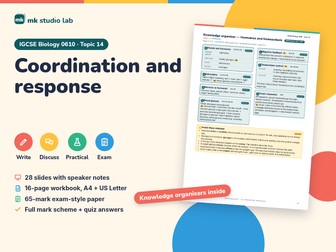
IGCSE Biology coordination and responseQuick View
markkim0221

IGCSE Biology coordination and response

(0)
A four-lesson slide deck and 16-page workbook for Cambridge IGCSE Biology 0610 Topic 14: nervous system, the eye, hormones and homeostasis, 2026–2028. This IGCSE Biology pack teaches the whole of Topic 14 Coordination and response (14.1–14.5) as one short unit, written to the Cambridge IGCSE Biology 0610 syllabus for examination in 2026, 2027 and 2028. Core and Supplement (Extended) outcomes are labelled throughout, so the same files work with a mixed class. What is included A 28-slide PowerPoint (16:9) for four lessons, with a specification reference on every slide, teacher answers in the speaker notes, two checkpoint tasks, an exam-tips slide, an exit ticket and an answers slide. A 16-page student workbook in A4, plus a matching US Letter version with the same page numbers. A knowledge organiser, three 10-question retrieval quizzes with answers, and a 65-mark exam-style question pack (Section A, 6 multiple-choice marks; Section B, 59 structured marks), with a suggested time of 75 minutes, plus a full mark scheme. Original diagrams drawn for this pack, including neurones, a reflex arc, a synapse, the eye, hormones and tropisms. How to use it Use the slide deck as the backbone of four lessons. Print the A4 workbook in the UK, or the US Letter file in international schools; the page numbers match. The quizzes work as low-stakes starters, homework or spaced revision. The 65-mark paper can be used as an end-of-topic test, homework or a mock section. Core-only candidates can be set Section A questions 1–4 and Section B questions 1, 3, 5, 6(a)–(b) and 8(a)–(d), together worth 35 of the 65 marks. Questions that use Supplement content are marked [E]. The mark scheme uses familiar IGCSE conventions. It is not an official Cambridge mark scheme. This pack is for teachers of Cambridge IGCSE Biology 0610 (and the 0970 UK-only equivalent) working with students aged 14–16. Cambridge IGCSE is a trademark of Cambridge University Press & Assessment. This resource is independently produced and is not endorsed by or affiliated with Cambridge University Press & Assessment. Specification references are to the Cambridge IGCSE Biology 0610 syllabus for examination in 2026, 2027 and 2028. Licence: Tes Teaching Resource Licence. For classroom use by the purchasing teacher; please do not redistribute, resell, or upload to shared drives or public websites. From MK Studio Lab.