Introduce students to the main weather hazards experienced in the UK, including storms, flooding, heatwaves, and snow and ice. Students learn what makes weather hazardous and consider the impacts these events can have on people, infrastructure, and the environment.
The lesson explores why the UK experiences changeable and extreme weather. Students learn about the UK’s mid-latitude location, different air masses, and the role of high and low pressure systems in creating different weather conditions.
Students complete a starter activity, teacher-led tasks, questioning, and a video activity before applying their knowledge to a series of GCSE-style exam questions ranging from 1 to 4 marks. Answer slides and marking guidance are included.
An extension task challenges students to create their own 4-mark question for a partner and mark their response, providing an opportunity to consolidate understanding and practise assessment skills.
This lesson is designed for Year 10 GCSE Geography and focuses on developing students’ ability to answer long-answer (6–8 mark) exam questions effectively. It is ideal as a skills-based lesson between topics or as targeted exam preparation, particularly within the Rivers unit or wider Physical Geography.
The lesson begins with a retrieval-style starter activity, where students analyse a GCSE-style question to identify the number of marks, the command word, and the topic being assessed. This immediately sets an exam-focused tone and encourages students to think like examiners. Clear learning objectives are shared, outlining expectations around structure, command words, and quality of written responses.
Students are then introduced to what a long-answer question is and why structure is essential for accessing higher marks. Key GCSE command words are explicitly taught, with a clear explanation of what each one requires and how mark tariffs typically increase with higher-level commands. The lesson places strong emphasis on PEEL paragraphs, showing students how to organise extended responses clearly and logically.
A model answer is shared and broken down step-by-step, allowing students to see what a high-quality response looks like in practice. This is followed by a collaborative task where students work together to improve a weaker response, identifying missing elements such as explanation, terminology, and links back to the question. This supports peer discussion and builds confidence before independent work.
Students then complete an independent exam-style question focused on rivers and flooding, applying the skills taught during the lesson. Clear success criteria are provided, including paragraph structure, use of geographical terminology, and SPaG checks. The lesson concludes with a short plenary that encourages reflection on exam technique.
An optional homework task asks students to create flashcards or a mind map on how to answer long-answer GCSE Geography questions, reinforcing key skills and supporting revision.
This lesson is clear, structured, and highly exam-relevant. It supports students in improving written responses, understanding command words, and developing confidence with extended answers—making it a valuable resource for any GCSE Geography teacher.
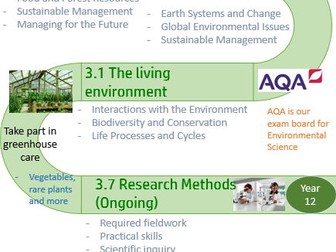
This comprehensive resource provides a clear, structured learning journey through the AQA A-Level Environmental Science specification, designed to support both teachers and students in navigating the course with confidence. Covering Year 12 and Year 13 content, the resource maps out required fieldwork, practical skills, and ongoing research methods alongside the core topics of the living and physical environment, biological resources, energy, pollution, and sustainability. Each section highlights key themes such as biodiversity, global environmental issues, sustainable management, and system resilience, ensuring learners can see how topics interconnect across the two years. The journey also emphasizes scientific inquiry and practical engagement, including greenhouse care and biodiversity studies, helping students develop applied skills alongside theoretical knowledge. With exam preparation built in—two written papers at the end of Year 13—this resource offers a roadmap that makes complex content manageable, motivating, and easy to follow.
Fully aligned with AQA specification
Ideal for classroom display or student reference
Encourages independent study and revision
Supports curriculum planning and sequencing
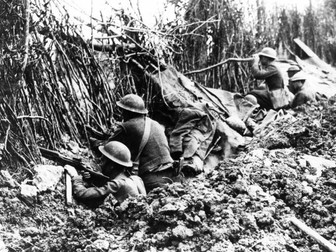
This comprehensive Year 9 History worksheet provides a structured and engaging cover lesson on World War One, ideal for independent study or teacher-led reinforcement. It introduces students to the key causes of WW1 through the acronym MAIN (Militarism, Alliances, Imperialism, Nationalism), before exploring the assassination of Archduke Franz Ferdinand, the role of alliances in escalating conflict, and the impact of propaganda and new technologies on modern warfare. The resource balances factual content with comprehension questions and creative tasks, ensuring students not only recall knowledge but also apply it in imaginative ways.
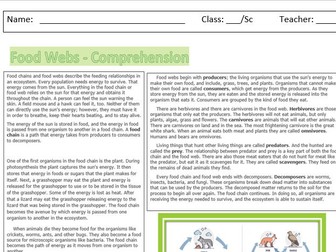
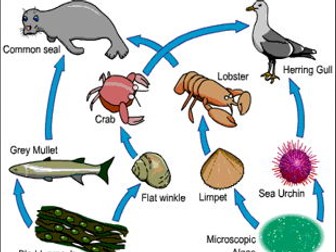
Hello. This resource is a comprehension sheet on Food Webs. This is mainly focuses on KS3 (Year 7 and 8) and can be used as a small Homework sheet for students. It has 8 questions and is around a 15 miniute activity. Hope you can use this resource well.
Hello. This PPTX involves an whole lesson plan on understanding this topic. It is a free resource. Begin with a starter and go over a comprehension sheet (on my other resource tabs), check understanding of some key terms and food chains. The, move onto food webs and some class and independent tasks with a review at the end. Hope you can use this resource well.