A fun, imaginative Reception drama lesson exploring movement, storytelling, and Easter themes. Children journey through a magical Easter Garden, act out springtime characters, and create simple group scenes - supported by a clear, teacher-friendly script.
Includes a colourful PowerPoint to guide the session, making it low‑prep and easy to deliver
Perfect for: EYFS, Expressive Arts, Drama, and Seasonal Easter activities.
The Explorers: A Year 1 Drama Scheme of Work
A fully immersive three‑lesson drama adventure designed to develop movement, imagination, teamwork, and early drama skills—all wrapped inside an exciting explorer‑themed fictional world.
This Scheme of Work places children as trainee explorers on a series of playful missions, guided by the teacher in role as The Explorer Leader or Explorer Willow. The fictional frame provides a clear purpose, a reason to pretend, and continuity from week to week.
What’s Included
A complete 3‑lesson structure following a consistent format: warm‑ups, entering the fiction, exploration in role, reflection, and closing transitions.
Fully scripted Teacher‑in‑Role guidance with prop ideas, status notes, and sample dialogue to support confident delivery—even for teachers new to drama.
Age‑appropriate drama devices such as freeze frames, soundscape, mime, levels, pathways, and thought‑tracking to build foundational performance skills.
High‑engagement missions including:
Explorer Movement Training
The First Mission in the Woods
The Lost Creature Rescue Mission with clues and guided adventures
Built‑in opportunities for teamwork, emotional expression, and simple problem‑solving, crafted specifically for younger learners.
Why Teachers Love It
No specialist drama knowledge required—clear scripts, cues, and step‑by‑step tasks support all teachers.
Non‑competitive warm‑ups and accessible movement activities ideal for varied confidence levels, attention spans, and classroom sizes.
A strong narrative that keeps children motivated, curious, and fully invested from lesson to lesson.
Opportunities for reflection with simple, concrete prompts to develop oracy and self‑awareness.
Perfect for:
Year 1 / Key Stage 1 Drama
Creative Curriculum / Topic Work
Movement, storytelling, and PSHE links
Teachers seeking high‑impact, low‑prep imaginative learning
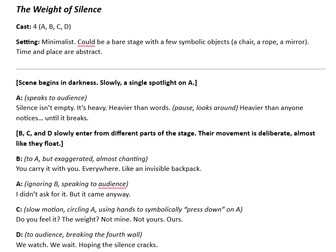
This downloadable bundle contains** four original short scripts** designed specifically for Key Stage 4 Drama students to explore a wide range of non-naturalistic devices, including direct address, stylised movement, freeze frames, split stage, mime, symbolic props, and abstract staging. Each script is approximately 5 minutes long with a cast of 4, making them ideal for GCSE practical exploration, devising stimulus work, component preparation, or as stretch/challenge material for high-ability KS3 groups.
These scripts can be used to:
Introduce or consolidate understanding of non-naturalistic theatre techniques
Support GCSE Devising through character, theme, and abstract storytelling
Serve as rehearsal texts for practical assessments
Stimulate classroom discussion around themes such as mental health, class divide, bullying, family, and comedy through physical theatre
Give students ready-to-perform scenes requiring interpretation, creativity, and ensemble work
Each script includes suggestive, flexible staging ideas rather than prescriptive directions, allowing students to take ownership of the style and performance choices.
Included Scripts & Themes
The Weight of Silence
A tense, atmospheric piece exploring the pressures of unspoken emotions and internal conflict through stylised movement and symbolic props.
The Words We Carry
A serious exploration of bullying, showing the lingering weight of hurtful words through symbolic objects, rhythmic insults, and fragmented ensemble movement.
Threads
A moving piece about familial love and tension, using a physical ribbon as a metaphor for connection, conflict, and reconciliation.
The Line
A powerful, non-naturalistic scene exploring class division, boundaries, and social inequality through split scenes, ensemble choreography, and symbolic staging.
One-Off Christmas Pantomime Drama Lesson (Years 7-9)
Bring some festive fun into the drama studio with this engaging one-off Christmas pantomime lesson, perfect for key stage 3. This resource introduces students to the lively, comedic world of pantomime, teaches key theatrical vocabulary, and guides them towards creating and performing their own short scene.
This lesson works brilliantly as an end-of-term activity while still hitting clear learning objectives and building performance skill.
Whats Included:
6-slide introductory pp covering:
What is pantomime?
Key features ( audience participation, stock characters)
Key vocabulary
Group task instructions
Clear, structured group task where students create and rehearse a short 2 - 3 minute pantomime scene.
A 5-minute play within a play designed for key stage 3 or 4 students (cast of 6). This short script captures the hilarity of primary school pupils attempting a Nativity performance, giving students the chance to explore comedy, timing, and character work in a festive setting. Great for one off lessons at the end of the autumn term.
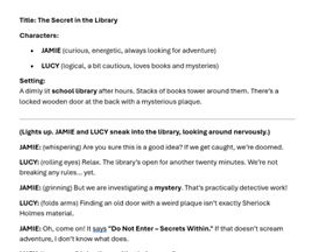
4 short duologues appropriate for script exploration in Key Stage 3.
Out of This World: An alien called Zog meets a boy called Jamie
The Bench: Middle aged Eleanor and Daniel meet for the first time - great for exploration into Naturalism.
The Deal: Set in 1920’s New York in the style of a classic film noir.
The Secret in the LIbrary: Two school children explore the secrets of the library after hours.
A revision booklet for answering the Live Theatre question in Section B of the Eduqas GCSE exam. This booklet focuses on the National Theatre’s ‘One Man, Two Guvnors’ but could be used as a template for other productions.
The booklet includes:
Cast List
Information on the style
Exam Board specific vocabulary/glossary
Example Questions
Suggested timings
Suggested essay structure and paragraph structure
Mark Scheme from the exam board
Design and Technical Theatre quiz designed to help students answer the Eduqas GCSE Drama paper in both Section A and Section B.
Includes:
Powerpoint Presentation of questions to allow for ‘pub quiz’ style activity.
20 Multiple Choice Questions
Questions that focus on Lighting Design, Sound Design, Set and Props, Costume, Hair and Makeup
Answers at the end of the powerpoint