The T Cell ShowQuick View
School_of_Biological_Sciences

The T Cell Show

(0)
An animated immune system talk show with teacher notes and a worksheet for KS3 and KS4 that explores immune organs and the body’s defences. The T Cell Show introduces the immune system through an animated interview hosted by a T cell. A B cell reporter visits different organs to learn how they help protect the body. The approximately 21-minute episode explores bone marrow, the thymus, the spleen, and lymph nodes, along with the protective roles of the skin and other parts of the body. Students also learn that some gut bacteria are helpful and that the immune system depends on many parts working together. The accompanying worksheet asks students to identify organ functions, explain protective barriers, consider helpful bacteria and describe how different parts of the immune system cooperate. An optional extension explores the show’s use of the thymus as a “school” for T cells. Suggested for KS4 Biology, with selected clips and vocabulary support for KS3. Use it to introduce the topic, revisit learning or prompt classroom discussion. Allow approximately 40–50 minutes for the full video and activity, or choose shorter clips for a focused session. Includes • Teacher notes with learning aims, suggested classroom use and approximate clip timings. • A printable one-page student worksheet. • Suggested answers and guidance on scientific simplifications. • Links to the video, website and a relevant AQA GCSE Biology curriculum section. Curriculum connection: AQA GCSE Biology 8461, section 4.3.1.6 Human defence systems. The organ detail offers enrichment; the resource should be used alongside teaching of the full specification

Becoming a Scientist: The graphic novelQuick View
School_of_Biological_Sciences

Becoming a Scientist: The graphic novel

(0)
Becoming a Scientist: The Graphic Novel is an engaging KS3/KS4 resource exploring scientists’ backgrounds, career journeys and routes into science. The graphic novel, written by Professor Adrian Liston and illustrated by Yulia Lapko, showcases the diverse backgrounds and career paths of immunology researchers from the Liston-Dooley Lab at the Department of Pathology, University of Cambridge. Students can read the stories of the researchers and explore the different experiences, choices and pathways that can lead to a career in science. The accompanying Role Model Worksheet encourages students to choose a scientist who interests them, identify interesting facts about their journey, and reflect on what they have learned. The resource can be used to support classroom discussions about scientific careers, role models, diversity in science and working scientifically. It is suitable for KS3 and KS4 students and can be used alongside science lessons or careers-focused activities. Includes: Becoming a Scientist: The Graphic Novel A student Role Model Worksheet Teacher notes with suggested use and curriculum links The resource links to Working Scientifically in the National Curriculum and GCSE AQA and Edexcel specifications.
The Infection GameQuick View
School_of_Biological_Sciences

The Infection Game

(0)
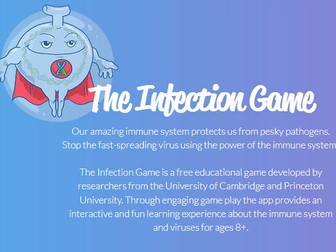
An interactive biology game exploring the immune system, pathogens, antigens, antibodies and immune cells, designed for GCSE and A-level students. The Infection Game is a fun and accurate way to introduce and explore how the immune system defends the body against disease. Students learn about the roles of different immune cells, including T cells and B cells, while playing the game. The resource can support teaching about infection, communicable diseases, pathogens, viruses and the immune system. It is suitable for GCSE and A-level Biology and can be used to introduce key concepts or reinforce students’ understanding. Curriculum links: • GCSE AQA: Organisation, Health issues, Infection and response, Communicable diseases • GCSE Edexcel: Health, disease and the development of medicines, Communicable diseases, Pathogens, Pathogen spread, Viruses • A-level AQA: Cells, Cell recognition and the immune system • A-level Edexcel: Immunity, Infection and Forensics