KS4 Internal Energy animationQuick View
paul_burke1

KS4 Internal Energy animation

(0)
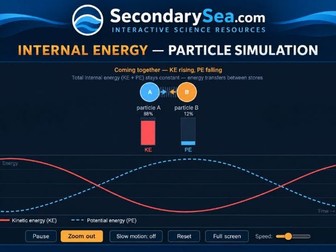
Interactive GCSE Physics simulation exploring internal energy through the relationship between kinetic energy (KE) and potential energy (PE). Students can watch how energy transfers between kinetic and potential stores as particles move, while the total internal energy remains constant. The animation links the particle model to changing energy bars and a live graph, helping students visualise a concept that can otherwise feel quite abstract. The simulation includes controls for pausing, slowing the motion, zooming and resetting, making it useful for teacher demonstration, whole-class discussion or independent student exploration. Useful for: GCSE Physics and Combined Science Internal energy and the particle model Kinetic and potential energy stores Energy transfers Classroom demonstrations and revision The resource runs directly in a web browser with no software or installation required.
KS3-GCSE Science: Unit Conversions LabQuick View
paul_burke1

KS3-GCSE Science: Unit Conversions Lab

(0)
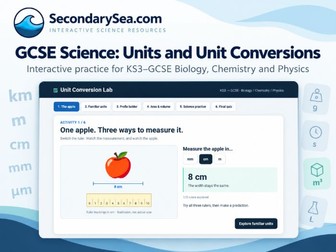
Practice unit conversions with the SecondarySea Unit Conversion Lab, an interactive resource for KS3 and GCSE Science. Students work through familiar units, metric prefixes, area and volume conversions, science-based examples and a final quiz, with visual explanations and instant feedback along the way. Suitable for Biology, Chemistry and Physics lessons, revision or independent practice. More interactive science resources: www.secondarysea.com No installation or login required. The activity runs directly in a web browser and no student data is saved or recorded.
GCSE Biology: Surface Area:Volume- SA:VQuick View
paul_burke1

GCSE Biology: Surface Area:Volume- SA:V

(0)
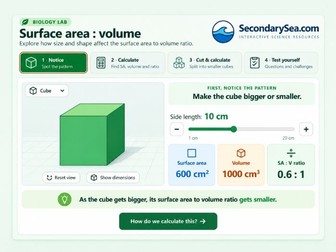
An interactive GCSE Biology resource for practising and consolidating surface area to volume ratio. Students explore how changing the size of a cube affects its surface area, volume and SA:V ratio, before working through calculations and applying their understanding to smaller cubes. Designed to be used after the concept of surface area to volume ratio has been taught, helping students practise the calculations and embed their understanding of the relationship between size and SA:V. Ideal as a classroom activity, consolidation task or revision resource. It can be used as a teacher-led activity or independently by students. Easy to share with students, runs directly in a web browser and no student data is saved or recorded. For more interactive science resources, animations and simulations, visit SecondarySea: www.secondarysea.com
DC Motor Effect Interactive Simulation – GCSE PhysicsQuick View
paul_burke1

DC Motor Effect Interactive Simulation – GCSE Physics

(0)
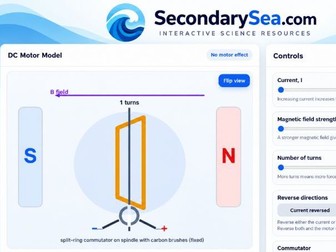
Interactive GCSE Physics simulation exploring the motor effect and the operation of a simple DC motor. Students can investigate how changing the current, magnetic field strength and number of turns affects the force on the coil. They can also reverse the current or magnetic field to explore how this changes the direction of the force, and examine the role of the split-ring commutator. The simulation is useful for helping students visualise a topic that can be difficult to represent clearly using static diagrams alone. It works well for whole-class teaching, guided questioning, revision or independent student exploration. Useful for: GCSE Physics and Combined Science The motor effect Fleming’s left-hand rule Magnetic fields and current-carrying conductors Factors affecting force on a conductor DC motors and split-ring commutators The resource runs directly in a web browser with no software or installation required. More available at secondarysea.com
Build an Atom Workshop – Interactive Atom Structure Simulation (KS3/GCSE Chemistry)Quick View
paul_burke1

Build an Atom Workshop – Interactive Atom Structure Simulation (KS3/GCSE Chemistry)

(0)
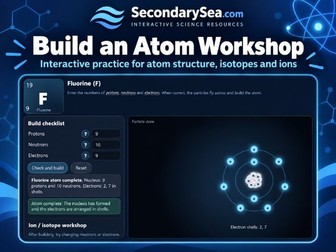
Interactive KS3/GCSE Chemistry resource for teaching and revising atomic structure. Students build atoms by entering the correct numbers of protons, neutrons and electrons. When the values are correct, the particles move into place and the atom is constructed visually, helping students see the relationship between the nucleus and electron shells more clearly. The resource is also useful for extending discussion into ions and isotopes, allowing students to explore how changing electron or neutron number affects the atom. This makes the workshop useful for: introducing atomic structure checking understanding classroom modelling revision and retrieval practice independent student exploration Useful for: KS3 Science GCSE Chemistry Protons, neutrons and electrons Atomic structure Electron shells Ions Isotopes The resource runs directly in a web browser with no software or installation required. More resources available at secondarysea.com