Magnification Worksheets – Simplified & Supportive!Quick View
Quality_Teaching_Resources

Magnification Worksheets – Simplified & Supportive!

(0)
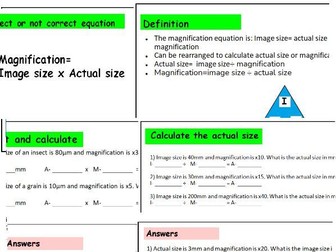
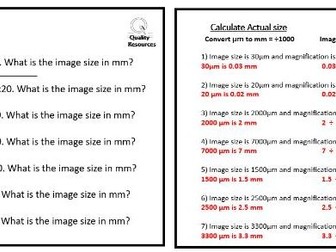
Enhance your science classroom with these specially-designed magnification worksheets crafted to support all learners, including low-ability and SEN students. Whether you’re reinforcing core concepts or breaking down tricky calculations, these resources simplify the learning process while keeping students motivated and engaged. Key Features: Built for Success • Step-by-Step Guidance Each worksheet breaks down calculations into easy-to-follow stages. Students are guided to clearly identify and label Magnification (M), Image Size (I), and Actual Size (A) before they begin—building confidence from the start. • Targeted Practice A diverse range of calculation tasks ensures repeated practice in a structured format. From calculating image and actual size to converting units between micrometers (μm) and millimeters (mm)—everything is covered. • Clear, Accessible Layout Designed with clarity in mind, the clean layout and supportive structure make even the most complex topics feel manageable perfect for students who need that little bit of extra help. Why Choose These Worksheets? • Inclusive Design Created with low-ability and SEN students in mind, these worksheets help ensure that every learner can access and succeed with magnification and size calculation topics. • Increased Engagement The clear structure and steady progression help students stay focused and motivated turning challenging topics into achievable wins. • Immediate Feedback With answers provided, you can quickly check understanding, provide instant feedback, and offer targeted support right when it’s needed. For questions, support, or feedback, contact us at: qualityresources032@gmail.com
KS3 Plant Cells Complete Lessons with Scaffolded WorksheetsQuick View
Quality_Teaching_Resources

KS3 Plant Cells Complete Lessons with Scaffolded Worksheets

(0)
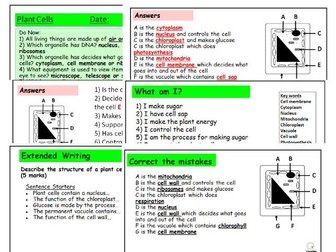
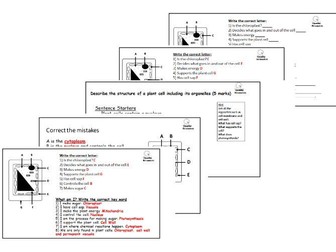
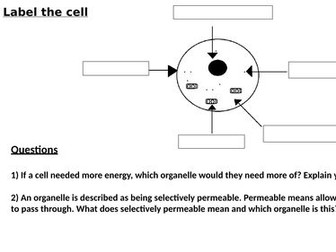
This complete lesson on plant cells is designed to engage students with 43 slides of structured activities, success criteria, and high-quality worksheets. Thoughtfully differentiated for all abilities, this resource ensures students develop a deep understanding of plant cells. What’s Included: -Full PowerPoint Presentation – Clear explanations, visual aids, and success criteria to guide learning. -Do Now/Starter with Answers – Engaging questions to activate prior knowledge and spark interest. Mini Quiz – Quick comprehension check to assess understanding. 12 Interactive Activities – Covering key concepts with scaffolded support. Key Tasks Include: • Labelling a plant cell diagram • Identifying and correcting mistakes in a diagram • ‘What am I?’ task – students match descriptions to key terms • Extended writing (5-mark question) comparing plant and animal cells ** Differentiated Worksheets for Low Attainers/SEN**– Structured, accessible activities to support all learners. Designed to save you time while delivering high-quality instruction, this lesson ensures students grasp plant cell structure and function with confidence. For any questions or feedback, contact us at qualityresources032@gmail.com – we’re happy to help!
Plant Cells – Complete KS3 Lesson with 10 Differentiated Worksheets & AnswersQuick View
Quality_Teaching_Resources

Plant Cells – Complete KS3 Lesson with 10 Differentiated Worksheets & Answers

(0)
Deliver an engaging and effective KS3 lesson on plant cells with this fully resourced and differentiated package. Designed to support pupils across a wide range of abilities, this comprehensive set includes 10 high-quality worksheets (all with answers) that guide students through key learning objectives with clarity and structure. Whether you’re introducing the topic for the first time or consolidating understanding, these resources provide a flexible, ready-to-teach solution that will save you planning time and boost student confidence. What’s Included: -10 High-Quality Worksheets – A full set of engaging tasks to reinforce and assess understanding Fully Differentiated Versions – Support for low-ability and SEN learners, with scaffolded tasks and simplified instructions Answers Provided for All Activities – Easy marking and immediate feedback to inform your teaching Clear Structure – Activities build on prior knowledge and progress toward more advanced tasks Activities Include: • Labeling a Plant Cell Diagram – Identify and name key organelles with precision • Spot the Mistake – Analyze a diagram with deliberate errors to develop critical thinking and correction skills • Key Term Match-Up – Match the correct letter to the correct part of the cell to reinforce vocabulary • ‘What Am I?’ Task – Read scientific descriptions and write the correct key word, improving scientific literacy • Extended Writing Task (5 Marks) – Compare plant and animal cells using correct terminology and structure, ideal for assessment practice This resource is ideal for whole-class teaching, homework, revision, or intervention. The differentiated format ensures that all students, including those who may struggle with science, can access and engage with the content successfully. Perfect for busy teachers who want to deliver high-quality lessons without the stress of starting from scratch. Questions or feedback? Email us at: qualityresources032@gmail.com – we’re happy to help!
Magnification Mastery – Step-by-Step KS3 Lesson for SEN & Low-Ability LearnersQuick View
Quality_Teaching_Resources

Magnification Mastery – Step-by-Step KS3 Lesson for SEN & Low-Ability Learners

(0)
Support low-ability and SEN learners in mastering magnification calculations with this fully structured and accessible lesson resource. Designed to simplify the core concepts of Magnification (M), Image Size (I), and Actual Size (A), this lesson breaks down the topic into manageable, confidence-building steps. Whether used in class, for intervention, or as a revision tool, this resource helps students gain the foundational understanding they need to succeed in microscopy and measurement. What’s Included: Complete PowerPoint Lesson – Step-by-step explanations of magnification, image size, and actual size calculations Differentiated Worksheets with Answers – Scaffolded tasks to suit all learners, including full worked examples Interactive Starter Task – Multiple-choice questions to activate thinking and support engagement from the outset Clear Success Criteria & Equation Breakdown – Simple, student-friendly breakdowns of the M = I ÷ A formula and how to rearrange it Check-for-Understanding Quiz – Students identify whether equations are used correctly, reinforcing understanding in a low-pressure format Guided Practice Tasks – Students are walked through how to calculate each variable, with prompts to label what’s given and what’s missing Unit Conversion Practice – Micrometers to millimeters and vice versa, explained clearly and practiced within the context of real exam-style questions This resource ensures that students are not only practicing magnification calculations but truly understanding the process behind them. Perfect for low-ability groups, SEN pupils, or anyone needing a more supportive entry point into this challenging topic. Questions or feedback, contact us at: qualityresources262@gmail.com
KS3 Animal Cells - Scaffolded Worksheets for Low Attainers and SENQuick View
Quality_Teaching_Resources

KS3 Animal Cells - Scaffolded Worksheets for Low Attainers and SEN

(0)
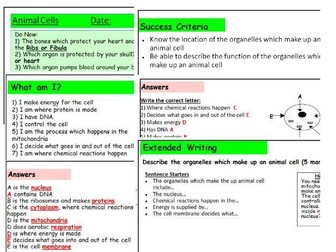
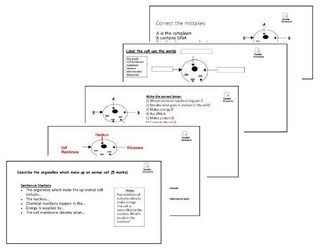
Support your KS3 students in confidently learning about animal cells with this set of brilliant differentiated worksheets. Designed specifically for SEN and low-attaining learners, these resources break down key concepts with clear instructions, engaging tasks, and full model answers to promote understanding and independence. With 8 ready-to-use worksheets and 6 scaffolded activities, this resource is ideal for lessons, homework, revision, or targeted support. What’s Included: 8 High-Quality Worksheets – Structured and supportive, with tasks that build knowledge step-by-step All Answers Included – Perfect for self-assessment, peer review, or quick teacher feedback SEN & Low Ability Friendly – Simplified language and clear visuals help every learner succeed Model Answer Included – Supports extended writing and helps students understand how to structure their responses Activities Include: • Label the diagram of an animal cell • Spot and correct errors in a cell diagram • Fill in missing letters for key terms • Match parts of the cell with the correct letters • ‘What am I?’ – Identify parts of the cell based on a description • 5-Mark Extended Writing Task – Describe an animal cell with a model answer provided This is a flexible and engaging resource, ideal for building foundational science skills in a way that’s accessible and confidence-boosting for all learners. For support or feedback, contact: qualityresources032@gmail.com
KS3 Atoms Complete Lesson with WorksheetsQuick View
Quality_Teaching_Resources

KS3 Atoms Complete Lesson with Worksheets

(0)
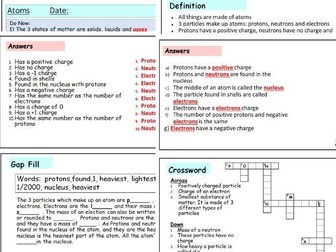
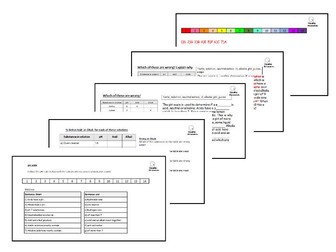
Engaging KS3 Lesson on Atomic Structure - 52 Slide PowerPoint A comprehensive lesson for KS3 students, designed to enhance their understanding of atomic structure. This lesson includes 52 slides with a Do Now/Starter, Success Criteria, mini quiz, and interactive activities, complete with answers for each activity. What’s Included: • Slide Presentation: o Retrieval Starter: Engages students and activates prior knowledge. o Key Concepts: Clearly explains the atomic structure, including protons, neutrons, and electrons. o Activities with Answers: Detailed explanations provided to support student learning. • Activities Include: o Labelling Exercise: Students label statements as protons, neutrons, or electrons. o Crossword Puzzle: Students solve clues about subatomic particles, reinforcing key vocabulary. o Fill in the Gaps: Students complete sentences and correct mistakes in provided examples. o Match-Up: Definitions are matched with their correct descriptions for better understanding. Benefits for SEN and Low-Attaining Students: • Differentiated Tasks: Activities are designed with varying levels of difficulty to support all learners, including scaffolded tasks for low-attaining and SEN students. • Worksheets Included: High-quality worksheets that provide additional support and practice for each activity. This complete lesson plan provides a thorough exploration of atomic structure, ideal for classwork, homework, or revision. For any questions or feedback, please contact us at qualityresources032@gmail.com
KS3 Animal Cells Complete Lesson and WorksheetQuick View
Quality_Teaching_Resources

KS3 Animal Cells Complete Lesson and Worksheet

(0)
Fantastic KS3 Lesson on Animal Cells – 42 slides of engaging content! This complete lesson package includes: • Do Now/Starter activity • Clear success criteria • Mini quiz with answers • Interactive activities • Accompanying worksheets Activities include: • Labeling the Diagram of an Animal Cell: Help students identify key parts of the animal cell. • Correct Mistakes: Spot errors in a diagram of the animal cell and make corrections. • ‘What Am I?’ Task: Students use descriptions to identify key animal cell parts. • Extended Writing 5-Mark Question: Students describe the animal cell, with a model answer provided for guidance. Why Choose This Resource? • Differentiated for Low-Attaining Learners: Scaffolded worksheets designed to support all students, including those with SEN. • Complete Lesson Plan: Combines interactive slides with engaging worksheets for comprehensive learning. • Ready-to-Use: Answer keys included for each activity, saving time on marking. For any questions or feedback, please contact us at qualityresources032@gmail.com.
GCSE Indicators Acids and Alkalis Complete LessonQuick View
Quality_Teaching_Resources

GCSE Indicators Acids and Alkalis Complete Lesson

(0)
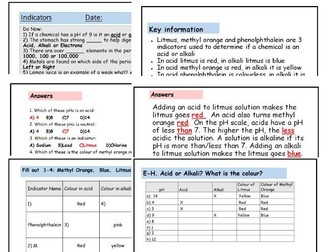
Fantastic KS3 Lesson on Indicators of Acids and Alkalis – 48 Slides of engaging content! This complete lesson package includes: • Do Now/Starter activity • Clear success criteria • Interactive activities • Accompanying worksheets Activities include: • Finishing the Sentences: Complete sentences related to indicators of acids and alkalis. • Comparing Indicators: Answer questions comparing different indicators. • Multiple Choice: Test understanding of acid and alkali indicators. • Table Fill: Record colour changes for 3 indicators in a table. • Determining Acids and Alkalis: Use a table to determine whether a solution is an acid or alkali, along with the colour changes of indicators used. Why Choose This Resource? • Differentiated for Low-Ability Learners: Clear tasks for all students, with scaffolded support. • Complete Lesson Plan: Combines interactive slides with engaging worksheets. • Ready-to-Use: Includes answers for each activity, saving time on marking. Transform your science lessons with this comprehensive and accessible resource, helping students gain a solid understanding of acids and alkalis! For any questions or feedback, please contact us at qualityresources032@gmail.com.
KS3 Animal Cells WorksheetQuick View
Quality_Teaching_Resources

KS3 Animal Cells Worksheet

(0)
A range of high quality worksheets and activities to help pupils develop their understanding of Animal cells. Activities include: • Labeling the Diagram of an Animal Cell: Help students identify key parts of the animal cell. • Correct Mistakes: Spot errors in a diagram of the animal cell and make corrections. • ‘What Am I?’ Task: Students use descriptions to identify key animal cell parts. • Extended Writing 5-Mark Question: Students describe the animal cell, with a model answer provided for guidance. Why Choose This Resource? • Differentiated for Low-Attaining Learners: Scaffolded worksheets designed to support all students, including those with SEN. • Ready-to-Use: Answer keys included for each activity, saving time on marking. For any questions or feedback, please contact us at qualityresources032@gmail.com.
Complete Using Microscopes Lesson Package for SEN & Low-Ability StudentsQuick View
Quality_Teaching_Resources

Complete Using Microscopes Lesson Package for SEN & Low-Ability Students

(0)
Fantastic KS3 Lesson on Microscopes – Engage and inspire SEN and low-ability learners! This comprehensive lesson package includes: • Engaging PowerPoint presentation • Detailed worksheet with structured activities • Answers included for all tasks Worksheet Activities: • Unscramble the Word: Use clues to unscramble microscope-related terms, with hints provided to assist. • Choose the Correct Word: Select the correct term from two options to complete the sentences. • Finish the Sentence: Complete sentences by choosing the appropriate ending. • Correct the Mistakes: Identify and fix errors in sentences related to microscopes. PowerPoint Presentation: • Retrieval Starter with Answers: Reinforces prior knowledge. • Key Words and Facts: Introduces essential terms and fascinating facts about microscopes. • Key Information: Clear explanations of microscope use. • Interactive Tasks: o Sequence the Steps: Arrange the steps of microscope use in the correct order. o True or False: Validate statements about microscopes. o Key Word Match-Up: Match terms with their definitions. • Plenary Activity: Summarize learning by creating a headline. Why Choose This Resource? • Tailored for SEN and Low-Ability Learners: Clear, accessible, and supportive. • Complete Lesson Plan: Combines interactive slides with engaging worksheets. • Ready-to-Use: Includes answer keys for all activities. Transform your science lessons with this inclusive and engaging package, helping your students master the use of microscopes confidently! For any questions or feedback, please contact us at qualityresources032@gmail.com.
KS3 Acids and Alkalis Complete Lesson with WorksheetsQuick View
Quality_Teaching_Resources

KS3 Acids and Alkalis Complete Lesson with Worksheets

(0)
Fantastic KS3 Lesson on Acids and Alkalis – 51 Slides of engaging content! This complete lesson package includes: • Do Now/Starter activity • Clear success criteria • Mini quiz with answers • Interactive activities • Accompanying worksheets Activities include: • Identify the Mistakes: Spot and correct errors in labelling substances as acids or alkalis. • Gap-fill Exercise: Learn about acids, alkalis, and the concept of neutralisation. • Sentence Match-Up: Match sentence starters with appropriate endings to describe acids and alkalis. • Labelling Substances: Identify acids and alkalis, and classify them as strong or weak. • Neutralisation Questions: Answer questions related to the neutralisation process. Why Choose This Resource? • Differentiated for Low-Attaining Learners: Clear and scaffolded tasks to support all students. • Complete Lesson Plan: Interactive slides combined with worksheets for comprehensive learning. • Ready-to-Use: Answer keys included for each activity, making marking easier and quicker. Transform your science lessons with this engaging and accessible resource on acids and alkalis! For any questions or feedback, please contact us at qualityresources032@gmail.com.
KS3 Animal Cells Complete LessonQuick View
Quality_Teaching_Resources

KS3 Animal Cells Complete Lesson

(0)
Boost Your Students’ Understanding of Animal Cells with This Comprehensive KS3 Lesson Pack Engage your students with this dynamic resource designed for all abilities, including low-ability and SEN learners. Featuring 42 slides and 12 structured activities, this lesson simplifies the topic of animal cells while supporting skill development through engaging tasks and differentiated worksheets. What’s Included: Labelling the Animal Cell: Students identify key structures to build foundational knowledge. Correcting Mistakes: Analyse and fix errors in an animal cell diagram, reinforcing learning. Key Word Match: Engage in a fun activity where students match descriptions to correct terms. Extended Writing Practice: A 5-mark question supported by a detailed model answer to develop scientific writing skills. Differentiated Worksheets: Scaffolded tasks tailored for low-ability/SEN learners, ensuring accessibility for all. Why Choose This Lesson Pack? Comprehensive and Engaging: Covers key concepts with high-quality activities and slides. Differentiated Support: Resources tailored for varying ability levels to promote success. Time-Saving Answers: Complete solutions provided for quick feedback and planning ease. Perfect for classroom teaching, homework, or revision, this resource is your go-to for teaching animal cells effectively while making learning fun and accessible. For any questions or feedback, please contact us at qualityresources032@gmail.com
Acids and Alkalis Worksheets with AnswersQuick View
Quality_Teaching_Resources

Acids and Alkalis Worksheets with Answers

(0)
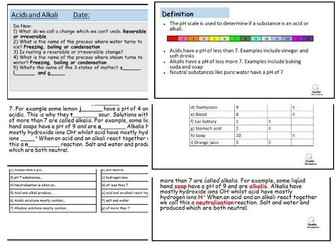
Engaging and Differentiated Acids and Alkalis Worksheets – With Answers! This comprehensive set includes 12 high-quality worksheets and 10 engaging activities designed to enhance students’ understanding of acids, alkalis, and neutralisation. Perfect for a range of abilities, including low-ability and SEN students, these resources support differentiated learning with clear explanations, structured tasks, and detailed answers for self-assessment or teacher use. What’s Included? Identify the Errors: Spot mistakes in substances incorrectly labelled as acids or alkalis. Introduction to Neutralisation: Fill-the-gap activity to reinforce key terms and concepts. Sentence Matching: Pair sentence starters with correct endings to build a deeper understanding of acids and alkalis. Categorisation: Use a results table to classify substances as strong acids, weak acids, strong alkalis, or weak alkalis. Labelling: Identify substances and label them correctly as acids or alkalis. Why Choose This Resource? Designed to align with key curriculum objectives, this resource offers varied, scaffolded activities to suit all learners. It’s ideal for classroom teaching, homework, or revision sessions, ensuring students can grasp and apply the essential concepts of acids and alkalis in an engaging way. Download today and take the stress out of lesson planning! For any questions or feedback, please contact us at qualityresources032@gmail.com
GCSE Osmosis Experiment Worksheets – Differentiated Activities with Model DataQuick View
Quality_Teaching_Resources

GCSE Osmosis Experiment Worksheets – Differentiated Activities with Model Data

(0)
Unlock the secrets of osmosis with this 22-slide lesson pack featuring 11 dynamic activities that will engage your students and deepen their understanding of the osmosis experiment. Perfect for GCSE students, this resource includes differentiated tasks designed to support low-attainers and SEN students, making complex concepts accessible and easy to grasp. What’s Included? Method Steps Ordering: Reinforce the scientific method by putting the steps of the osmosis experiment in the correct order. Change in Mass Calculations: Help students practice calculating changes in mass and percentage change, essential skills for understanding osmosis. Data Analysis: Stimulate critical thinking with questions about variables using model data to make abstract concepts tangible. Graph Preparation and Drawing: Guide students through drawing a graph using model data, with a model graph answer to aid comprehension. Conclusion Writing: Provide sentence starters to help students form well-rounded conclusions from their data. Why Choose This Resource? Differentiated worksheets ensure that all students, including those with SEN needs, can fully engage and succeed. Model data and example graphs allow students to focus on the key skills of data analysis and interpretation. Comprehensive coverage of the osmosis experiment, from data collection to drawing conclusions. Engaging activities that keep students motivated while reinforcing important scientific concepts. Grab your copy now and transform your osmosis lessons into a hands-on learning experience that your students will remember! For questions or feedback, contact us at **qualityresources032@gmail.com
GCSE Osmosis PowerPoint Lesson with Differentiated WorksheetsQuick View
Quality_Teaching_Resources

GCSE Osmosis PowerPoint Lesson with Differentiated Worksheets

(0)
This 19-slide PowerPoint on Osmosis is an engaging, complete lesson package designed to ensure that students grasp the key concepts of osmosis. It includes 8 activities, each accompanied by answers, making it easy to deliver interactive and insightful lessons. With differentiated tasks for low-attaining students, this resource caters to a wide range of learners. What’s Included? Describing Osmosis: Use key scientific terminology to describe the osmosis process. Sentence Completion: Finish the sentences to reinforce understanding of osmosis concepts. Error Correction: Correct mistakes in given scenarios to deepen comprehension. Data Calculation Task: Work with data to calculate changes in mass and percentage changes in mass during osmosis experiments. Why Choose This Resource? Differentiated worksheets tailored for low-attainers and SEN students, ensuring accessibility for all. Clear success criteria and a structured lesson flow to guide students through each concept. Complete lesson package with a PowerPoint presentation, worksheets, and activities for a comprehensive learning experience. Download now to help your students master the process of osmosis! For questions or feedback, contact us at qualityresources032@gmail.com
Engaging Water Treatment Worksheets: Differentiated for SEN/Low Ability StudentsQuick View
Quality_Teaching_Resources

Engaging Water Treatment Worksheets: Differentiated for SEN/Low Ability Students

(0)
Unlock the essential concepts of water treatment with this comprehensive set of 8 differentiated worksheets, designed to cater to all learning abilities, including SEN and low-ability students. These engaging activities will guide your students through the complexities of water treatment methods with clarity and ease. **What’s Included? Key Word Matching: Match key terms with their correct descriptions to reinforce understanding of water treatment processes. Mind the Gaps: Complete gap-fill exercises to deepen knowledge and retention of water treatment methods. Method Identification: Develop critical thinking skills by identifying the appropriate water treatment method for different scenarios. Correct Method Tick: Select the correct water treatment method from given options to solidify learning. **Why Choose This Resource? Differentiated worksheets that support students of all abilities, ensuring accessible learning for every student. Clear, comprehensive answers provided for independent learning and instant feedback. Engaging activities designed to simplify complex concepts and enhance student understanding of environmental science. Download now and provide your students with the tools they need to master water treatment methods. For any questions or feedback, contact us at **qualityresources032@gmail.com
Accessible Magnification Lesson: Tailored for SEN & Low-Ability StudentsQuick View
Quality_Teaching_Resources

Accessible Magnification Lesson: Tailored for SEN & Low-Ability Students

(0)
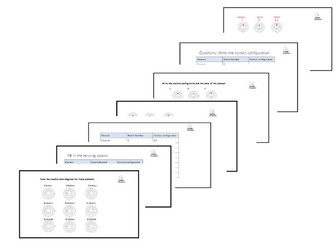
Transform your teaching of magnification with this complete, SEN-friendly lesson designed to simplify calculations for M (Magnification), I (Image Size), and A (Actual Size). Perfect for low-ability students, this engaging resource combines step-by-step guidance with interactive activities to build confidence and foundational skills in microscopy and measurement. What’s Included? Comprehensive PowerPoint and Worksheets with Answers: A full lesson plan with clear explanations and structured activities. Interactive Starter/Do Now: Multiple-choice questions to ensure an inclusive and engaging start to the lesson. Success Criteria and Equation Breakdown: Simple, scaffolded steps to demystify key calculations. Understanding Quiz: Students practise identifying correct equations to reinforce learning. Step-by-Step Calculation Practice: Includes conversions and guided questions to help students master each stage of the process. This resource ensures a supportive and accessible approach to magnification, giving students the tools to succeed. Download today and empower your students to achieve in science! For any questions or feedback, please contact us at qualityresources032@gmail.com
Complete GCSE Lesson: Neurons, Neurotransmitters, and Synaptic TransmissionQuick View
Quality_Teaching_Resources

Complete GCSE Lesson: Neurons, Neurotransmitters, and Synaptic Transmission

(0)
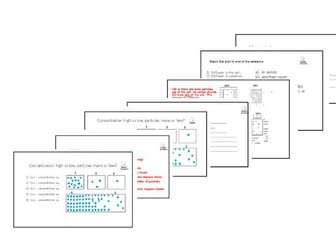
Engage and inspire your students with this 41-slide GCSE PowerPoint lesson on neurons, neurotransmitters, and synaptic transmission. Packed with 13 activities, differentiated tasks, and accompanying worksheets, this comprehensive resource ensures every learner can succeed, including low-attaining and SEN students. What’s Included? Interactive Starter/Do Now Activity: Get students engaged from the outset. Success Criteria: Clearly outlined goals to guide learning. Mini Quiz and Activities: Includes answers to promote independent learning and understanding. Differentiated Tasks: Scaffolded support for low-attaining and SEN students. Accompanying Worksheets: Designed to complement and reinforce key concepts. Activities Include: Gap Fill: Learn about nerve cell adaptations. Matching Adaptations: Identify and select correct special cell features. Sentence Completion: Explain key adaptations in detail. Keyword Challenge: Match descriptions to key terms. Synaptic Transmission Steps: Arrange the stages of synaptic transmission in the correct order. Why Choose This Resource? Thoughtfully differentiated to cater to all abilities. Includes everything you need to deliver an engaging and effective lesson. Clear, structured activities to build confidence and deepen understanding. Download now and help your students master the fascinating topic of neurons and synaptic transmission! For questions or feedback, contact us at qualityresources032@gmail.com
GCSE Differentiated Worksheets: Nerves, Synapses, and NeurotransmittersQuick View
Quality_Teaching_Resources

GCSE Differentiated Worksheets: Nerves, Synapses, and Neurotransmitters

(0)
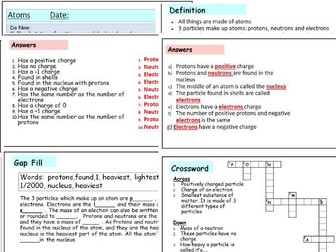
This 17-worksheet bundle is designed to help students develop a deep understanding of nerves, synapses, and neurotransmitters. With 12 engaging activities, including differentiated tasks for low-attaining and SEN students, this resource ensures learners at all levels can engage with and master the topic. What’s Included? Gap Fill Activities: Describe the adaptations of nerve cells (neurons) to reinforce key concepts. Adaptations Matching: Choose the correct adaptations from a list, focusing on special cells. Sentence Completion: Finish sentences to explain neuron adaptations and their functions. Keyword Identification: Match the correct keywords to their descriptions, building vocabulary and understanding. Sequencing Tasks: Put the steps for activating electrical impulses by neurotransmitters in the correct order to understand synaptic transmission. Why Choose This Resource? A range of differentiated activities tailored to all abilities, including SEN students. Answer sheets provided for self-assessment and quick feedback. Comprehensive coverage of crucial topics, from nerve adaptations to neurotransmitter activation. Download today to help your students grasp the essential concepts of the nervous system! For any questions or feedback, contact us at qualityresources032@gmail.com
GCSE Reflex Arc Lesson – Engaging Activities with Worksheets for All AbilitiesQuick View
Quality_Teaching_Resources

GCSE Reflex Arc Lesson – Engaging Activities with Worksheets for All Abilities

(0)
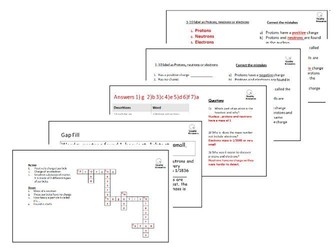
Unlock the science behind reflex arcs with this 37-slide lesson pack featuring 10 engaging activities designed to help your students understand this key biological process. Whether you’re teaching GCSE students or those with SEN/low ability, this resource offers a range of differentiated tasks that make learning accessible and engaging for all. What’s Included? Reflex Arc Ordering: A gap-fill exercise to help students understand and correctly order the stages of the reflex arc. Impulse Pathway Explanation: Finish the sentences to explain how nerve impulses travel through the body during a reflex response. Matching Exercise: Match the role of receptors, neurons, and effectors in the reflex process, reinforcing the relationships between different components. Key Word Identification: Write the correct key terms based on detailed descriptions to reinforce understanding of reflex pathways. Reflex Response Activation: Put the steps for activating the reflex response in the correct order to build a strong understanding of the process. Extended Writing Task: Apply knowledge with an extended writing task, where students explain a reflex scenario—such as the response to hot water being spilled on a leg. Why Choose This Resource? Differentiated worksheets cater to students of all abilities, including low-attainers/SEN students, ensuring everyone can engage with the content. Complete lesson flow with a starter activity, success criteria, and a mini quiz to check understanding. Extended writing task gives students an opportunity to apply their learning in a real-world context. Clear, scaffolded activities make complex concepts like the reflex arc easy to grasp. Enhance your lesson on the reflex arc and make learning both informative and interactive! For questions or feedback, contact us at **qualityresources032@gmail.com
GCSE Scalar & Vector Quantities: Differentiated Lesson & Worksheets for SEN/Low AbilityQuick View
Quality_Teaching_Resources

GCSE Scalar & Vector Quantities: Differentiated Lesson & Worksheets for SEN/Low Ability

(0)
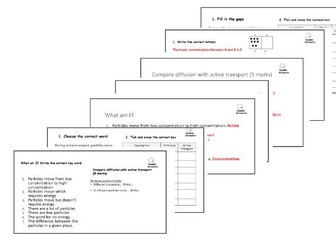
Equip your students with a deep understanding of scalar and vector quantities with this comprehensive lesson pack. Designed specifically for GCSE students, this resource is ideal for engaging all learners, especially those needing extra support. The visually appealing PowerPoint presentation and interactive worksheets combine to create an engaging and effective learning experience. What’s Included? Worksheet Features: Match the Term: Students match key terms with definitions to build foundational understanding. Multiple Choice Questions: Test comprehension of scalar and vector quantities. Gap Fill: Reinforce learning with key concept recall. Scalar or Vector Identification: Identify and categorize scalar vs. vector quantities. Answer Key: Provides instant feedback for self-correction. PowerPoint Features: Engaging Starter: Activate prior knowledge with a retrieval task. Essential Vocabulary & Key Info: Introduce core concepts clearly. Check for Understanding: True/False and Table Completion tasks to assess knowledge. Plenary Activity: A summary task for students to reflect and consolidate learning. Why Choose This Resource? Differentiated worksheets support students of all abilities, especially those requiring additional help. Interactive PowerPoint presentation keeps students engaged while reinforcing core concepts. Complete answers allow for immediate feedback and independent learning. Perfect for classroom use, homework assignments, or revision sessions. Help your students master scalar and vector quantities and give them the tools they need to succeed in their GCSEs. For any questions or feedback, contact us at **qualityresources032@gmail.com