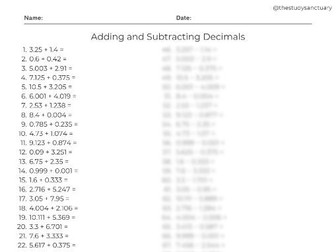
180 questions on adding, subtracting, multiplying and dividing decimals - up to 3 decimal places. Complete with a set of answers.
Aimed at lower-level GCSE and higher-level KS3 students.
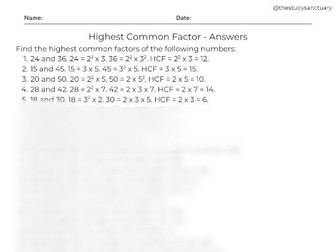
A worksheet for practicing finding the prime factors of numbers, highest common factors and lowest common multiples. There are 40 questions on each of the three topics. Complete with a set of answers and working.
Aimed at GCSE and some KS3 students.
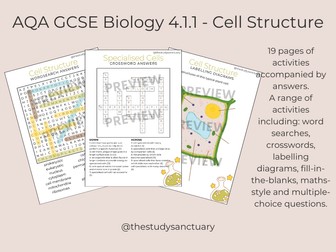
These pdf files include various activities to help GCSE students consolidate their knowledge of cell structures. The activities cover specialised cells and their adaptations and the structures of animal, plant and bacterial cells.
The activities include word searches, crosswords, labelling diagrams, fill-in-the-blanks, maths-style and multiple-choice questions. Answers also accompany them.
They can be used for lesson starters or integrated into the lesson. The activities will help students become comfortable using the prefixes centi, milli, micro and nano and help them master using standard form and the magnification equation.
They will be able to identify which sub-cellular structures belong to which cell types and describe the functions of these structures. They will also be able to describe the adaptations of a range of specialised cells and how these structures help the cells perform their functions. Sperm, muscle, nerve, root hair, xylem and phloem cells are covered.
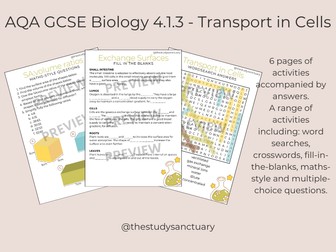
These pdf files include various activities to help GCSE students consolidate their knowledge of transport in cells. The activities cover diffusion, osmosis, active transport and exchange surfaces.
The activities include word searches, crosswords, fill-in-the-blanks, maths-style and multiple-choice questions. Answers also accompany them.
They can be used as lesson starters or integrated into the lesson. The activities will help students become comfortable calculating, comparing, and simplifying surface area volume ratios. They will also help students understand the adaptations of specific exchange surfaces, including the small intestine and lungs (in mammals), gills (in fish), and roots and leaves (in plants).
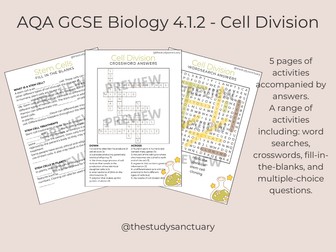
These pdf files include various activities to help GCSE students consolidate their knowledge of cell division. The activities cover the different stages of the cell cycle and stem cells.
They include word searches, crosswords, fill-in-the-blanks and multiple-choice questions. Answers also accompany them.
They can be used as lesson starters or integrated into the lesson. They will help students define keywords related to cell division and understand what occurs in each stage of the cell cycle. They will also learn about stem cells, where they are found (in plants and animals), and their potential uses.
90 long division questions. Most result in whole numbers but some have remainders in the answers. Most suited for GCSE but could also be appropriate for some KS3 students - depending on their abilities.
90 questions for practicing long multiplication. Includes questions with a range of difficulties: 2-digit × 1-digit, 2-digit × 2-digit, 3-digit × 1-digit, 3-digit × 2-digit and 4-digit × 1-digit.
Aimed at KS3/GCSE level.
90 addition and 90 subtraction questions, complete with a set of answers. Aimed at lower level GCSE. Includes numbers of up to 4 digits, 1 decimal place and negative numbers.
Good for students to practice using the column method.
 Quick View

 Quick View
 Quick View
 Quick View
 Quick View