These worksheets support students to edit and review their own work. CUPS is the editing acronym that stands for capitals, understanding, punctuation and spelling and ARMS is the reviewing acronym that stands for add, remove, move and substitute. These sheets can be used for self and peer editing and reviewing.
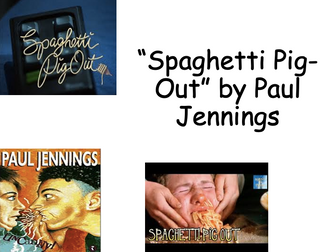
PowerPoint lesson. Australian children’s author, Paul Jennings, writes whacky short stories that were turned into a TV series in the 1990s called Round the Twist - all freely available on YouTube (link provided on lesson PowerPoint). This lesson looks at genre and the descriptive techniques used in ‘Spaghetti Pig Out’ and asks students to compare the short story to the TV version.
This is a series of 15 PowerPoint lessons with attached activities that takes students in in upper primary or lower secondary (low literacy) through all the skills and concepts needed to write a short horror narrative. The lessons take students from word level (nouns, verbs, adjectives etc.) through simple, compound and complex sentences and finally to descriptive writing techniques all with a coherent horror theme. The lessons support the scaffolded writing of a horror story - using hand-drawn horror playing cards and also provide editing and reviewing support using the acronym CUPS and ARMS. There is a writing skills checklist provided to ensure students have mastered their knowledge of grammar while constructing an effective horror narrative.
The PowerPoint and corresponding worksheets are numbered 1-15. The lessons are all structured with learning objectives, explicit vocabulary instruction and gradual release of responsibility with checking for understanding.
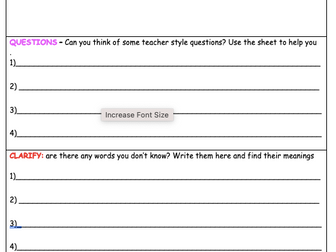
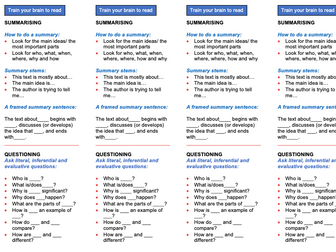
This booklet can be used to study any novel through the use of reciprocal reading. This is a powerful evidence-based strategy to support small group reading sessions. The teacher must model then support students to carry out group discussions using the strategies of summarising, questioning, carifying and predicting. When students are familiar with these strategies, they take on the role of a teacher and lead a discussion on what they have read. This booklet allows students to record their structured discussions. The booklet contains includes sentence starters for the 3 levels of questioning: literal, inferential and evaluative and a glossary for new vocabulary. This resource can be used in conjunction with my reciprocal role reading cards.
The roles in reciprocal reading are summariser, clarifyer, questioner and predictor. These cards can be printed double sided and laminated into book marks. They explain each role and provide sentence stems to support students in structured discussions about the text they are reading. They can be used with my generic novel study booklet.
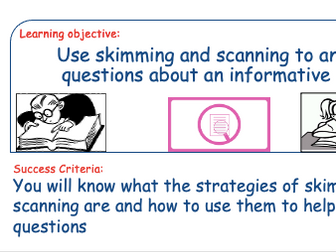
This is an edi PowerPoint lesson that practises the skills of skimming and scanning using a text from the 2016 Year 7 NAPLAN reading magazine. The lesson includes learning objectives, success criteria and explicit voacbulary instruction and is overall a fun text about penguins and their poo (or guano to be precise!)
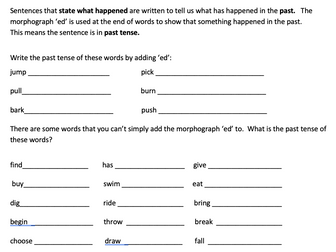
This 21 page grammar booklet is perfect for consolidating elements of grammar in upper primary to lower secondary. Students complete activities on sentence types, subject and predicate, verb tense, nouns, pronouns, articles and adjectives
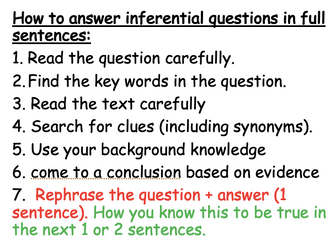
This edi PowerPoint reviews the skills of skimming and scanning and the steps for answering a literal question (see my other PowerPoints) and uses the model of gradual reliease (I do, we do, you do) to guide students towards independent practice when it comes to answering literal and inferential questions in a text. The lesson uses a Year 7 NAPLAN text on Freeganism - the text iis quite complex. Link provided.