Area and Circumference of Circles: Full GCSE Maths LessonQuick View
gareth116

Area and Circumference of Circles: Full GCSE Maths Lesson

(0)
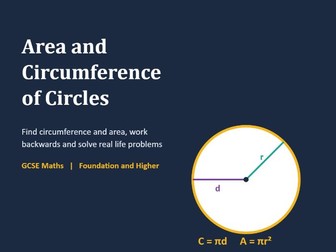
A complete, ready to teach lesson on the circumference and area of a circle for KS3 and GCSE maths (Foundation and Higher). 31 editable PowerPoint slides with teacher notes on every slide. The lesson builds step by step from the parts of a circle to exam style problems: Learning objectives (must, should, could) and a warm up on halving, squaring, square roots and rounding, with answers Key words: centre, radius, diameter and circumference, with a colour coded diagram What is π? Shown by unrolling the circumference against the diameter The formulas C = πd (or 2πr) and A = πr², and why area always uses the radius Circumference: worked examples from a diameter, from a radius and working backwards, then six “your turn” questions with answers Area: worked examples from a radius and from a diameter, answers in terms of π, and finding the radius from the area Practice set of six mixed questions, including a semicircle, with an answer slide Problem solving: how many turns a bike wheel makes in 1 km, and one large pizza or two small ones? Exam style question (4 marks) with a mark scheme Common mistakes, an exit ticket with answers, and a key points summary Every question has a worked answer slide, so it works for whole class teaching, cover lessons, intervention groups and revision. Radius, diameter and circumference are colour coded on every diagram. Fully editable, so you can adapt questions for your class. Ideal for Year 8, Year 9 and Year 10 (ages 12 to 16) and suitable for AQA, Edexcel and OCR GCSE Maths. If you find this useful, please leave a review. Also in the series: Pythagoras’ Theorem and Trigonometry: SOHCAHTOA.
Trigonometry SOHCAHTOA: Full GCSE Maths LessonQuick View
gareth116

Trigonometry SOHCAHTOA: Full GCSE Maths Lesson

(0)
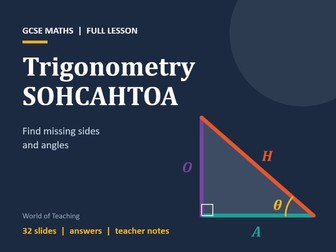
A complete, ready to teach lesson on right angled trigonometry (SOHCAHTOA) for GCSE maths, Foundation and Higher. 32 editable PowerPoint slides with teacher notes on every slide. The lesson takes students from labelling the sides to solving exam style problems: Learning objectives and a warm up starter on rearranging and rounding, with answers Naming the sides: opposite, adjacent and hypotenuse, with a labelling activity and answers SOHCAHTOA explained, plus a clear four step method (label, choose, substitute, solve) Finding a missing side, with three worked examples covering x on the top and x on the bottom Finding a missing angle using sin⁻¹, cos⁻¹ and tan⁻¹, with two worked examples Your turn and mixed practice questions, each with an answer slide Problem solving: angle of elevation and the ladder angle Exact trig values for Higher tier (0, 30, 45, 60 and 90 degrees) Exam style question with a mark scheme Common mistakes, an exit ticket with answers, and a key points summary Sides are colour coded the same way throughout (opposite, adjacent, hypotenuse), which really helps weaker students choose the right ratio. Every question has a worked answer slide, so it suits whole class teaching, cover lessons, intervention and revision. Fully editable. Ideal for Year 10 and Year 11 (ages 14 to 16) and suitable for AQA, Edexcel and OCR GCSE Maths. Follows on from our Pythagoras’ Theorem lesson.
Diffusion: AQA GCSE Biology Revision PowerPointQuick View
gareth116

Diffusion: AQA GCSE Biology Revision PowerPoint

(0)
A one topic revision PowerPoint for AQA GCSE Biology Paper 1, Cell Biology. Dense, visual summary slides that are ready to use for a recap starter, homework or a revision lesson. What it covers: What diffusion is: a clear definition with a labelled diagram Factors affecting the rate: concentration gradient, diffusion distance, temperature and surface area Diffusion in the body: gases in the lungs, glucose in the small intestine, muscles and the liver Surface area to volume ratio: worked cube examples and why large organisms need exchange surfaces Key vocabulary and exam tips Fully editable. Suitable for GCSE Biology and Combined Science (Foundation and Higher). Part of a six part Cell Biology revision set: Cell Structure, Microscopy, Diffusion, Osmosis, Active Transport, and Cell Division and Stem Cells. If you find it useful, please leave a review.
Microscopy: AQA GCSE Biology Revision PowerPointQuick View
gareth116

Microscopy: AQA GCSE Biology Revision PowerPoint

(0)
A one topic revision PowerPoint for AQA GCSE Biology Paper 1, Cell Biology. Dense, visual summary slides that are ready to use for a recap starter, homework or a revision lesson. What it covers: Light vs electron microscopes: magnification, resolution, cost and what each can show Magnification calculations: the I = M x A triangle, worked examples and converting between mm, micrometres and nanometres Electron microscopy: how TEM and SEM work and what they reveal Preparing and viewing slides: making a temporary mount of onion or cheek cells, step by step Key vocabulary and exam tips Fully editable. Suitable for GCSE Biology and Combined Science (Foundation and Higher). Part of a six part Cell Biology revision set: Cell Structure, Microscopy, Diffusion, Osmosis, Active Transport, and Cell Division and Stem Cells. If you find it useful, please leave a review.
How Hitler Became a Dictator 1933 to 1934: GCSE History Lesson PowerPointQuick View
gareth116

How Hitler Became a Dictator 1933 to 1934: GCSE History Lesson PowerPoint

(0)
A complete, ready to teach GCSE History lesson on how Hitler turned the chancellorship into a dictatorship in just 18 months. 35 fully editable slides with teacher notes on every slide. What it covers: Starter: a recap quiz on how Hitler became Chancellor, 8 key words and the four limits on his power in January 1933 The Reichstag Fire: what happened, the Reichstag Fire Decree, the debate over who started the fire and a chart of the March 1933 election The Enabling Act: how it was passed by 444 votes to 94, and what it allowed Hitler to do Removing opposition: Gleichschaltung, the banning of trade unions and parties, and the one party state by July 1933 The Night of the Long Knives: the threat from Röhm and the SA, the purge of June 1934 and its results Hitler becomes Führer: the death of Hindenburg, the army’s oath and the August 1934 plebiscite Tasks: quizzes with answers, an ordering task and a legal methods versus terror comparison Exam practice: a 12 mark “explain why” question, a levelled mark scheme, a model PEEL paragraph and common mistakes Plenary: an exit ticket with answers and a key points summary The exam question is written in the style of Edexcel GCSE History (Weimar and Nazi Germany, 1918 to 1939), and the lesson works just as well for AQA, OCR and Eduqas courses. This lesson follows on from “Hitler’s Rise to Power 1919 to 1933”, also available in my shop. If you find it useful, please leave a review.
AQA GCSE Biology Cell Biology Revision Bundle (6 PowerPoints)Quick View
gareth116

AQA GCSE Biology Cell Biology Revision Bundle (6 PowerPoints)

6 Resources
All six AQA GCSE Biology Paper 1 Cell Biology revision PowerPoints in one bundle, saving over 40% on buying them separately. Cell Structure Microscopy Diffusion Osmosis Active Transport Cell Division and Stem Cells Each PowerPoint is a dense, one topic revision summary with labelled diagrams, comparison tables, worked examples where relevant, key vocabulary and exam tips. Fully editable. Ideal for recap starters, homework, revision lessons and intervention for GCSE Biology and Combined Science (Foundation and Higher). Written for AQA, and useful for other exam boards too.
Hitler's Rise to Power 1919 to 1933: GCSE History Lesson PowerPointQuick View
gareth116

Hitler's Rise to Power 1919 to 1933: GCSE History Lesson PowerPoint

(0)
A complete, ready to teach GCSE History lesson on how Hitler went from leading a tiny Munich party to becoming Chancellor of Germany in January 1933. 35 fully editable slides with teacher notes on every slide. What it covers: Starter: a warm up quiz on the Weimar Republic, 8 key words and a big picture timeline from 1919 to 1933 The early Nazi Party, 1919 to 1923: the DAP, the 25 Point Programme, the SA and the Munich Putsch, and why its failure helped Hitler The lean years, 1924 to 1928: recovery under Stresemann, and how Hitler rebuilt the party The Depression, 1929 to 1932: the Wall Street Crash, rule by decree, a chart of Reichstag seats, why people voted Nazi and what the party promised each group How Hitler became Chancellor: the elections of 1932 and the deal between Papen, Hindenburg and Hitler in January 1933 Exam practice: a 12 mark “explain why” question, a levelled mark scheme, a model PEEL paragraph and common mistakes Plenary: an exit ticket with answers and a key points summary Quizzes and tasks are followed by answer slides, so the lesson works for whole class teaching, cover lessons or revision. The exam question is written in the style of Edexcel GCSE History (Weimar and Nazi Germany, 1918 to 1939), and the lesson works just as well for AQA, OCR and Eduqas courses. If you find it useful, please leave a review.
Cell Structure: AQA GCSE Biology Revision PowerPointQuick View
gareth116

Cell Structure: AQA GCSE Biology Revision PowerPoint

(0)
A one topic revision PowerPoint for AQA GCSE Biology Paper 1, Cell Biology. Dense, visual summary slides that are ready to use for a recap starter, homework or a revision lesson. What it covers: Eukaryotic vs prokaryotic cells: a side by side table of size, DNA, organelles and cell walls Animal and plant cells: organelles found in both, in animal cells only and in plant cells only, and their functions Bacterial cell structure: labelled diagram with circular DNA, plasmids, ribosomes, cell wall, capsule and flagellum Specialised cells: red blood cells, sperm cells, nerve cells, root hair cells, ciliated cells and palisade cells, and their adaptations Key vocabulary and exam tips Fully editable. Suitable for GCSE Biology and Combined Science (Foundation and Higher). Part of a six part Cell Biology revision set: Cell Structure, Microscopy, Diffusion, Osmosis, Active Transport, and Cell Division and Stem Cells. If you find it useful, please leave a review.
Active Transport: AQA GCSE Biology Revision PowerPointQuick View
gareth116

Active Transport: AQA GCSE Biology Revision PowerPoint

(0)
A one topic revision PowerPoint for AQA GCSE Biology Paper 1, Cell Biology. Dense, visual summary slides that are ready to use for a recap starter, homework or a revision lesson. What it covers: What active transport is: movement against a concentration gradient using carrier proteins and energy from respiration Diffusion, osmosis and active transport compared in one table Real examples: mineral ions into root hair cells, glucose absorption in the gut and more Evidence that active transport needs energy: metabolic poisons, lack of oxygen and temperature Key vocabulary and exam tips Fully editable. Suitable for GCSE Biology and Combined Science (Foundation and Higher). Part of a six part Cell Biology revision set: Cell Structure, Microscopy, Diffusion, Osmosis, Active Transport, and Cell Division and Stem Cells. If you find it useful, please leave a review.
Osmosis: AQA GCSE Biology Revision PowerPointQuick View
gareth116

Osmosis: AQA GCSE Biology Revision PowerPoint

(0)
A one topic revision PowerPoint for AQA GCSE Biology Paper 1, Cell Biology. Dense, visual summary slides that are ready to use for a recap starter, homework or a revision lesson. What it covers: What osmosis is: water moving from high to low water potential through a partially permeable membrane Osmosis and plant cells: turgid and plasmolysed cells, with diagrams Osmosis and animal cells: lysis, no change and crenation in dilute, isotonic and concentrated solutions Required practical: measuring osmosis in potato cylinders, from method to conclusion Key vocabulary and exam tips Fully editable. Suitable for GCSE Biology and Combined Science (Foundation and Higher). Part of a six part Cell Biology revision set: Cell Structure, Microscopy, Diffusion, Osmosis, Active Transport, and Cell Division and Stem Cells. If you find it useful, please leave a review.
Cell Division and Stem Cells: AQA GCSE Biology Revision PowerPointQuick View
gareth116

Cell Division and Stem Cells: AQA GCSE Biology Revision PowerPoint

(0)
A one topic revision PowerPoint for AQA GCSE Biology Paper 1, Cell Biology. Dense, visual summary slides that are ready to use for a recap starter, homework or a revision lesson. What it covers: The cell cycle: G1, S, G2 and mitosis, and why mitosis matters for growth and repair Stages of mitosis: prophase, metaphase, anaphase and telophase (PMAT), with diagrams Stem cells: embryonic, adult and plant meristem cells Medical uses of stem cells and the ethical issues Key vocabulary and exam tips Fully editable. Suitable for GCSE Biology and Combined Science (Foundation and Higher). Part of a six part Cell Biology revision set: Cell Structure, Microscopy, Diffusion, Osmosis, Active Transport, and Cell Division and Stem Cells. If you find it useful, please leave a review.