Test Your English KnowledgeQuick View
catalin1974

Test Your English Knowledge

(0)
This book is designed to assess and strengthen your command of the English language, a vital component of most competitive exams. You will encounter a variety of question types, including: Grammar and Usage Test your understanding of tenses, articles, prepositions, and sentence structure. Vocabulary Enhance your word power through questions on synonyms, antonyms, and idiomatic expressions. Error Spotting Identify grammatical errors in given sentences. Reading Comprehension Analyze short passages and answer related questions. Sentence Rearrangement & Cloze Tests Improve your logical flow and context understanding. Each question is multiple choice and designed to simulate real exam conditions. Read carefully, think critically, and aim for accuracy.
Ways in teaching drama to childrenQuick View
catalin1974

Ways in teaching drama to children

(0)
A book on ways of teaching drama to children is more than just a guide for theater games—it’s an invitation into a world where imagination becomes the bridge between learning and play. These books often begin by exploring the why: why drama matters in a child’s development. They delve into the transformative power of pretending, role-play, and storytelling, showing how drama can help children build empathy, communication, and confidence—skills that last far beyond the stage. As you turn the pages, you enter the classroom alongside the teacher. You see how to structure lessons that balance freedom with guidance. There are chapters on improvisation, where children are encouraged to think on their feet and respond in character to unexpected situations. Other sections might focus on story dramatization, where a familiar tale like The Three Little Pigs comes to life through costume boxes, expressive voices, and group collaboration. The book may also explore process drama, a method where there’s no script, no stage, and often no audience. Instead, teacher and students step into roles and explore imagined situations together—perhaps as villagers solving a mystery or as explorers in an unknown land. It’s learning through doing, through being. You’ll find practical tools, too—games that break the ice, exercises to warm up voices and bodies, and activities that foster trust and teamwork. The tone is usually supportive and encouraging, offering advice for managing different personalities, guiding shy children out of their shells, and keeping the enthusiastic ones focused and respectful. Importantly, these books usually emphasize that drama is not about producing “perfect” performances. It’s about process over product—about what children learn about themselves and others as they imagine, create, and express. By the end, a teacher—new or experienced—walks away not just with lesson plans, but with a deeper appreciation for drama as a powerful educational tool. It’s a celebration of childhood imagination and a call to nurture it through joyful, meaningful play.
Strategies of using drama in teaching vocabulary and grammarQuick View
catalin1974

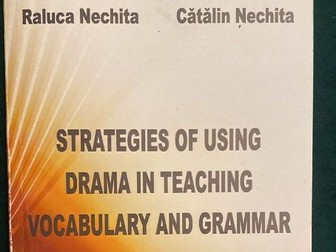
Strategies of using drama in teaching vocabulary and grammar

(0)
The document titled “Strategies of Using Drama in Teaching Vocabulary and Grammar” explores how drama-based activities can enhance language learning by engaging students physically, emotionally, and intellectually. It emphasizes that drama is not merely an entertaining classroom activity but a powerful pedagogical tool that facilitates deeper understanding and retention of vocabulary and grammar concepts. Drama is described as a creative activity involving movement, language, imagination, emotion, and social interaction to represent stories, situations, or acts. In the classroom, drama activities can range from simple games involving movement to extended projects culminating in public performances. Benefits of Drama in Language Learning Integrating drama into language teaching offers several advantages: Enhanced Engagement: Students become active participants, which increases motivation and interest. Improved Communication Skills: Through role-play and performance, students practice real-life communication scenarios. Contextual Learning: Drama provides context for vocabulary and grammar, aiding in comprehension and application. Emotional and Social Development: Students develop empathy by taking on different roles and perspectives.

Strategies of using drama in teaching vocabulary and grammarQuick View
catalin1974

Strategies of using drama in teaching vocabulary and grammar

(0)
The activities are suitable for learners at all levels and can be seamlessly integrated into existing curricula. Each exercise comes with clear instructions and practical advice, enabling teachers to implement them effectively in the classroom. The techniques focus on using drama to create meaningful communication tasks, thereby promoting active language use and learner engagement.
Ways in teaching drama to childrenQuick View
catalin1974

Ways in teaching drama to children

(0)
The document titled “Strategies of Using Drama in Teaching Vocabulary and Grammar” explores how drama-based activities can enhance language learning by engaging students physically, emotionally, and intellectually. It emphasizes that drama is not merely an entertaining classroom activity but a powerful pedagogical tool that facilitates deeper understanding and retention of vocabulary and grammar concepts. Drama is described as a creative activity involving movement, language, imagination, emotion, and social interaction to represent stories, situations, or acts. In the classroom, drama activities can range from simple games involving movement to extended projects culminating in public performances. Benefits of Drama in Language Learning Integrating drama into language teaching offers several advantages: Enhanced Engagement: Students become active participants, which increases motivation and interest. Improved Communication Skills: Through role-play and performance, students practice real-life communication scenarios. Contextual Learning: Drama provides context for vocabulary and grammar, aiding in comprehension and application. Emotional and Social Development: Students develop empathy by taking on different roles and perspectives.