
Social impact of the 1947 Partition of India.Quick View
History_Resource_Cupboard

Social impact of the 1947 Partition of India.

(0)
** KS3 History Lesson**: What was the social impact of the 1947 Partition of India? A fully resourced lesson exploring change and continuity through the Partition of India This engaging and ready-to-teach KS3 history lesson focuses on the 1947 Partition of India, exploring its social impact and long-term consequences. It develops students’ understanding of the historical concept of change and continuity while building knowledge of migration, empire, and decolonisation. Ideal for teaching topics on: Empire and independence Migration and conflict British India and the end of Empire Historical concepts: change and continuity, cause and consequence ** What’s included:** Clear explanations of key terms (Partition, Refugee, Migration, Independence, Social Impact) Background context on British rule in India and the creation of Pakistan Comprehension and inference questions with sentence starters Historical map analysis with migration patterns Testimony-based task: note-taking from a survivor of Partition Emphasis on how life changed for millions and how some tensions and divisions continued Extension tasks: quiz writing, correcting model answers, and deeper reflection Fully differentiated with built-in scaffolding ** Learning focus:** Apply change and continuity to real historical events Develop historical empathy and critical thinking Understand how Partition reshaped identities, borders, and communities National Curriculum links (KS3 History): Understand how Britain has influenced and been influenced by the wider world Study significant events and developments beyond 1066 that shaped the modern world Examine the impact of empire, including India and decolonisation Develop use of historical concepts such as change, continuity, cause, and consequence Interpret and evaluate historical sources and narratives Perfect for units on Migration Through Time, British Empire, or Post-WWII World History. Ideal for history departments focusing on inclusive and global curriculum.
KS3 - Holocaust Resistance Significance BundleQuick View
History_Resource_Cupboard

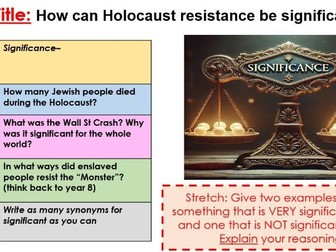
KS3 - Holocaust Resistance Significance Bundle

(0)
Jewish Resistance During the Holocaust | KS3 7-Lesson Scheme | Holocaust Education & Significance Overview This KS3 9-lesson scheme of work explores an often-overlooked aspect of Holocaust education: the many forms of Jewish resistance. Designed for use in secondary History, RE, or Citizenship, this enquiry-led unit goes beyond the traditional narrative of victimhood to examine stories of courage, resilience, and historical significance. Through a range of historical case studies, students will explore diverse forms of resistance—armed uprisings, partisan warfare, cultural preservation, spiritual defiance, and more. Each lesson is structured to develop critical thinking, empathy, and ethical reflection, giving pupils a deeper and more nuanced understanding of the Holocaust. This resource is ideal for Holocaust Memorial Day, genocide education, and broader units on 20th-century history or human rights**. This unit empowers pupils to understand that Jewish people were not passive victims, but active agents who resisted in courageous, creative, and diverse ways. It reframes Holocaust learning through a lens of dignity, complexity, and historical significance. Lesson Titles What was the Holocaust? How can Holocaust resistance be significant? How did resistance occur in the ghettos? How did Jewish people resist in concentration camps? How did partisans resist the Holocaust? How did Anne Frank resist the Holocaust? How significant was Jewish resistance to the Holocaust? What’s Included 9 fully resourced, ready-to-teach Holocaust lessons for KS3 Comprehensive scheme of learning (SoL) with: Lesson objectives and key enquiry questions Prior knowledge links and knowledge progression Key vocabulary and terminology Common misconceptions addressed Printable worksheets, primary sources, and extension activities AfL strategies embedded throughout: quizzes, discussion tasks, peer/self-assessment Opportunities for group work, debate, and reflective writing Teacher background notes to ensure confident, contextualised delivery Curriculum & Pedagogical Features Focus on the second-order concept of historical significance, using Christine Counsell’s 5 R’s (Remarkable, Remembered, Resonant, Resulting in change, and Revealing) Strong emphasis on enquiry-based learning and disciplinary thinking Builds on prior knowledge from KS3 Holocaust studies or WW2 context Structured to support long-term learning, literacy, and conceptual clarity Ideal For KS3 History, RE, and Citizenship teachers Teaching about Jewish resistance during the Holocaust Holocaust Memorial Day assemblies or themed weeks Supporting work on genocide, human rights, and ethical dilemmas Teachers looking for Ofsted-ready, knowledge-rich resources