KS1 Computing Scheme – iPads Only (6 Weeks) Ofsted-Ready | Teach Computing Aligned | No Laptops NeedQuick View
BareminimumBrilliance

KS1 Computing Scheme – iPads Only (6 Weeks) Ofsted-Ready | Teach Computing Aligned | No Laptops Need

(0)
Struggling to teach Computing in KS1 with only iPads? This 6-week Computing scheme is designed specifically for KS1 and mixed Year 1/2 classes, using iPads only – no laptops, no extra tech, no complicated setup. The unit is Ofsted-ready, clearly aligned to the National Curriculum for Computing, Teach Computing KS1 strands, EEF best practice, and online safety expectations. Each lesson is fully planned and structured, making it ideal for: Non-specialist Computing teachers Mixed-age KS1 classes Schools with limited technology access Subject leads needing clear intent, implementation and impact What’s included: ✔ A full 6-week Computing scheme of work (1 hour per week) ✔ In-depth, step-by-step lesson plans for every lesson ✔ Clear learning objectives, key knowledge and vocabulary ✔ iPad-only activities (no laptops required) ✔ Built-in online safety teaching ✔ Assessment opportunities and pupil voice prompts ✔ Suitable for Year 1, Year 2 and mixed KS1 classes Curriculum coverage includes: Understanding technology Using iPads safely Creating digital pictures Taking and using photos Giving simple instructions (early algorithms) Reviewing and explaining learning This resource focuses on explicit teaching, modelling, retrieval and vocabulary, ensuring pupils are genuinely learning computing concepts — not just “using apps”. Please note: This is an original scheme of work, aligned with but not affiliated with or endorsed by Teach Computing, the DfE, the EEF or Ofsted.
KS1 RE - Judaism: What do Jewish people believe about God? (Lesson 1)Quick View
BareminimumBrilliance

KS1 RE - Judaism: What do Jewish people believe about God? (Lesson 1)

(0)
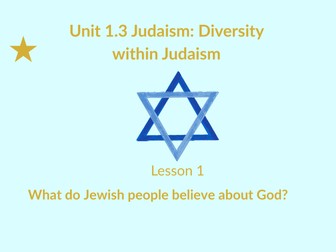
A complete KS1 RE lesson exploring the question: What do Jewish people believe about God? This lesson is fully aligned with the Northamptonshire Agreed Syllabus 2025-2030 and forms Lesson 1 of the unit Judaism: Diversity within Judaism. Pupils learn that Jewish people believe in one God, that God created the world, and that God cares about how people live. Respectful religious language is modelled throughout using the phrase “Jewish people believe…”. The lesson follows the syllabus’ woven-in approach to belief, expression and meaning, using structured talk and a single purposeful sorting activity to establish core understanding. Includes: • Full slideshow with clear learning objective and key learning • One sorting and discussion task sheet (the only sorting activity in the unit) • Widgit-compatible key vocabulary • Oracy question and stem sentence • Clear plenary and recap slide Designed for a 45–60 minute KS1 RE lesson. Low-prep, inclusive, and suitable for Years 1 and 2.
KS1 Adventure Story Writing Unit – Whistleless (Sentence-Driven Writing Sequence)Quick View
BareminimumBrilliance

KS1 Adventure Story Writing Unit – Whistleless (Sentence-Driven Writing Sequence)

(0)
This KS1 adventure story writing unit provides a complete, sentence-driven writing sequence based on a retelling of Whistleless. The unit follows a clear 8-day structure, guiding pupils from shared reading and oral rehearsal through explicit sentence-level grammar teaching and into independent writing. The focus is on retelling a familiar story so pupils can concentrate on sentence construction, grammar, and vocabulary without the cognitive load of inventing a new plot. What’s included: • A high-stretch model text for shared reading and deconstruction • Four clear plot points to structure the retelling • Explicit grammar teaching across the sequence: – adjectives for description – because sentences (cause and effect) – coordinated actions using and – exclamation sentences • Differentiated dictated sentences for Year 1 and Year 2 • Independent sentence prompts and dual-coded vocabulary support • Daily oracy and movement activities linked to the plot points • Dedicated lessons for independent writing, editing, and performance (reading aloud) This unit is suitable for: • Year 1 or mixed Year 1/2 classes • Teachers seeking a structured, practical approach to writing • Classrooms prioritising sentence quality, oral rehearsal, and independence The sequence supports KS1 National Curriculum expectations for writing, including sentence demarcation, coordination, subordination, vocabulary development, and spoken language. It is designed to be easy to teach, inspection-safe, and reusable. Ideal as a standalone unit or as part of a wider sentence-driven writing curriculum.
KS1 Letter Writing Unit - Sentence Driven Writing - Dear EarthQuick View
BareminimumBrilliance

KS1 Letter Writing Unit - Sentence Driven Writing - Dear Earth

(0)
This KS1 letter writing unit provides a complete, sentence-driven writing sequence built around the outcome ‘Dear Earth’. The unit follows an explicit 8-day structure, guiding pupils from experiencing a high-quality model text through sentence level grammar teaching and into independent writing. Each lesson is carefully structured to reduce cognitive load while maintaining high expectations for language and sentence construction. What’s included: • A high stretch model letter (used for reading, discussion and deconstruction) • Clear plot points to structure writing • Explicit grammar lessons (first person, adjectives, commands, questions) • Differentiated dictated sentences for Year 1 and Year 2 • Independent sentence prompts with dual coded vocabulary support • Daily oracy and movement routines to support sentence rehearsal • Dedicated lessons for independent writing, editing, and performance (reading aloud) This unit is designed for: • Year 1 or mixed Year 1/2 classes • Teachers who want clear, practical writing lessons without overcomplicated schemes • Classrooms focusing on sentence quality, spoken language, and independence The sequence supports National Curriculum expectations for KS1 writing, including sentence demarcation, sentence types, coordination, vocabulary development, and oral rehearsal. It is particularly well suited to teachers looking for a structured but flexible approach that can be reused across different writing outcomes. Ideal for whole class teaching, mixed-age classes, and schools prioritising explicit writing instruction.
Explorers of the Frozen World - Lesson 1 | Where in the World is the Arctic? (KS1 Geography)Quick View
BareminimumBrilliance

Explorers of the Frozen World - Lesson 1 | Where in the World is the Arctic? (KS1 Geography)

(0)
Take your class on an Arctic adventure in this ready-to-teach KS1 Geography lesson. Children locate the Arctic on a world map, learn the difference between continents and oceans, and discover why the North Pole is so cold. The lesson is hands-on, vocabulary-rich, and designed for 45–60 minutes — perfect for a busy week or a geography deep dive. What’s included Editable teaching slides (modelled steps – I Do → We Do → You Do) Pupil worksheet with LO & challenge Guillotine-friendly UK flag sheet Teacher modelling guidance Clear learning outcomes aligned with DfE & Ofsted expectations Learning Objective: To locate the Arctic on a world map and name the continents and oceans. Perfect for: Year 1 & Year 2 | KS1 Geography | Seasonal weather & continents topics
Explorers of the Frozen World - Lesson 2 | What is the Arctic like? (KS1 Geography)Quick View
BareminimumBrilliance

Explorers of the Frozen World - Lesson 2 | What is the Arctic like? (KS1 Geography)

(0)
Bring the Arctic to life in your classroom with this engaging KS1 Geography lesson from the Explorers of the Frozen World unit. Pupils explore what the Arctic looks and feels like through sensory language, video clips, and descriptive writing. The lesson builds vocabulary, develops observation skills, and supports cross-curricular links with English. What’s included Editable slides with full modelling (I Do → We Do → You Do) Pupil worksheet with picture box, sentence frames, and challenge task YouTube link for an age-appropriate Arctic clip Teacher notes for guided modelling Curriculum-aligned LO and word bank Learning Objective: To describe what the Arctic looks and feels like. Perfect for: Year 1 & Year 2 | KS1 Geography | Seasonal weather & place knowledge topics
Explorers of the Frozen World - Lesson 3 | Who were the first Arctic explorers? (KS1 History)Quick View
BareminimumBrilliance

Explorers of the Frozen World - Lesson 3 | Who were the first Arctic explorers? (KS1 History)

(0)
Step into the past with this ready-to-teach KS1 History lesson from the Explorers of the Frozen World unit. Children learn about the first Arctic explorers – Robert Peary and Matthew Henson – and discover how they reached the North Pole in 1909. Through storytelling, visuals and sequencing, pupils build a simple timeline and understand what life was like on a freezing expedition. What’s included Editable teaching slides (modelled sequence – I Do → We Do → You Do) Pupil worksheet with timeline template, sentence frames & challenge Guillotine-friendly explorer cut-outs Clear teacher modelling steps and vocabulary focus Curriculum-aligned LO and key question Learning Objective: To learn who the first Arctic explorers were and show what happened long ago. Perfect for: Year 1 & Year 2 | KS1 History | Significant People and Explorers topics
Explorers of the Frozen World -  Lesson 4 | How do we know what happened? (KS1 History)Quick View
BareminimumBrilliance

Explorers of the Frozen World - Lesson 4 | How do we know what happened? (KS1 History)

(0)
Turn your pupils into history detectives in this engaging KS1 History lesson from the Explorers of the Frozen World unit. Children explore how historians find out about the past using clues called evidence. They study photographs, diaries, maps and artefacts to decide what each one can tell us. The lesson develops disciplinary knowledge (“How do we know?”) while keeping tasks short, visual and age-appropriate. What’s included Editable slides with clear modelling (I Do → We Do → You Do) Pupil worksheet for line-matching and short written explanation Teacher notes with question prompts Vocabulary word bank with images Curriculum-aligned LO and challenge question Learning Objective: To understand that historians use sources and evidence to find out about the past. Perfect for: Year 1 & Year 2 | KS1 History | Evidence & Enquiry Skills topics
Explorers of the Frozen World - Lesson 5 | How have people adapted to life in the Arctic? (KS1 GeogrQuick View
BareminimumBrilliance

Explorers of the Frozen World - Lesson 5 | How have people adapted to life in the Arctic? (KS1 Geogr

(0)
Discover how people survive in one of the coldest places on Earth in this ready-to-teach KS1 Geography lesson from the Explorers of the Frozen World unit. Children learn how the Inuit have adapted their homes, clothes and food to the freezing Arctic climate. The lesson combines observation, comparison and explanation to deepen understanding of human–physical geography links. What’s included Editable teaching slides (modelling sequence – I Do → We Do → You Do) Pupil worksheet with draw-and-explain grid and challenge task Teacher modelling notes for key vocabulary Visual word bank with icons Curriculum-aligned LO and extension question Learning Objective: To understand how people’s homes, clothes and food help them live in a freezing climate. Perfect for: Year 1 & Year 2 | KS1 Geography | Human–Physical Geography | Seasonal Weather Topics
Explorers of the Frozen World -  Lesson 6 | Who really reached the North Pole? (KS1 History)Quick View
BareminimumBrilliance

Explorers of the Frozen World - Lesson 6 | Who really reached the North Pole? (KS1 History)

(0)
Investigate one of history’s biggest Arctic mysteries in this ready-to-teach KS1 History lesson from the Explorers of the Frozen World unit. Children explore evidence about Robert Peary, Matthew Henson and Frederick Cook to decide who might have reached the North Pole first. They weigh up clues, share opinions and explain their thinking just like real historians. What’s included Editable teaching slides (I Do → We Do → You Do) Pupil worksheet with evidence table, opinion writing frame & challenge question Teacher notes for guided discussion Visual vocabulary word bank with icons Curriculum-aligned LO and clear key question Learning Objective: To decide who might have reached the North Pole first by looking at evidence. Perfect for: Year 1 & Year 2 | KS1 History | Significant People & Historical Enquiry Topics
Explorers of the Frozen World - Lesson 7 | How is our weather different from the Arctic? (KS1 GeograQuick View
BareminimumBrilliance

Explorers of the Frozen World - Lesson 7 | How is our weather different from the Arctic? (KS1 Geogra

(0)
Compare climates and practise real-world geography skills in this ready-to-teach KS1 lesson from the Explorers of the Frozen World unit. Pupils become weather scientists—observing the conditions outside their classroom, recording data, and comparing it with weather in the Arctic. The lesson is practical, cross-curricular and ideal for introducing simple fieldwork and data collection. What’s included Editable slides (I Do → We Do → You Do structure) Pupil worksheet with observation table, sentence frames & challenge Teacher notes for outdoor mini-fieldwork Visual vocabulary word bank with icons Curriculum-aligned LO and enquiry question Learning Objective: To observe and record weather and compare it with the Arctic. Perfect for: Year 1 & Year 2 | KS1 Geography | Weather & Seasonal Changes Topics
Explorers of the Frozen World - Lesson 8 | What have we learned about the Arctic? (KS1 Geography & HQuick View
BareminimumBrilliance

Explorers of the Frozen World - Lesson 8 | What have we learned about the Arctic? (KS1 Geography & H

(0)
Celebrate learning and assess understanding with this end-of-unit review lesson from the Explorers of the Frozen World series. Pupils recall key facts about the Arctic’s people, weather, explorers and environment through discussion, quizzes and a creative knowledge-map task. It’s light, visual and perfect for the final week of term or as a retrieval lesson before starting a new topic. What’s included Editable teaching slides (recap quiz + knowledge-map task) Pupil worksheet template for knowledge mapping & reflection writing Teacher notes with quick-fire retrieval questions Visual vocabulary word bank with icons Curriculum-aligned LO and challenge prompt Learning Objective: To recall and explain what we have learned about the Arctic. Perfect for: Year 1 & Year 2 | KS1 Geography & History | Retrieval Practice | End-of-Unit Assessment
Explorers of the Frozen World - Complete 8-Lesson Unit (KS1 Geography & History)Quick View
BareminimumBrilliance

Explorers of the Frozen World - Complete 8-Lesson Unit (KS1 Geography & History)

8 Resources
Take your class on a cross-curricular Arctic adventure with this fully resourced 8-lesson KS1 unit. Explorers of the Frozen World combines Geography and History through exciting, knowledge-rich lessons that build curiosity, vocabulary and understanding of how people live and explore in one of the coldest places on Earth. Each lesson follows a clear I Do → We Do → You Do sequence with editable slides, printable worksheets, challenge questions and vocabulary word banks. Perfect for busy teachers who want high-impact lessons with minimal prep. Lessons included 1️⃣ Where in the world is the Arctic? (map work) 2️⃣ What is the Arctic like? (description & senses) 3️⃣ Who were the first Arctic explorers? (timeline) 4️⃣ How do we know what happened? (evidence & sources) 5️⃣ How have people adapted to life in the Arctic? (Inuit focus) 6️⃣ Who really reached the North Pole? (historical enquiry) 7️⃣ How is our weather different from the Arctic? (fieldwork & comparison) 8️⃣ What have we learned about the Arctic? (review & assessment) Includes: ✅ Editable teaching slides ✅ Pupil worksheets & challenges ✅ Guillotine-friendly resources ✅ WIGIT vocabulary sheets (History + Geography) ✅ Clear LOs & curriculum alignment Learning Focus: Geography – location, climate, human/physical features History – significant people, evidence, timelines, enquiry Perfect for: Year 1 & Year 2 | KS1 Geography & History | Seasonal Weather & Explorers Topics
KS1 RE – The Good Shepherd | God is loving and caring (Lesson 1)Quick View
BareminimumBrilliance

KS1 RE – The Good Shepherd | God is loving and caring (Lesson 1)

(0)
**A complete KS1 RE lesson fully aligned with the Northamptonshire Agreed Syllabus 2025–2030. ** This lesson explores the Bible story of The Good Shepherd and helps pupils understand that Christians believe God is loving and caring. The activities and oracy prompts reflect the syllabus’ woven-in approach to belief, expression and meaning, supporting pupils to talk, think and reflect about what Christians believe God is like. **Includes: ** • Full slideshow with learning objective and key points • Printable task sheet • Widget word bank • Oracy-based discussion question and stem sentence • Clear purpose statement for teacher understanding Designed for a 45–60 minute RE session. All materials are ready to use and match the remaining lessons in Unit 1.2 for a consistent, low-prep, syllabus-aligned experience. Part of Bare Minimum Brilliance Unit 1.2 – What Do Christians Say God Is Like? Suitable for KS1 (Years 1 and 2) under the Northamptonshire Agreed Syllabus 2025–2030.
KS1 RE – The Prodigal Son | God welcomes and forgives (Lesson 3)Quick View
BareminimumBrilliance

KS1 RE – The Prodigal Son | God welcomes and forgives (Lesson 3)

(0)
**A complete KS1 RE lesson fully aligned with the Northamptonshire Agreed Syllabus 2025–2030. ** This lesson explores the Bible story of The Prodigal Son and helps pupils understand that Christians believe God welcomes people back and forgives them when they are sorry. The activities and oracy prompts reflect the syllabus’ woven-in approach to belief, expression and meaning, supporting pupils to talk, think and reflect about what Christians believe God is like. **Includes: ** • Full slideshow with learning objective and key points • Printable task sheet • Widget word bank • Oracy-based discussion question and stem sentence • Clear purpose statement for teacher understanding Designed for a 45–60 minute RE session. All materials are ready to use and match the remaining lessons in Unit 1.2 for a consistent, low-prep, syllabus-aligned experience. Notes (optional) Part of Bare Minimum Brilliance Unit 1.2 – What Do Christians Say God Is Like? Suitable for KS1 (Years 1 and 2) under the Northamptonshire Agreed Syllabus 2025–2030.
KS1 RE – The Creation Story | God is the Creator (Lesson 5)Quick View
BareminimumBrilliance

KS1 RE – The Creation Story | God is the Creator (Lesson 5)

(0)
**A complete KS1 RE lesson fully aligned with the Northamptonshire Agreed Syllabus 2025–2030. ** This lesson explores the Bible story of The Creation Story and helps pupils understand that Christians believe God made the world and everything in it. The activities and oracy prompts reflect the syllabus’ woven-in approach to belief, expression and meaning, supporting pupils to talk, think and reflect about what Christians believe God is like. **Includes: ** • Full slideshow with learning objective and key points • Printable task sheet (My Creation Museum Poster) • Widget word bank • Oracy-based discussion question and stem sentence • Clear purpose statement for teacher understanding Designed for a 45–60 minute RE session. All materials are ready to use and match the remaining lessons in Unit 1.2 for a consistent, low-prep, syllabus-aligned experience. Part of Bare Minimum Brilliance Unit 1.2 – What Do Christians Say God Is Like? Suitable for KS1 (Years 1 and 2) under the Northamptonshire Agreed Syllabus 2025–2030.
KS1 RE – What Do Christians Say God Is Like? Recap and Reflection (Lesson 6)Quick View
BareminimumBrilliance

KS1 RE – What Do Christians Say God Is Like? Recap and Reflection (Lesson 6)

(0)
**A complete KS1 RE lesson fully aligned with the Northamptonshire Agreed Syllabus 2025–2030. ** This final lesson helps pupils bring together their learning from the whole unit What Do Christians Say God Is Like? Children recall five Bible stories—The Good Shepherd, The Lost Sheep, The Prodigal Son, Calming the Storm and The Creation Story—and match each one to what it teaches Christians about God. Through reflection and oracy, pupils identify that Christians believe God is loving, forgiving, welcoming, powerful and the Creator. **Includes: ** • Full slideshow with learning objective and key points • Printable recap and reflection sheet (matching activity) • Widget word bank • Oracy-based discussion question and stem sentence • Clear purpose statement for teacher understanding Designed for a 45–60 minute RE session. All materials are ready to use and match the remaining lessons in Unit 1.2 for a consistent, low-prep, syllabus-aligned experience. Part of Bare Minimum Brilliance Unit 1.2 – What Do Christians Say God Is Like? Suitable for KS1 (Years 1 and 2) under the Northamptonshire Agreed Syllabus 2025–2030.
KS1 RE – The Lost Sheep | God forgives (Lesson 2)Quick View
BareminimumBrilliance

KS1 RE – The Lost Sheep | God forgives (Lesson 2)

(0)
**A complete KS1 RE lesson fully aligned with the Northamptonshire Agreed Syllabus 2025–2030. ** This lesson explores the Bible story of The Lost Sheep and helps pupils understand that Christians believe God forgives and cares for everyone. The activities and oracy prompts reflect the syllabus’ woven-in approach to belief, expression and meaning, encouraging children to talk, think and reflect about what Christians believe God is like. Includes: • Full slideshow with learning objective and key points • Printable task sheet • Widget word bank • Oracy-based discussion question and stem sentence • Clear purpose statement for teacher understanding Designed for a 45–60 minute RE session. All materials are ready to use and match the remaining lessons in Unit 1.2 for a consistent, low-prep, syllabus-aligned experience. Part of Bare Minimum Brilliance Unit 1.2 – What Do Christians Say God Is Like? Suitable for KS1 (Years 1 and 2) under the Northamptonshire Agreed Syllabus 2025–2030.
Title   KS1 RE Unit 1.2 – What Do Christians Say God Is Like? (6 Complete Lessons + Resources)Quick View
BareminimumBrilliance

Title KS1 RE Unit 1.2 – What Do Christians Say God Is Like? (6 Complete Lessons + Resources)

6 Resources
Description A complete KS1 RE unit fully aligned with the Northamptonshire Agreed Syllabus 2025–2030. This 6-lesson pack explores the question “What Do Christians Say God Is Like?” through a series of engaging Bible stories, oracy-based discussions and creative, low-prep tasks. The unit follows the syllabus’ woven-in approach to belief, expression and meaning, helping children talk, think and reflect about what Christians believe. Included lessons: 1️⃣ The Good Shepherd – God is loving and caring 2️⃣ The Lost Sheep – God forgives 3️⃣ The Prodigal Son – God welcomes and forgives 4️⃣ Calming the Storm – God is powerful and protective 5️⃣ The Creation Story – God is the Creator 6️⃣ Recap and Reflection – What Christians believe about God Each lesson includes: • Full slideshow with learning objective and key points • Printable task sheet or activity • Widget word bank • Oracy question and stem sentence • Clear purpose statement for teacher understanding Perfect for Years 1 and 2 (45–60 minutes per lesson). All materials are ready to use and visually consistent across the series, ideal for teachers following the new Northamptonshire Syllabus or adapting for other KS1 Christianity units.
KS1 RE – Calming the Storm | God is powerful and protective (Lesson 4)Quick View
BareminimumBrilliance

KS1 RE – Calming the Storm | God is powerful and protective (Lesson 4)

(0)
**A complete KS1 RE lesson fully aligned with the Northamptonshire Agreed Syllabus 2025–2030. ** This lesson explores the Bible story of Jesus Calming the Storm and helps pupils understand that Christians believe God is powerful and can protect people when they are afraid. The activities and oracy prompts reflect the syllabus’ woven-in approach to belief, expression and meaning, encouraging pupils to talk, think and reflect about what Christians believe God is like. **Includes: ** • Full slideshow with learning objective and key points • Printable task sheet (Storm in a Bottle activity) • Widget word bank • Oracy-based discussion question and stem sentence • Clear purpose statement for teacher understanding Designed for a 45–60 minute RE session. All materials are ready to use and match the remaining lessons in Unit 1.2 for a consistent, low-prep, syllabus-aligned experience. Part of Bare Minimum Brilliance Unit 1.2 – What Do Christians Say God Is Like? Suitable for KS1 (Years 1 and 2) under the Northamptonshire Agreed Syllabus 2025–2030.
EYFS Oracy Launch Kit | Early Talk & Listening Through Play | Ofsted & EEF AlignedQuick View
BareminimumBrilliance

EYFS Oracy Launch Kit | Early Talk & Listening Through Play | Ofsted & EEF Aligned

(0)
**BARE MINIMUM BRILLIANCE · EYFS ORACY LAUNCH KIT ** A six-week framework for building confident communicators in Early Years – designed to make talk visible, joyful and easy to evidence. This ready-to-teach pack helps you embed purposeful speaking and listening into daily EYFS practice through songs, play, and shared reflection. WHAT’S INCLUDED • 6 weeks of editable teaching slides (simple visuals, clear structure) • 6 printable A4 activity sheets for small group work or displays • Ofsted & EEF alignment front sheet for your inspection file • Key vocabulary, talk prompts, and reflection stems • Teacher guidance for modelling and extending talk ** WEEKLY FOCUS AREAS** 1 Listening Ears On 2 Taking Turns in Talk 3 Using New Words in Play 4 Sharing Ideas and Feelings 5 Speaking to a Group 6 Celebrating Our Voices WHY PRACTITIONERS LOVE IT ✔ Fully planned and zero-prep ✔ Supports the Communication & Language EYFS goals ✔ Evidence for Intent → Implementation → Impact ✔ Calm, consistent routines that develop talk confidence ✔ Flexible for whole-class carpet time or small group sessions RESEARCH-INFORMED DESIGN Aligned with: Ofsted Early Years Inspection Handbook (2023) EEF Guidance Report: Preparing for Literacy (2018) Communication & Language Early Learning Goals (DfE, 2021) Oracy development principles from Voice 21 and the EEF Early Language Toolkit USE IN: • Daily carpet sessions • Circle time • Role-play and small group interventions Bare Minimum Brilliance Zero-prep teaching resources that make you look brilliant. EYFS, Nursery, Reception, Early Years, Communication and Language, Oracy, Speaking and Listening, Vocabulary, Turn Taking, PSHE, Ofsted, EEF, Inspection Ready, Language Development, Talk Partners