Cambridge IGCSE Chemistry 0620 - Revision notes for all 19 ChaptersQuick View
LoukiaLouka

Cambridge IGCSE Chemistry 0620 - Revision notes for all 19 Chapters

(0)
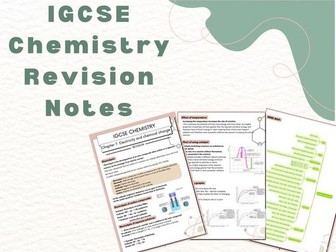
IGCSE Chemistry Revision Notes Overview (Syllabus 0620, 2026–2028) This collection of revision notes includes a dedicated and structured document for each chapter of the Cambridge IGCSE Chemistry syllabus (0620). Each document is carefully crafted to match the official syllabus content and learning objectives, ensuring students are well-prepared for exams. Every chapter’s revision note includes: Clear definitions of key terms and concepts. Diagrams, mind maps, and visual summaries to aid understanding. Explanations of core principles (e.g., kinetic particle theory, gas laws, reactions). Worked examples (e.g., calculating relative molecular mass). Links to real-world applications of chemical phenomena. Summary tables for quick reference and comparison. Focus on required practical knowledge and theory integration. The included chapters are: Chapter 1: States of Matter Chapter 2: Atoms and Elements Chapter 3: Atoms Combining Chapter 4: Reacting Masses and Chemical Equations Chapter 5: Using Moles Chapter 6: Redox Reactions Chapter 7: Electricity and Chemical Change Chapter 8: Energy Changes in Reactions Chapter 9: The Rate of Reaction Chapter 10: Reversible Reactions and Equilibrium Chapter 11: Acids, Bases, and Salts Chapter 12: The Periodic Table Chapter 13: The Behaviour of Metals Chapter 14: Extracting and Using Metals Chapter 15: Chemistry of the Environment Chapter 16: Organic Chemistry Chapter 17: Polymers Chapter 18: Separation and Purification Chapter 19: Experiments and Tests in the Lab For instance, Chapter 7: Electricity and Chemical Change covers: Key terms like electrolyte, electrode, anode, and cathode. The process of electrolysis in molten and aqueous ionic compounds. Examples such as the electrolysis of molten PbBr₂ and aqueous NaCl. Applications including electroplating, purification of copper, and electrolysis of brine. A final mind map summarizing the main ideas. These revision notes are ideal for students aiming for a thorough understanding of each topic in a concise, accessible format, while staying aligned with Cambridge International standards. To receive a sample (for no additional charge), email ‘‘Chemistry Revision notes’’ to lousi_95@hotmail.com
IGCSE Chemistry Presentation SetQuick View
LoukiaLouka

IGCSE Chemistry Presentation Set

(0)
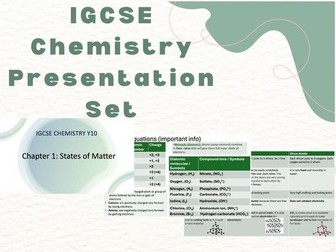
This collection of classroom presentations is designed to align with the Cambridge IGCSE Chemistry syllabus (0620). Each presentation corresponds to one chapter of the course and delivers key content in a clear, visual, and student-friendly format to support both teaching and revision. Every chapter presentation includes: Easy-to-read slides with clear definitions of important chemistry terms. Illustrated explanations of core scientific principles (e.g. kinetic theory, changes of state, gas laws). Step-by-step processes and visual models to explain complex ideas. Real-world examples that connect chemistry to everyday life. Keywords, diagrams, and simple summaries that make learning interactive and engaging. Focus on exam-relevant content and required practical knowledge. The included chapters are: Chapter 1: States of Matter Chapter 2: Atoms and Elements Chapter 3: Atoms Combining Chapter 4: Reacting Masses and Chemical Equations Chapter 5: Using Moles Chapter 6: Redox Reactions Chapter 7: Electricity and Chemical Change Chapter 8: Energy Changes in Reactions Chapter 9: The Rate of Reaction Chapter 10: Reversible Reactions and Equilibrium Chapter 11: Acids, Bases, and Salts Chapter 12: The Periodic Table Chapter 13: The Behaviour of Metals Chapter 14: Extracting and Using Metals Chapter 15: Chemistry of the Environment Chapter 16: Organic Chemistry Chapter 17: Polymers Chapter 18: Separation and Purification Chapter 19: Experiments and Tests in the Lab For instance, Chapter 1: States of Matter covers: The kinetic particle theory and how particles behave in solids, liquids, and gases. Changes of state, such as melting, boiling, freezing, and condensation. How heating and cooling curves work and what they show about energy. Gas behavior, including the relationship between temperature, volume, and pressure. Diffusion and how it’s affected by temperature and particle mass. Clear examples like the diffusion of ammonia and hydrogen chloride gases. A complete, visually guided explanation of each topic with classroom-friendly slide flow. These presentations are ideal for helping students visualize and understand key chemistry concepts in a step-by-step, engaging way—perfect for both Year 10 and Year 11 learners. If you’d like to receive a free sample presentation, feel free to email me at lousi_95@hotmail.com.