Adjectives WorksheetsQuick View
TheGreenLinguomancer

Adjectives Worksheets

(0)
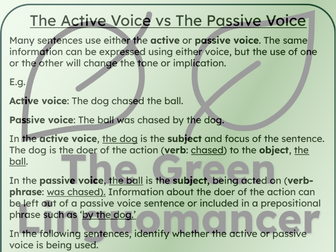
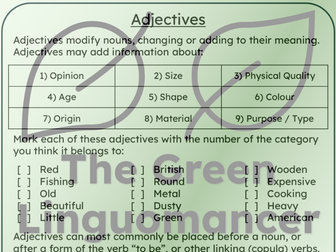
This is a comprehensive, multi-page worksheet on adjectives, designed for educational use. The material is structured to help students understand and identify various types of adjectives through clear explanations and practical exercises. It covers: Definition & Categories: Adjectives modify nouns. * The worksheet includes a matching exercise to categorize adjectives by opinion, size, shape, colour, and more. Placement: * Attributive: Placed before a noun. * Predicative: Placed after a linking verb like “to be”. * Postpositive: Placed after the noun. Forms: * Absolute, Comparative, and Superlative * Adjectives that change form or use adverbs like “more” or “most” to compare. Other Types: * Compound: Multiple words, often hyphenated. * Possessive: Show possession. * Demonstrative: Specify a noun (e.g., this, that). * Proper: Derived from proper nouns, with a capital letter. * Participial: From verb participles (e.g., -ed, -ing). * Interrogative: Used in questions (e.g., what, which). * Distributive: Refer to a singular noun in a group (e.g., each, every). Activities: The worksheet includes highlighting exercises, a fill-in-the-blank table , a word search , and a story analysis task.
The Active Voice vs The Passive Voice - Macro enabled, interactive presentationQuick View
TheGreenLinguomancer

The Active Voice vs The Passive Voice - Macro enabled, interactive presentation

(0)
This resource is a comprehensive PowerPoint presentation designed to teach and practice the active and passive voice. The presentation, titled “The Active Voice VS The Passive Voice,” begins with a clear explanation of both concepts, using the example sentence “The dog chased the ball” to illustrate the differences in subject, verb, and object placement for each voice. **The PowerPoint is macro enabled and will not function correctly if you do not allow macros when you open the file. ** The presentation includes four activities to reinforce learning: Identifying the Voice: A series of example sentences where students must determine whether the active or passive voice is being used. Re-writing Sentences: Exercises that challenge students to convert sentences from one voice to the other. Matching Game: A game where students match key grammatical terms to their definitions. Word Search: A vocabulary word search featuring terms such as “subject,” “verb,” “object,” “passive,” and “active”. This resource is suitable for individual or group use in a classroom setting. This is my first macro enabled powerpoint presentation. I have tested it many times, but if you find a glaring bug, please let me know. I will correct the issue as soon as possible and email you a new copy.
The Active and Passive Voice WorksheetsQuick View
TheGreenLinguomancer

The Active and Passive Voice Worksheets

(0)
Active & Passive Voice Worksheets (KS3) This resource is a 4-page worksheet set for Key Stage 3 (ages 11-14) students, designed to teach and practice the active and passive voice. What’s Included: Introduction: Explains active and passive voice with examples, focusing on how choosing a voice changes a sentence’s emphasis. Identification Practice: Students identify active or passive voice in 10 sentences. Includes a challenge to highlight sentence components (subjects, verbs, objects, prepositional phrases). Conversion Exercises: Practice converting 5 active sentences to passive, and 5 passive sentences to active. Vocabulary Activities: A matching activity for key grammar terms and a word search to reinforce vocabulary. Analysis Task: Students analyze sentences to understand why a particular voice might have been used, considering tone and implication. This worksheet aims to provide clear instruction and varied practice for understanding and using active and passive voice in English.