T Level Science - Biology A1.2 Eukaryotic cell ultrastructureQuick View
adharafardhin

T Level Science - Biology A1.2 Eukaryotic cell ultrastructure

(0)
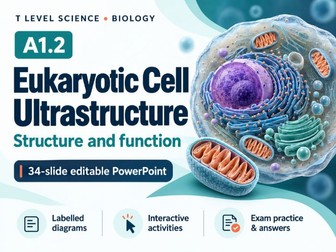
T Level Science Biology A1.2 PowerPoint on eukaryotic cell ultrastructure, with labelled diagrams, interactive activities and exam practice. This editable, 34-slide teaching resource covers Pearson T Level Science Core Biology topic A1.2 within A1: Cells and Tissues. It helps students identify cellular components, describe their ultrastructure and explain how their structures support their functions. Content covered Cell-surface membrane, cytoplasm and cytosol, nucleus, nuclear envelope, nucleolus, 80S ribosomes, mitochondria, rough and smooth endoplasmic reticulum, Golgi apparatus and vesicles, lysosomes, chloroplasts, cell walls, large permanent vacuoles, cytoskeleton and centrioles. What is included? Labelled cell and organelle diagrams alongside clear structure and function explanations. A retrieval starter revisiting A1.1, with answers. Short checkpoints to assess understanding throughout the topic. A paired sequencing activity following the production and export of a secreted protein. An organelle identification activity with answers and extension questions. A structure and function matching activity. An applied biology scenario comparing cells using evidence about their organelles. Exam practice with model responses and suggested mark points. Command-word guidance, a mini exam sprint, misconception checks and an exit ticket. Teacher notes containing activity instructions, answers, suggested timings and scientific sources. Classroom use Suitable for teaching across approximately two 60-minute sessions, with flexibility to adjust the pace for your learners. Selected slides can also support revision and exam preparation. Students can complete the activities using notebooks or paper, with optional mini-whiteboards. No separate activity worksheets are required. The PowerPoint is editable, allowing teachers to adapt the content and timings. Practice questions and suggested mark schemes are teacher-created rather than official Pearson assessment materials.
T Level Science - Biology: A1.1 Prokaryotic & Eukaryotic CellsQuick View
adharafardhin

T Level Science - Biology: A1.1 Prokaryotic & Eukaryotic Cells

(0)
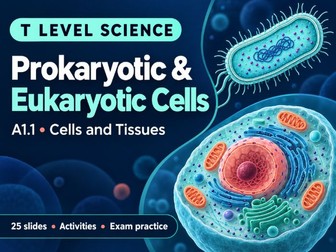
T Level Biology A1.1: teach prokaryotic and eukaryotic cells with an editable PowerPoint, microscopy images, activities and exam-style questions. Save planning time with this 25-slide teaching resource supporting Pearson T Level Science specification point A1.1, within Cells and Tissues. Students explore cell structure, compare prokaryotic and eukaryotic organisation, and use evidence to explain their conclusions. Content covered Shared cell features: cell-surface membrane, cytoplasm, ribosomes and DNA. Key differences in nuclei, DNA organisation, membrane-bound organelles and typical cell size. Eukaryotic groups: animals, plants, fungi and protists. Bacteria and Archaea. Why size, a cell wall or a unicellular lifestyle alone cannot reliably identify a cell type. Activities and assessment The presentation includes a retrieval starter with answers, microscopy observation task, paired evidence-ranking activity and independent classification practice. A four-pair matching task helps students connect scientific points to explanations. An applied microbiology scenario, exam command-word guidance and a four-mark practice question with a model response support exam preparation. A mini-whiteboard challenge, true-or-false misconception check and exit ticket provide further opportunities to check understanding. Support for teachers Speaker notes include activity timings, suggested answers, discussion prompts and marking guidance. Use the slides for whole-class teaching, paired discussion, independent work or revision, and adapt the editable content to suit your learners. What you receive One editable PowerPoint presentation (.pptx), containing 25 slides with teaching content, activities and teacher notes. Activities are included within the presentation; no separate worksheets are supplied. This resource focuses on A1.1 prokaryotic and eukaryotic cell comparisons. It does not cover the whole A1 Cells and Tissues topic.