Sustainability PPT & Worksheet – Our Role in Protecting the EnvironmentQuick View
bienksm

Sustainability PPT & Worksheet – Our Role in Protecting the Environment

(0)
A comprehensive and engaging lesson designed to help students understand sustainability and their role in protecting the environment. This resource includes a detailed PowerPoint presentation and a student worksheet that encourages learners to think critically about sustainable actions and how they can help care for the Earth. The lesson begins with a thought-provoking starter activity where students identify the odd one out between walking, cycling, and driving, prompting discussion about environmentally friendly choices. Learners are then introduced to the concept of sustainability and explore why sustainable living is essential for protecting ecosystems, natural resources, and future generations. The lesson clearly outlines the WALT (We Are Learning To) and WILF (What I’m Looking For) to guide learning and ensure students understand the lesson objectives. WALT: To recognise the importance of sustainable living. WILF: I can define sustainability. I can understand the importance of sustainable living. I can suggest at least one way I can be more sustainable at school and at home. Students explore key sustainability concepts including: Waste management and recycling Renewable energy (such as solar and wind energy) Conservation of natural resources The role individuals play in protecting the environment. The lesson includes guided questioning throughout, helping teachers check understanding and stimulate discussion. Spotlight questions include: What does sustainability mean? Why is sustainability important? Name at least three types of sustainable actions we can take to protect the Earth. A *challenge question *is also included to extend higher-level thinking: What does the word biodiversity mean? The main activity is a mind-map style worksheet where students apply what they have learned by identifying sustainable actions. A helpful word bank supports learners with ideas such as protecting natural resources, planting more trees, managing waste, using sustainable energy, and choosing to walk instead of drive. This structured activity encourages students to organise their thinking and reflect on real-world ways they can contribute to environmental protection. What’s included: PowerPoint lesson presentation Student worksheet with mind-map activity Starter discussion activity Clear WALT and WILF learning objectives Spotlight questions to guide discussion Challenge question for higher-order thinking Word bank to support learners Perfect for: KS2 Science and Geography Environmental awareness lessons Sustainability and conservation topics Earth Day activities Whole-class teaching, discussion, or independent work This resource helps students understand that small everyday choices can make a big difference in protecting our planet, empowering them to think about their own role in creating a more sustainable future.
Conservation Activity – Stop, Reduce, Increase (Differentiated Worksheet)Quick View
bienksm

Conservation Activity – Stop, Reduce, Increase (Differentiated Worksheet)

(0)
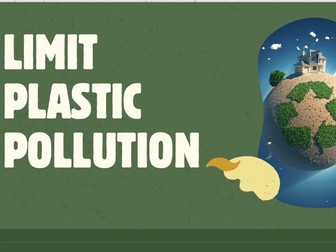
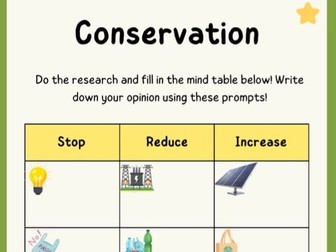
An engaging conservation activity where students research and think critically about how humans can protect the environment. Learners explore what actions we should stop, reduce, and increase to help care for our planet. This differentiated worksheet encourages students to investigate environmental issues and organise their ideas in a structured mind table. Pupils analyse everyday actions such as reducing plastic use, increasing renewable energy, protecting forests, and making more sustainable choices. The activity promotes discussion, research skills, and environmental awareness while helping students understand how small changes can make a positive impact on the Earth. What’s included: 3 differentiated worksheets (easy to challenge levels) Clear Stop / Reduce / Increase thinking framework Visual prompts to support understanding Space for learners to research and record their ideas Learning focus: Students identify harmful actions that should stop, behaviours that should be reduced, and positive actions that should increase in order to support conservation and sustainability. Perfect for: KS2 Science (Environment / Sustainability topics) Geography lessons on conservation Earth Day or environmental awareness activities Independent work, group discussion, or research tasks The visual prompts help guide students to think about issues such as plastic pollution, energy use, deforestation, renewable energy, and protecting nature, making the task accessible and engaging for a wide range of learners.
Effects of Pollution on Humans and Animals – Lesson & Differentiated WorksheetQuick View
bienksm

Effects of Pollution on Humans and Animals – Lesson & Differentiated Worksheet

(0)
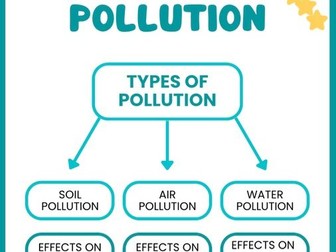
This engaging lesson helps students understand the different types of pollution and how they affect both humans and animals. It includes a clear, student-friendly PowerPoint presentation and a differentiated worksheet to support a range of learning abilities. The lesson begins with a thought-provoking starter image to encourage discussion about pollution and its impact on wildlife. Students are then introduced to the concept of pollution and learn about different types including air pollution, water pollution, soil pollution, noise pollution, and light pollution. The presentation explains how these pollutants can affect human health, ecosystems, and animals in an accessible way. Students consolidate their learning with a differentiated worksheet that allows them to identify different types of pollution and consider their effects on humans and animals. The lesson finishes with a reflective plenary activity where learners share words associated with pollution and respond to discussion questions. This resource is ideal for introducing environmental awareness and encouraging critical thinking about how human actions affect the natural world. What’s included: PowerPoint lesson presentation Differentiated worksheet Starter discussion activity Spotlight questions for deeper thinking Plenary activity (word cloud reflection) Perfect for: KS2 / Year 4 Science Topics on environment, pollution, and ecosystems Whole-class teaching, independent work, or discussion lessons
Recycling Lesson & Interactive Activity – “Ready, Set, Recycle!” (KS2 Environmental Science)Quick View
bienksm

Recycling Lesson & Interactive Activity – “Ready, Set, Recycle!” (KS2 Environmental Science)

(0)
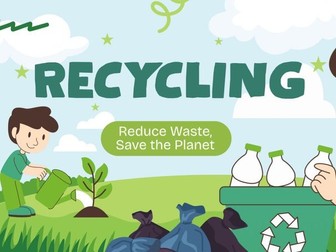
Make environmental education meaningful, memorable, and active with this engaging recycling lesson and hands-on sorting activity designed to help students understand how recycling protects our planet. This ready-to-teach resource includes a structured PowerPoint lesson and a practical worksheet that brings sustainability concepts to life through discussion, critical thinking, and real-world application.Make environmental education meaningful, memorable, and active with this engaging recycling lesson and hands-on sorting activity designed to help students understand how recycling protects our planet. This ready-to-teach resource includes a structured PowerPoint lesson and a practical worksheet that brings sustainability concepts to life through discussion, critical thinking, and real-world application.
Industrial Revolution steam train drawing task.Quick View
bienksm

Industrial Revolution steam train drawing task.

(0)
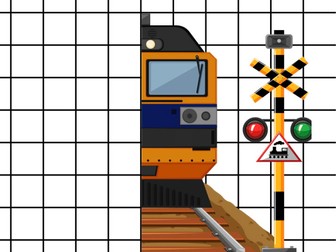
This Year 4 Art assessment combines art and history by exploring symmetry through a creative Industrial Revolution steam train drawing task. Pupils apply their understanding of line symmetry to complete the missing half of a steam train using a grid. The activity encourages careful observation, mathematical thinking, and links learning to the Industrial Revolution topic, where steam trains played a key role in changing transport and industry. The resource includes a clear teaching PPT explaining: What symmetry is The historical context of the Industrial Revolution Step-by-step modelling of how to reflect shapes using a grid Assessment success criteria (WALT & WILF) This task works well as: An end-of-unit art assessment A cross-curricular maths and art activity A history topic link Included: Teaching PowerPoint Assessment criteria Reflection questions for pupil evaluation Skills developed: Understanding line symmetry Grid drawing and spatial awareness Observation and accuracy Cross-curricular historical understanding Suitable for: Year 3–5 (ideal for Year 4) Topics: Art | Maths (Symmetry) | Industrial Revolution | Cross-curricular learning