A Confident ME - Balancing your Stress BucketQuick View
RussWills

A Confident ME - Balancing your Stress Bucket

(0)
Using the “Balancing your Stress Bucket” visual worksheet is a clear way to show how everyday factors can fill our emotional buckets, causing overwhelm and stress that impacts our mental health and sense of wellbeing. Young people often find it hard to identify and evaluate what is causing their stress and overwhelm. The printable provides opportunity for discussion helps them gain clarity and empowers them to understand and manage their feelings. Students complete the boxes with ways they can balance their buckets by using the taps at the bottom of sheet to release their stress by identifying areas of wellbeing that will support their mental health. This eye catching printable comes with a step by step guide on the second page of how to make the most of our Stress Bucket Printable in your setting. Great for pastoral teams in High School, therapists, school counsellors, PSHE lessons, small group interventions and 1:1 sessions.
Self-Regulation Tool - Resource and printables - The Power of PauseQuick View
RussWills

Self-Regulation Tool - Resource and printables - The Power of Pause

(0)
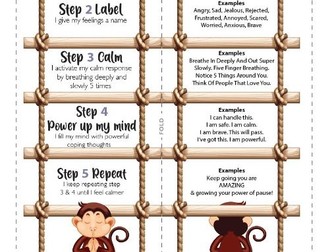
The term Power of Pause describes the ability to pause when difficult emotions begin to take over. This pause allows children to respond thoughtfully, rather than react impulsively, leading to more positive outcomes for themselves and others. Instead of reacting with behaviours such as shouting, hurting, avoiding or crying, children learn to pause, understand what is happening in their bodies, and choose a more helpful response. This resource has 8 pages and comes with a step by step guide on how to decend from the heights of those big emotions down to a place of calm and emotional safety. How to use this resource: The ladder printables have been developed for children to use as a clear, visual prompt of the process of how to independently overcome big emotions. Included with this resource are a variety of formats that you may use for class display, to colour in, postcard size pocket prompts and two versions; one simpler and a second version that includes more detail and examples. Who is this resource for? Teachers, teaching assistants, pastoral leads, SEND staff, as well a whole class PHSE resource. Additionally, it is fabulous for helping parents to support their child when they are experiencing those big emotions that often become too overwhelming.
Emotion Cards with Barometer and ActivitiesQuick View
RussWills

Emotion Cards with Barometer and Activities

(0)
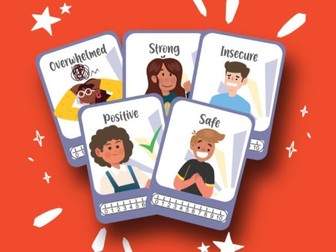
The A Confident ME Emotion Cards help young people identify, understand, accept, and express their emotions. By learning that all emotions are okay we can navigate life’s challenges, build resilience and develop healthy relationships. Includes 40 beautifully designed emotion cards each with a barometer to gauge the intensity of the emotion feeling Includes a **4 pages of activities/games **and information on becoming emotionally agile. There isn’t a day that goes by that we don’t use these in our practice with children and young people.
A Confident ME Feelings Cards - Cloud Characters and StoriesQuick View
RussWills

A Confident ME Feelings Cards - Cloud Characters and Stories

(0)
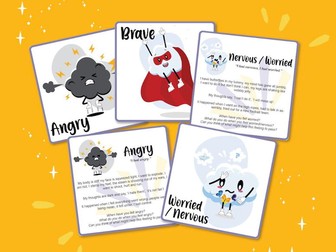
**A Confident ME - 12 carefully designed Cloud Character Emotion Cards - Each emotion comes with a matching story card ** These feelings cards help children to develop an awareness of how all emotions are okay and are part of how we experience life. These cards are the first step to understanding that it’s ‘okay not to be okay’ and the foundation in which self-regulation is built upon. See further A Confident ME resources on TES. These large A5 cards are great for classroom displays and using one to one. Our emotion Cloud Characters are beautifully illustrated to show the physiological signs that may be felt whilst experiencing each emotion. The cloud itself represents that the emotion, once accepted will pass, just like a cloud in the sky. The matching story cards informs: • What happens in the body when we experience each emotion • What thoughts may be present • Common situations that could trigger this emotion • Questions to ask the child when feeling or discussing each emotion