Fractions, Decimals & PercentagesQuick View
Postman_Pad

Fractions, Decimals & Percentages

(0)
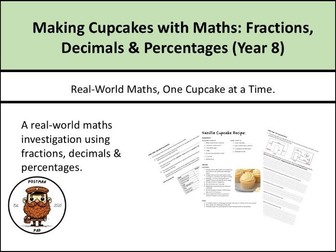
Making Cupcakes with Maths: Fractions, Decimals & Percentages (Year 8) Bring real-world maths into your classroom with this engaging, hands-on investigation that places students in charge of designing, costing, and running a cupcake business. This comprehensive Year 8 Mathematics task uses a familiar and motivating context to develop deep understanding of fractions, decimals, ratios, percentages, and financial mathematics through authentic problem-solving. Across a series of connected investigations, students scale recipes, convert between number forms, compare supermarket prices, calculate profit and loss, reason with ratios, and apply percentages to realistic business scenarios. The task gradually builds in complexity, encouraging students to justify decisions, communicate reasoning, and apply mathematical modelling in meaningful contexts. This resource is ideal as a rich assessment task, extended investigation, or project-based learning activity, and can be used over multiple lessons or as a summative task. Key Features Real-world, engaging cupcake business context Strong focus on fractions, decimals, ratios, percentages, and financial maths Explicit opportunities for reasoning, justification, and problem-solving Includes cost comparisons, profit calculations, scaling, and unit conversions Encourages students to show working and communicate mathematically Clear A–E marking rubric aligned with achievement standards Print-ready student workbook format (Word document) Curriculum Alignment Aligned to Year 8 Mathematics, including: Operations with integers and rational numbers Fractions, decimals, ratios, and percentages Mathematical modelling in financial and measurement contexts Interpretation, reasoning, and communication of mathematical results What’s Included Full student investigation booklet Structured, multi-part task with increasing challenge Realistic data tables and applied scenarios Assessment rubric (A–E) for consistent marking This task works especially well for teachers looking to move beyond worksheets and into authentic, applied mathematics that students can relate to and enjoy.
Geometry & Coordinates ChallengeQuick View
Postman_Pad

Geometry & Coordinates Challenge

(0)
Turn your maths classroom into a crime scene! In this engaging Maths Murder Mystery, students work as investigators to solve a fictional murder by cracking a series of mathematical clues. Each correctly solved clue eliminates half of the suspects, gradually narrowing the field until the murderer is revealed. This resource is structured around five interconnected clues, each targeting a different mathematical skill set. Students apply their understanding of 2D and 3D shapes, angles, compass directions, coordinates, and logical decoding to uncover key information about the suspect. The task encourages problem-solving, perseverance, collaboration, and mathematical reasoning in a highly motivating, game-based format . The activity works perfectly as: A revision task A collaborative group challenge An end-of-term enrichment lesson A relief or extension activity Minimal preparation is required, and the mystery narrative keeps students engaged from start to finish. Key Maths Skills Covered Properties of 2D and 3D shapes Angle reasoning and angle–letter codes Compass directions and spatial movement Cartesian coordinates Logical reasoning and decoding What’s Included Full murder mystery scenario Five maths-based clues with escalating challenge Suspect list and structured elimination process Complete worked solutions for teachers
Geometry Assignment - Artistic AnglesQuick View
Postman_Pad

Geometry Assignment - Artistic Angles

(0)
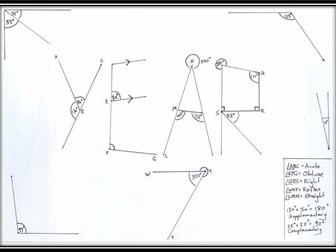
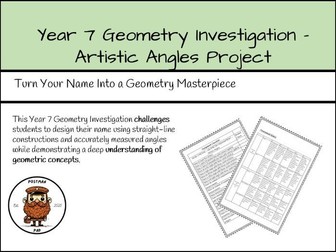
Turn geometry concepts into personal art! This rigorous, creative project challenges students to demonstrate their mastery of geometry by designing a poster of their own name. This is not just a “coloring activity”—it is a comprehensive assessment that requires students to construct, measure, and identify complex geometric elements within their design. This project is perfect for an end-of-unit assessment, a creative math center, or a high-engagement homework assignment. Project Overview Students are tasked with writing their name (minimum 5 letters) using straight lines and angles. They must then integrate a specific checklist of geometry requirements into their design, including borders or decorations. This task moves beyond simple identification, requiring students to construct specific angles and shapes accurately. Math Concepts Covered This assignment hits a wide range of geometry standards in a single product. Students must demonstrate: Line Relationships: Constructing and marking parallel and perpendicular lines with correct symbols. Angle Classification: Identifying and labeling acute, obtuse, right, straight, and reflex angles using three-point notation. Measurement: * Measuring at least 10 angles with a protractor. * Constructing specific required angles (e.g., 12∘, 97∘, and a 300∘ reflex angle). * Angle Pairs: creating and identifying complementary and supplementary angles. * Polygons & Quadrilaterals: * Regular vs. Irregular quadrilaterals. * Congruent polygons. * Concave vs. Convex polygons. What’s Required of Students To complete the “Geometry Name Poster,” students follow a detailed 11-point checklist (included in the prompt) that ensures they cover all necessary skills. They must also create a Key to organize their data, making grading easier for you. Ideas for Use Summative Assessment: Use this in place of a standard test to assess distinct geometry skills. Differentiation: The open-ended nature of the “Name” design allows students to work at their own entry point while meeting specific criteria. Bulletin Board Display: These posters make for fantastic, colorful classroom displays that show off student learning. End of Year Review: A fun way to recap vocabulary before state testing.
Chemical Element Pokemon CardQuick View
Postman_Pad

Chemical Element Pokemon Card

(0)
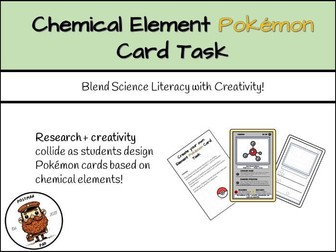
This creative science task challenges students to transform a real chemical element into a Pokémon character whose features, abilities, and personality reflect the element’s actual properties. Students select an element from the periodic table, research its characteristics, and then design a Pokémon-style card that represents its behaviour, uses, strengths, and weaknesses. By blending scientific understanding with imaginative design, students deepen their knowledge of atomic structure, chemical properties, and reactivity while producing a visually engaging and scientifically grounded final product. This task is ideal for revising Year 8–9 chemistry concepts, supporting literacy in science, and encouraging creative expression.
Famous Scientist Pokémon Card TaskQuick View
Postman_Pad

Famous Scientist Pokémon Card Task

(0)
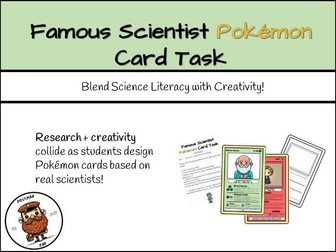
This engaging, curriculum-aligned project combines Science, Literacy, and Creative Thinking to help students explore how scientific discoveries shape the world. Students first research a famous scientist and then represent them as a Pokemon card, symbolically capturing their discoveries, strengths, and influence. It’s an imaginative way to bring Science as a Human Endeavour (SHE) to life while promoting communication, analysis, and design skills.
Colour By Numbers - Lab SafetyQuick View
Postman_Pad

Colour By Numbers - Lab Safety

(0)
This worksheet introduces students to essential laboratory safety practices through a fun and interactive colour-by-numbers activity. Students answer multiple-choice questions related to safe behaviour, correct equipment use, hazard awareness, and general lab rules. Each correct answer corresponds to a colour, allowing students to reveal a hidden picture as they work. This format supports engagement, encourages careful reading, and provides a low-pressure way to reinforce safety expectations before beginning practical work.
Colour By Numbers - Scientific MethodQuick View
Postman_Pad

Colour By Numbers - Scientific Method

(0)
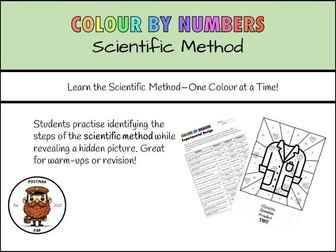
This worksheet introduces students to the core steps of the scientific method and experimental design through an engaging colour-by-numbers activity. Students answer multiple-choice questions focused on key concepts—such as observation, questioning, prediction, testing, and variables—and then use their answers to colour the hidden picture. This format encourages careful reading and reinforces understanding of scientific processes in a low-stakes, enjoyable way. It is ideal for consolidating prior learning or providing revision through a fun, self-checking task.
Microbes and Disease Pokemon Card TaskQuick View
Postman_Pad

Microbes and Disease Pokemon Card Task

(0)
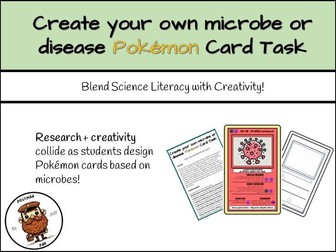
In this creative biology task, students design a Pokémon card based on a real microbe or disease. They begin by researching a microorganism—such as a bacterium, virus, fungus, or parasite—or a specific infectious disease. Using their findings, students transform the microbe’s characteristics into Pokémon-style traits, including type, attacks, weaknesses, resistances, and a Pokédex-style description. The activity reinforces understanding of how pathogens spread, how they affect the body, and the conditions that influence their survival. By merging scientific accuracy with imaginative design, students deepen their knowledge of microbiology while producing an engaging and memorable final product.
Colour By Numbers - Simple MachinesQuick View
Postman_Pad

Colour By Numbers - Simple Machines

(0)
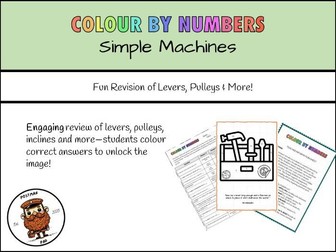
This worksheet introduces students to the fundamental concepts of simple machines through an engaging colour-by-numbers activity. Students answer multiple-choice questions that assess their understanding of levers, pulleys, gears, inclined planes, wedges, screws, and wheel-and-axle systems. Each correct answer corresponds to a specific colour, allowing students to gradually reveal a hidden picture as they work. This activity provides a fun, low-stakes opportunity to revise key ideas, consolidate learning, and strengthen terminology recall relating to simple machines.
Back-to-School Teacher Introduction & Inference ActivityQuick View
Postman_Pad

Back-to-School Teacher Introduction & Inference Activity

(0)
Get to Know the Teacher with Visual Evidence Start your school year with a high-engagement critical thinking activity that builds immediate classroom rapport! Skip the boring introduction and use this fun, evidence-based task where students act like detectives to make inferences about you based on real-life photo clues. Key Features and Benefits Practice Critical Skills: Directly introduces and reinforces the concepts of Inference vs. Evidence, a foundational skill across all subjects. Builds Classroom Community: Provides an authentic, low-stakes opportunity for students to learn about their teacher’s personality and life outside of school. High Engagement: Students are challenged to use detective skills to piece together clues, making the activity more fun and memorable than a traditional introduction. Flexible Format: Designed for seamless use in Digital (Google Slides/PowerPoint) or Print (Worksheet) settings. Perfect for the first days of class, whether in-person or remote. Minimal Prep: Simply choose 5-7 meaningful items and take pictures, the template and activity structure are ready to go! What’s Included in the Resource? Editable Student Worksheet/Handout: Includes clear sections for Image Number, Specific Evidence Seen, and Supported Inference. (Editable Word Document) Editable Presentation Template: A structured presentation (PowerPoint) where you can easily insert your own photos and reveal the answers.
Colour By Numbers - Editable TemplatesQuick View
Postman_Pad

Colour By Numbers - Editable Templates

(0)
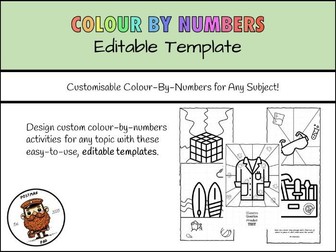
This Colour-by-Numbers Template Pack is a flexible and engaging resource designed for teachers who want to create their own curriculum-aligned colouring activities. The pack includes a selection of blank image outlines and matching answer grids, allowing educators to insert their own questions, answer options, and colour codes. Because the template works for any subject area — from science and maths to languages and history — it’s perfect for revision, early-finishers, lesson warm-ups, sub plans, or fun homework tasks. The open-ended structure gives teachers complete creative freedom while keeping the activity visually appealing and easy for students to complete.