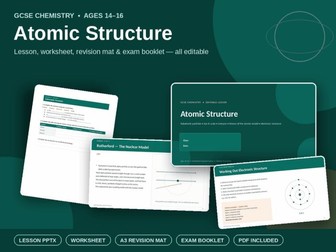
A complete, exam-ready GCSE Chemistry resource bundle on Atomic Structure, fully aligned to the AQA specification (subatomic particles, size and scale of atoms, isotopes, the history of the atomic model, and electronic structure). Fully editable and provided as both PowerPoint/Word and PDF.
What’s included:
19-slide lesson PowerPoint — relative charges and masses of subatomic particles, atomic/mass number calculations, isotopes, a detailed four-scientist history of the atomic model (Dalton, Thomson, Rutherford, Bohr, Chadwick) each with its own diagram, electronic structure with worked examples, exam questions and a plenary
Differentiated worksheet (Bronze/Silver/Gold/Stretch) with real worked data and a full answer key
A3 revision mat — a single dense summary sheet covering definitions, the history timeline, electronic structure rules and common exam mistakes
15-question exam booklet (40 marks) with multiple choice, short answer and extended-writing questions, plus a complete mark scheme
Ideal for a single or double lesson, cover work, homework, or pre-assessment revision. Every file is fully editable — adapt any question, diagram or exam question to your class.
Age range: 14-16 | KS4 | GCSE Foundation & Higher
Turn your percentages & ratio lesson into a heist! Students play as “Codebreakers” cracking a 5-digit vault code — multipliers, reverse percentages, ratio sharing, and real-world problems.
WHAT’S INCLUDED:
15-slide editable PowerPoint (story-driven, fully resourced)
5 differentiated worksheets (PDF, print-ready): Percentage recap, Increase/Decrease (Foundation), Reverse Percentages (Higher), Ratio, and a Boss Challenge combining both skills
Full answer key for every worksheet
Progress tracker + editable vault code
COVERS:
Percentage of an amount (recap)
Percentage increase/decrease using a multiplier
Reverse percentages — finding the original amount
Sharing in a given ratio
Combined ratio & percentage word problems
Part of the Vault Collection — check my shop for more topics!
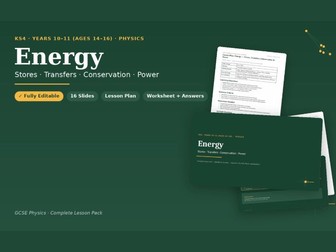
A complete, ready-to-teach lesson pack on Energy for GCSE Physics — fully editable and classroom-tested in structure.
Covering energy stores, kinetic and gravitational potential energy, conservation of energy, Sankey diagrams, power, efficiency, and renewable vs non-renewable resources, this bundle gives you everything you need for one comprehensive lesson (or split across two), with built-in differentiation for mixed-ability classes.
What’s included (3 fully editable resources):
16-slide PowerPoint presentation — objectives, energy/work/power definitions, energy stores reference sheet, Ek=½mv² and Ep=mgh equations, conservation of energy, Sankey diagrams, renewable vs non-renewable comparison, required practical (specific heat capacity), worked efficiency calculation, common misconceptions, exam-style question, differentiated tasks, and plenary exit ticket
Detailed lesson plan (Word) — minute-by-minute structure, success criteria, differentiation (support/core/stretch), assessment for learning, and homework
Student worksheet + full answer key (Word) — 13 questions across definitions, calculations, exam-style questions, and a challenge extension (energy transfer in free fall)
Key features:
100% editable — change any text, numbers, or colours to fit your class
Covers core GCSE Energy content (AQA / Edexcel / OCR compatible)
Includes the required practical for specific heat capacity
Clear Sankey diagram explainer — a topic students often find tricky
Differentiated for Support / Core / Stretch learners
Ready-made mark scheme for quick peer- or self-assessment
PDF previews included alongside editable files
Perfect for: GCSE Physics or Combined Science teachers looking for a polished, plug-and-play lesson on energy — save hours of prep time.
Key Stage: 4 (Years 10–11, Ages 14–16)
Subject: Physics / Combined Science
Topic: Energy — Stores, Transfers, Conservation, Power, Efficiency, Resources
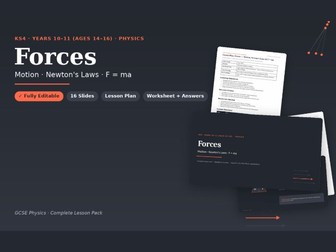
A complete, ready-to-teach lesson pack on Forces for GCSE Physics — fully editable and classroom-tested in structure.
Covering Newton’s Three Laws of Motion, resultant forces, F = ma, mass vs weight, and motion graphs, this bundle gives you everything you need for one comprehensive lesson (or split across two), with built-in differentiation for mixed-ability classes.
What’s included (3 fully editable resources):
16-slide PowerPoint presentation — objectives, key definitions (force, mass, weight), contact vs non-contact forces, Newton’s Second Law (F=ma), Newton’s First Law, finding resultant forces, Newton’s Third Law, mass vs weight comparison, required practical (motion graphs), worked calculations, common misconceptions, exam-style question, differentiated tasks, and plenary exit ticket
Detailed lesson plan (Word) — minute-by-minute structure, success criteria, differentiation (support/core/stretch), assessment for learning, and homework
Student worksheet + full answer key (Word) — 13 questions across definitions, calculations, exam-style questions, and a challenge extension (terminal velocity)
Key features:
100% editable — change any text, numbers, or colours to fit your class
Covers core GCSE Forces content (AQA / Edexcel / OCR compatible)
Includes the required practical for motion graphs (distance-time & velocity-time)
All three of Newton’s Laws explained with clear diagrams and real-world examples
Differentiated for Support / Core / Stretch learners
Ready-made mark scheme for quick peer- or self-assessment
PDF previews included alongside editable files
Perfect for: GCSE Physics or Combined Science teachers looking for a polished, plug-and-play lesson on forces and motion — save hours of prep time.
Key Stage: 4 (Years 10–11, Ages 14–16)
Subject: Physics / Combined Science
Topic: Forces — Motion, Newton’s Laws, F = ma, Mass & Weight
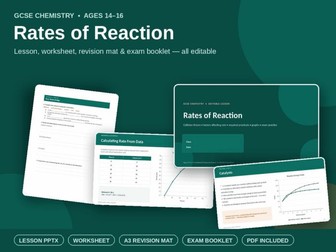
Rates of Reaction — Complete GCSE Chemistry Resource Bundle (Ages 14–16)
A comprehensive, exam-ready resource pack covering the full AQA/Combined Science specification on Rates of Reaction. Fully editable and provided as both PowerPoint/Word and PDF, this bundle saves hours of prep time while giving students everything they need to master the topic.
What’s included:
17-slide lesson PowerPoint — collision theory, the four factors affecting rate, graph interpretation, both required practicals (disappearing cross and gas production), exam questions and a plenary
Differentiated worksheet (Bronze/Silver/Gold/Stretch) with a full answer key for self- or teacher-marking
A3 revision mat — a single dense summary sheet covering definitions, formulae, the four factors, common exam mistakes and command-word guidance
14-question exam booklet (42 marks) with multiple choice, short answer and extended-writing questions, plus a complete mark scheme
Ideal for a single or double lesson, cover work, homework, or a revision session before assessments. Every file is fully editable — swap questions, relabel graphs with your own class data, or adjust difficulty to suit your group.
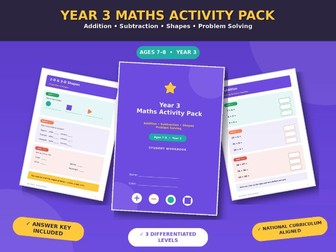
Year 3 Maths Activity Pack — Save Hours of Planning with This Complete, No-Prep Resource
Everything you need to teach and consolidate core Year 3 Maths in one ready-to-use pack. Fully differentiated, curriculum-aligned, and answer-keyed — just print and teach.
What You Get
12-page Student Workbook — print-ready PDF and fully editable PowerPoint
3-page Teacher Guide — learning objectives, curriculum links, and a complete worked Answer Key
A printable Certificate of Completion to celebrate pupil success
Fully Differentiated — Every Activity Has 3 Levels
No more staying up late splitting worksheets by ability. Every page is ready-made with three levels: Easy, for pupils working towards age-related expectations; Medium, for pupils working at age-related expectations; and Hard, which challenges pupils working at greater depth.
Mapped to the National Curriculum (England), Year 3 Mathematics
Covers Number (Place Value, Addition and Subtraction), Geometry (Properties of Shapes), and Problem Solving, so you can teach with confidence it hits the required objectives.
12 Activities Included
Counting and Place Value — number patterns and sequences
Addition — mental and written methods, including carrying
Subtraction — mental and written methods, including exchanging
2-D and 3-D Shapes — properties, sides, corners, and sorting
Practical Investigation — hands-on counting and sorting activity
Real-Life Word Problems — shopping, sharing, and school scenarios
Maths at Home — home-school link activity for extra practice
Amazing Maths Facts — fun facts to spark curiosity
Extension Challenge — Magic Square and Mystery Number puzzles for early finishers
Assessment Quiz — quick check of understanding across all topics
Certificate of Completion
Why Teachers Choose This Pack
No prep needed — no cutting, laminating, or extra planning. One resource stretches your whole class, from low to high attainers. Ideal for whole-class teaching, morning work, cover lessons, homework, tutoring, or catch-up intervention. The editable PowerPoint lets you tweak numbers instantly for next year’s class. Bright, engaging design that pupils enjoy working through.
Perfect for: Year 3 class teachers, teaching assistants running intervention groups, SEN and catch-up support, tutors, and homeschooling parents.
Format: PDF (print-ready, A4) and PowerPoint (.pptx, fully editable) — 4 files, instant download.
Age range: 14-16 | KS4 | GCSE Foundation & Higher
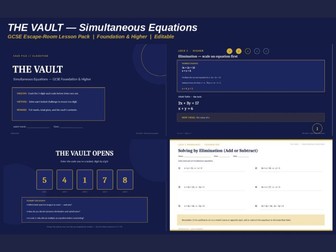
Turn your simultaneous equations lesson into a heist! Students play as “Codebreakers” cracking a 5-digit vault code — elimination, substitution, and real-world problems, all in one progressive challenge.
WHAT’S INCLUDED:
15-slide editable PowerPoint (story-driven, fully resourced)
5 differentiated worksheets (PDF, print-ready): Linear equation recap, Elimination (Foundation), Elimination with scaling (Higher), Substitution, and a Boss Challenge with worded problems
Full answer key for every worksheet
Progress tracker + editable vault code
COVERS:
Solving linear equations (recap)
Elimination — adding/subtracting directly
Elimination — scaling an equation first
Substitution method
Forming simultaneous equations from worded problems
Part of the Vault Collection — check my shop for more topics!
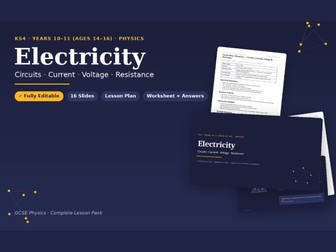
A complete, ready-to-teach lesson pack on Electricity for GCSE Physics — fully editable and classroom-tested in structure.
Covering current, potential difference, resistance, series & parallel circuits, and I–V characteristics, this bundle gives you everything you need for one comprehensive lesson (or split across two), with built-in differentiation for mixed-ability classes.
What’s included (3 fully editable resources):
16-slide PowerPoint presentation — objectives, key definitions, circuit symbols reference, Ohm’s Law, series vs parallel circuits, required practical (I–V graphs), worked calculations, common misconceptions, exam-style question, differentiated tasks, and plenary exit ticket
Detailed lesson plan (Word) — minute-by-minute structure, success criteria, differentiation (support/core/stretch), assessment for learning, and homework
Student worksheet + full answer key (Word) — 13 questions across definitions, calculations, exam-style questions, and a challenge extension
Key features:
100% editable — change any text, numbers, or colours to fit your class
Covers core GCSE Electricity content (AQA / Edexcel / OCR compatible)
Includes the required practical for I–V characteristics
Differentiated for Support / Core / Stretch learners
Ready-made mark scheme for quick peer- or self-assessment
PDF previews included alongside editable files
Perfect for: GCSE Physics or Combined Science teachers looking for a polished, plug-and-play lesson on electrical circuits — save hours of prep time.
Key Stage: 4 (Years 10–11, Ages 14–16)
Subject: Physics / Combined Science
Topic: Electricity — Circuits, Current, Voltage, Resistance
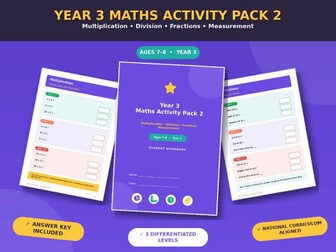
Year 3 Maths Activity Pack 2 — The Perfect Follow-Up to Pack 1, Covering Multiplication, Division, Fractions and Measurement
A complete, ready-to-print Maths pack covering four essential Year 3 topics: Multiplication, Division, Fractions, and Measurement (Length, Perimeter, and Time). Fully differentiated, curriculum-aligned, and answer-keyed — just print and teach.
What You Get
12-page Student Workbook — print-ready PDF and fully editable PowerPoint
3-page Teacher Guide — learning objectives, curriculum links, and a complete worked Answer Key
A printable Certificate of Completion to celebrate pupil success
Fully Differentiated — Every Activity Has 3 Levels
Every page is ready-made with three levels: Easy, for pupils working towards age-related expectations; Medium, for pupils working at age-related expectations; and Hard, which challenges pupils working at greater depth, including division with remainders and multi-step measurement problems.
Mapped to the National Curriculum (England), Year 3 Mathematics
Covers Number (Multiplication and Division facts for the 2, 3, 4, 5, 8 and 10 times tables), Fractions (unit and non-unit, equivalence), and Measurement (length, perimeter, and telling time to the nearest minute).
11 Activities Included
Multiplication — groups, arrays, and times tables up to 2-digit by 1-digit
Division — sharing, grouping, and division with remainders
Fractions — halves, quarters, thirds, and equivalent fractions
Length and Perimeter — measuring and calculating perimeter of 2-D shapes
Telling Time — clocks, 12-hour and 24-hour time, minutes and hours
Practical Investigation — hands-on measuring activity using real objects
Real-Life Word Problems — shopping, sharing, and measurement scenarios
Maths at Home — home-school link activity for extra practice
Extension Challenge — Times Table Grid and Fraction Riddle for early finishers
Assessment Quiz — quick check of understanding across all topics
Certificate of Completion
Why Teachers Choose This Pack
No prep needed — no cutting, laminating, or extra planning. One resource stretches your whole class, from low to high attainers. Ideal for whole-class teaching, morning work, cover lessons, homework, tutoring, or catch-up intervention. The editable PowerPoint lets you tweak numbers instantly for next year’s class. Pairs perfectly with Year 3 Maths Activity Pack 1 (Addition, Subtraction, Shapes, Place Value) for a full-term bundle.
Perfect for: Year 3 class teachers, teaching assistants running intervention groups, SEN and catch-up support, tutors, and homeschooling parents.
Format: PDF (print-ready, A4) and PowerPoint (.pptx, fully editable) — 4 files, instant download.
Age range: 14-16 | KS4 | GCSE Foundation & Higher
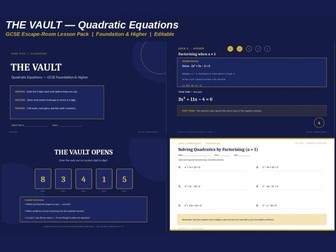
Turn your quadratics lesson into a heist! Students play as “Codebreakers” racing to crack a 5-digit vault code — every correct answer unlocks one digit. Fully differentiated across 5 progressive stages, from recap to exam-style problem solving.
WHAT’S INCLUDED:
15-slide editable PowerPoint (story-driven, fully resourced — just present and go)
5 differentiated worksheets (PDF, print-ready): Warm-up, Foundation, Higher, Quadratic Formula, and a Boss Challenge with worded problems
Full answer key for every worksheet
Progress tracker built into every slide
Editable vault code — set a new combination each time you teach it
COVERS:
Expanding double brackets & factor pairs (recap)
Solving quadratics by factorising (a = 1)
Solving quadratics by factorising (a ≠ 1)
The quadratic formula
Forming and solving quadratics from worded problems
PERFECT FOR: a full lesson, a revision session before mocks, or a cover lesson that still delivers real content.
If your class enjoys cracking the vault, check my shop — more topics coming soon in the Vault Collection!
Age range: 14-16 | KS4 | GCSE Foundation & Higher
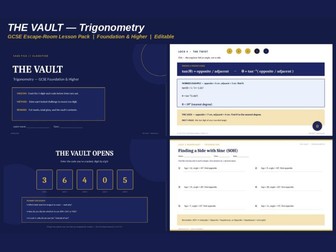
Turn your trigonometry lesson into a heist! Students play as “Codebreakers” racing to crack a 5-digit vault code — SOH, CAH, TOA, and inverse trig, all in one progressive challenge.
WHAT’S INCLUDED:
15-slide editable PowerPoint (story-driven, fully resourced)
5 differentiated worksheets (PDF, print-ready): Pythagoras recap, Sine, Cosine, Finding Angles, and a Boss Challenge with real-world problems
Full answer key for every worksheet
Progress tracker + editable vault code
COVERS:
Pythagoras’ theorem (recap)
Finding a side using sine (SOH)
Finding a side using cosine (CAH)
Finding an angle using inverse trig (TOA)
Real-world trigonometry (elevation, ladders, worded problems)
Part of the Vault Collection — check my shop for more topics!
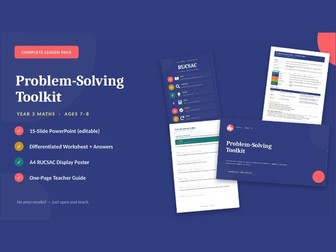
A complete, ready-to-teach Problem-Solving lesson for Year 3 (Ages 7–8), built around the
RUCSAC strategy (Read, Underline, Choose, Solve, Answer, Check).
Everything you need for one lesson, fully resourced:
15-slide PowerPoint — learning objective, key vocabulary, step-by-step RUCSAC
teaching, 4 fully worked examples (bar models, arrays, money, two-step problems),
a problem-solving toolkit, common mistakes, talk-partner task, plenary & exit ticket
Differentiated worksheet (3 levels: Mild / Spicy / Hot) with a full answer key
A4 RUCSAC display poster for your working wall
One-page teacher guide with timings, differentiation notes and key questions
Covers addition, subtraction, multiplication, division and money word problems, aligned
to the Year 3 National Curriculum. Perfect for a standalone lesson, a topic starter, or a
revision session.
What’s included:
PowerPoint (.pptx) — fully editable
Worksheet (Word + PDF)
Display poster (PowerPoint + PDF)
Teacher guide (Word + PDF)
No prep needed — just open and teach.
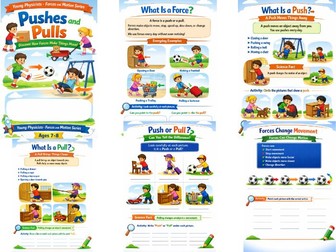
Pushes and Pulls | Forces and Motion Activities Workbook | KS2 Science | Ages 7–8 | Printable PDF
Introduce young learners to the exciting world of forces with this engaging Pushes and Pulls Activities Workbook. Designed for children aged 7–8 (KS2), this colourful printable resource helps pupils understand pushes and pulls through interactive activities, real-life examples, scientific vocabulary, and fun STEM-inspired challenges.
Perfect for classroom lessons, independent learning, homework, revision, homeschooling, and science enrichment activities.
What’s Included
12 printable A4 pages
Full-colour illustrations
Interactive science activities
Multiple-choice questions
Matching activities
Observation tasks
Scientific vocabulary practice
STEM-inspired challenges
Review activities
Certificate of Achievement
Learning Objectives
Children will learn to:
Understand the difference between pushes and pulls.
Identify forces in everyday life.
Describe how forces affect the movement of objects.
Predict how different forces change motion.
Develop observation, reasoning, and scientific thinking skills.
Build confidence through engaging hands-on activities.
Perfect For
KS2 Science
Ages 7–8
Primary classrooms
Homeschool learning
Independent practice
Homework
Science centres
STEM activities
Revision lessons
Resource Details
Subject: Science
Topic: Forces and Motion
Unit: Pushes and Pulls
Series: Young Physicists – Forces and Motion
Age Range: 7–8 Years
Key Stage: KS2
Pages: 12
Paper Size: A4
Format: Printable PDF
Full Colour
High-Resolution Print Quality
This resource is the first workbook in the Young Physicists – Forces and Motion Series, designed to help children build a strong foundation in physics through engaging, age-appropriate science activities that encourage curiosity, observation, and critical thinking.
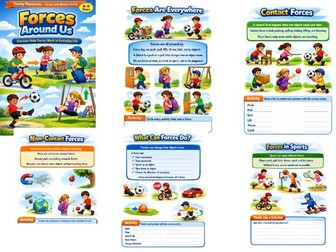
Forces Around Us | Forces and Motion Activities Workbook | KS2 Science | Ages 8–9 | Printable PDF
Help children explore the fascinating world of forces with this engaging Forces Around Us Activities Workbook, specially designed for KS2 learners aged 8–9. Through colourful illustrations, real-life examples, STEM investigations, and interactive activities, pupils will develop a deeper understanding of how forces act in everyday life.
This printable workbook is perfect for classroom teaching, independent learning, homework, revision, homeschooling, and STEM enrichment activities.
What’s Included
12 printable A4 pages
Full-colour illustrations
Contact and non-contact forces activities
Real-life science investigations
Interactive worksheets
Multiple-choice questions
Matching and observation tasks
Scientific vocabulary practice
STEM investigation activity
Science Detective challenge
End-of-book quiz
Certificate of Achievement
Learning Objectives
Children will learn to:
Identify contact and non-contact forces.
Explain how forces affect the movement of objects.
Recognise forces in everyday situations.
Observe, predict, and investigate simple scientific phenomena.
Develop scientific vocabulary and enquiry skills.
Strengthen critical thinking through engaging science activities.
Perfect For
KS2 Science
Ages 8–9
Primary classrooms
Homeschool learning
Independent practice
Homework
STEM activities
Science centres
Revision lessons
Resource Details
Subject: Science
Topic: Forces and Motion
Title: Forces Around Us
Series: Young Physicists – Forces and Motion (Book 2)
Age Range: 8–9 Years
Key Stage: KS2
Pages: 12
Paper Size: A4
Format: Printable PDF
Full Colour
High-Resolution Print Quality
This resource is Book 2 in the Young Physicists – Forces and Motion Series, helping children build scientific knowledge through inquiry-based learning, hands-on activities, and engaging real-world examples.
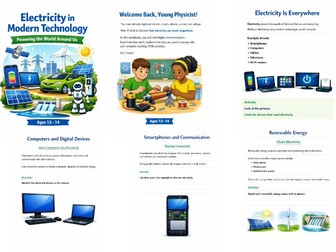
Complete the Young Physicists – Electricity Series with Book 10: Electricity in Modern Technology. Designed for learners aged 13–14, this printable A4 physics workbook explores how electricity powers the modern world through clear explanations, colourful illustrations, interactive activities, STEM investigations, and a knowledge quiz. Students discover how electricity is used in computers, smartphones, renewable energy systems, electric vehicles, robots, and smart technologies while connecting physics with everyday life.
This engaging workbook helps learners understand the vital role electricity plays in modern society by investigating how electrical energy powers digital devices, communication systems, transportation, and sustainable technologies. Through practical STEM activities, real-world examples, and scientific enquiry, students develop a deeper appreciation of how physics shapes the technology they use every day.
Pages Included:
Cover – Electricity in Modern Technology
Welcome Young Physicist!
Electricity Powers Technology
Computers and Digital Devices
Smartphones and Communication
Renewable Energy
STEM Investigation – Build a Simple Electric Device
Electricity at Home
Smart Technology
Amazing Technology Facts
Electricity in Modern Technology Quiz
Young Physicist Certificate
Resource Details:
Series: Young Physicists – Electricity Series (Book 10)
Age Range: 13–14 Years
Key Stage: KS3
Subject: Physics
Topic: Electricity in Modern Technology
Format: Printable PDF
Page Size: A4
Length: 12 Pages
Full Colour
Ready to Print
No Prep Resource
Perfect For:
KS3 Physics
Electricity
Modern Technology
Renewable Energy
Digital Technology
STEM Activities
Physics Worksheets
Classroom Learning
Homeschool Education
Independent Learning
Homework
Revision
Science Clubs
Explore how electricity powers today’s world through engaging explanations, practical STEM investigations, interactive activities, and real-world applications. Students will discover how electrical energy drives computers, smartphones, electric vehicles, renewable energy systems, and smart technologies while strengthening their understanding of KS3 physics and developing scientific enquiry skills.
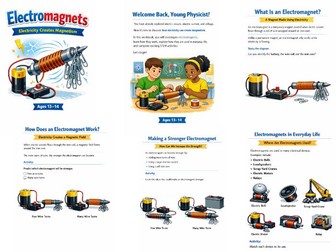
Continue the Young Physicists – Electricity Series with Book 9: Electromagnets. Designed for learners aged 13–14, this printable A4 physics workbook introduces electromagnets through clear explanations, colourful illustrations, interactive activities, STEM investigations, and a knowledge quiz. Students discover how electric current creates a magnetic field, investigate how electromagnets work, learn how to make stronger electromagnets, and explore their importance in everyday technology.
This engaging workbook helps learners develop a deeper understanding of the relationship between electricity and magnetism by exploring magnetic fields, iron cores, coils of wire, and electric current. Students investigate how electromagnets are used in electric motors, cranes, doorbells, loudspeakers, relays, and other modern technologies through practical STEM activities, real-world examples, and scientific enquiry.
Pages Included:
Cover – Electromagnets
Welcome Young Physicist!
What Is an Electromagnet?
How Does an Electromagnet Work?
Making a Stronger Electromagnet
STEM Investigation – Build a Simple Electromagnet
Electromagnets in Everyday Life
Think Like an Engineer
Amazing Electromagnet Facts
Electromagnets Quiz
Young Physicist Certificate
Resource Details:
Series: Young Physicists – Electricity Series (Book 9)
Age Range: 13–14 Years
Key Stage: KS3
Subject: Physics
Topic: Electricity and Magnetism – Electromagnets
Format: Printable PDF
Page Size: A4
Length: 12 Pages
Full Colour
Ready to Print
No Prep Resource
Perfect For:
KS3 Physics
Electricity and Magnetism
Electromagnets
Magnetic Fields
STEM Activities
Physics Worksheets
Classroom Learning
Homeschool Education
Independent Learning
Homework
Revision
Science Clubs
Discover how electricity creates magnetism through engaging explanations, practical STEM investigations, interactive activities, and real-world applications. This printable workbook helps students build confidence in KS3 physics while exploring how electromagnets power everyday technology, from electric motors and cranes to doorbells and loudspeakers.
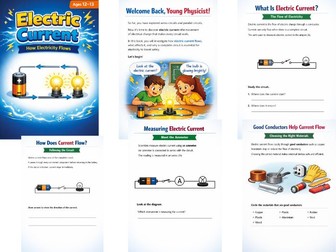
Continue the Young Physicists – Electricity Series with Book 7: Electric Current. Designed for learners aged 12–13, this printable A4 physics workbook introduces the concept of electric current through clear explanations, colourful illustrations, interactive activities, STEM investigations, and a knowledge quiz. Students discover how electric current flows through a complete circuit, learn how it is measured, investigate conductors and insulators, and explore how electricity powers everyday devices.
This engaging workbook helps learners build a deeper understanding of electric current by exploring how electrical charge moves through circuits, investigating the role of ammeters, identifying materials that allow electricity to flow, and connecting scientific ideas with real-life applications. Hands-on STEM activities encourage observation, scientific enquiry, critical thinking, and problem-solving while making electricity engaging, practical, and easy to understand.
Pages Included:
Cover – Electric Current
Welcome Young Physicist!
What Is Electric Current?
How Does Current Flow?
Measuring Electric Current
Good Conductors Help Current Flow
STEM Investigation – Does Every Material Carry Current?
Electric Current Around Us
Think Like an Engineer
Amazing Current Facts
Electric Current Quiz
Young Physicist Certificate
Resource Details:
Series: Young Physicists – Electricity Series (Book 7)
Age Range: 12–13 Years
Key Stage: KS3
Subject: Physics
Topic: Electricity – Electric Current
Format: Printable PDF
Page Size: A4
Length: 12 Pages
Full Colour
Ready to Print
No Prep Resource
Perfect For:
KS3 Physics
Electricity
Electric Current
STEM Activities
Physics Worksheets
Classroom Learning
Homeschool Education
Independent Learning
Homework
Revision
Science Clubs
Discover how electric current moves through circuits and powers everyday technology through engaging explanations, practical STEM investigations, interactive activities, real-world examples, and a review quiz. This printable workbook helps students strengthen their understanding of electricity while developing scientific enquiry skills and confidence in KS3 physics.
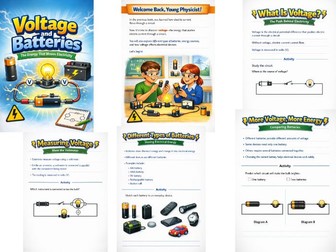
Continue the Young Physicists – Electricity Series with Book 8: Voltage and Batteries. Designed for learners aged 13–14, this printable A4 physics workbook introduces voltage and batteries through clear explanations, colourful illustrations, interactive activities, STEM investigations, and a knowledge quiz. Students discover how voltage provides the energy that drives electric current, learn how batteries store and supply electrical energy, investigate different battery types, and explore how voltage powers everyday technology.
This engaging workbook helps learners develop a deeper understanding of electrical energy by exploring the role of voltage in electrical circuits, learning how voltmeters measure potential difference, comparing different batteries, and investigating how electrical energy is used in real-life applications. Hands-on STEM activities encourage scientific enquiry, observation, critical thinking, and problem-solving while making electricity engaging, practical, and easy to understand.
Pages Included:
Cover – Voltage and Batteries
Welcome Young Physicist!
What Is Voltage?
Measuring Voltage
Different Types of Batteries
More Voltage, More Energy
STEM Investigation – Which Battery Lasts Longer?
Batteries in Everyday Life
Think Like an Engineer
Amazing Voltage Facts
Voltage and Batteries Quiz
Young Physicist Certificate
Resource Details:
Series: Young Physicists – Electricity Series (Book 8)
Age Range: 13–14 Years
Key Stage: KS3
Subject: Physics
Topic: Electricity – Voltage and Batteries
Format: Printable PDF
Page Size: A4
Length: 12 Pages
Full Colour
Ready to Print
No Prep Resource
Perfect For:
KS3 Physics
Electricity
Voltage
Batteries
Electrical Energy
STEM Activities
Physics Worksheets
Classroom Learning
Homeschool Education
Independent Learning
Homework
Revision
Science Clubs
Help students understand how voltage and batteries power electrical circuits through engaging explanations, practical STEM investigations, interactive activities, real-world examples, and a review quiz. This printable workbook strengthens students’ understanding of electrical energy while developing scientific enquiry skills and confidence in KS3 physics.
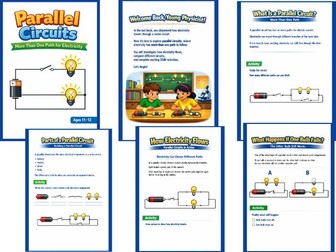
Continue the Young Physicists – Electricity Series with Book 6: Parallel Circuits. Designed for learners aged 11–12, this printable A4 physics workbook introduces parallel circuits through clear explanations, colourful illustrations, interactive activities, STEM investigations, and a knowledge quiz. Pupils discover how electricity flows through multiple paths, compare parallel and series circuits, and investigate why electrical devices in homes use parallel circuits.
This engaging workbook helps students develop a deeper understanding of electrical circuits by exploring the structure of parallel circuits, investigating how electric current travels through different branches, predicting what happens when one bulb is removed, and discovering real-world applications of parallel circuits. Practical STEM activities encourage scientific enquiry, observation, critical thinking, and problem-solving while making electricity engaging and easy to understand.
Pages Included:
Cover – Parallel Circuits
Welcome Young Physicist!
What Is a Parallel Circuit?
Parts of a Parallel Circuit
How Electricity Flows
What Happens If One Bulb Fails?
STEM Investigation – Build a Parallel Circuit
Parallel Circuits in Everyday Life
Compare the Circuits
Amazing Circuit Facts
Parallel Circuits Quiz
Young Physicist Certificate
Resource Details:
Series: Young Physicists – Electricity Series (Book 6)
Age Range: 11–12 Years
Key Stage: KS3
Subject: Physics
Topic: Electricity – Parallel Circuits
Format: Printable PDF
Page Size: A4
Length: 12 Pages
Full Colour
Ready to Print
No Prep Resource
Perfect For:
KS3 Physics
Electricity
Parallel Circuits
STEM Activities
Physics Worksheets
Classroom Learning
Homeschool Education
Independent Learning
Homework
Revision
Science Clubs
Explore how electricity travels through multiple paths while comparing series and parallel circuits using engaging investigations, real-world examples, interactive activities, and STEM learning. This printable workbook helps pupils build confidence in electricity by applying scientific enquiry skills to practical circuit investigations and everyday electrical systems.
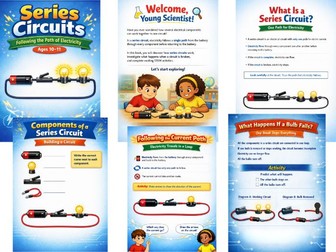
Continue exploring the exciting world of electricity with Book 5 of the Young Physicists – Electricity Series. Designed for learners aged 10–11, this printable A4 physics workbook introduces series circuits through clear explanations, colourful illustrations, interactive activities, STEM investigations, and a knowledge quiz. Students discover how electricity travels through a single complete path, investigate how electrical components work together, and explore why a broken circuit stops the flow of electric current.
This engaging workbook helps pupils develop a deeper understanding of electrical circuits by investigating the components of a series circuit, following the path of electric current, predicting what happens when a bulb fails, and exploring real-life examples of series circuits. Practical STEM activities encourage scientific enquiry, observation, critical thinking, and problem-solving while making electricity fun and easy to understand.
Pages Included:
Cover – Series Circuits
Welcome Young Physicist!
What Is a Series Circuit?
Components of a Series Circuit
Following the Current Path
What Happens If a Bulb Fails?
STEM Investigation – Build a Series Circuit
Series Circuits in Everyday Life
Circuit Detective
Amazing Circuit Facts
Series Circuits Quiz
Young Physicist Certificate
Resource Details:
Series: Young Physicists – Electricity Series (Book 5)
Age Range: 10–11 Years
Key Stage: Upper KS2
Subject: Physics
Topic: Electricity – Series Circuits
Format: Printable PDF
Page Size: A4
Length: 12 Pages
Full Colour
Ready to Print
No Prep Resource
Perfect For:
KS2 Science
Upper KS2 Physics
Electricity
Series Circuits
STEM Activities
Physics Worksheets
Classroom Learning
Homeschool Education
Independent Learning
Homework
Revision
Science Clubs
Explore how electricity travels through a complete circuit while developing scientific enquiry skills through hands-on STEM activities, real-world applications, interactive investigations, and engaging review questions. This printable workbook provides an exciting introduction to series circuits and prepares pupils for more advanced topics in electricity and physics.
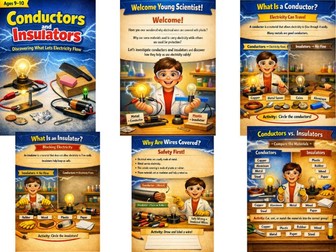
Help young learners discover how electricity travels through different materials with Book 4 of the Young Physicists: Electricity Series. Designed for children aged 9–10, this printable A4 science resource introduces conductors and insulators through engaging explanations, colourful illustrations, hands-on STEM investigations, interactive activities, and a review quiz.
Learners explore which materials allow electricity to flow, which materials block electricity, and why choosing the right materials is important for electrical safety. Through practical investigations and real-world examples, pupils develop scientific enquiry skills while building a strong understanding of this key KS2 electricity topic.
Pages Included:
Cover – Conductors and Insulators
Welcome Young Scientist!
What Is a Conductor?
What Is an Insulator?
Safety First!
Conductors vs. Insulators
STEM Investigation – Test Different Materials
Conductors and Insulators Around Us
Material Detective
Did You Know?
Check Your Knowledge
Young Physicist Certificate
Resource Details:
Series: Young Physicists – Electricity Series (Book 4)
Age Range: 9–10 Years
Key Stage: KS2
Format: Printable PDF
Page Size: A4
Length: 12 Pages
Full Colour
Ready to Print
No Prep Resource
Perfect For:
KS2 Science
Primary Science Lessons
Electricity Unit
Science Activities
Science Worksheets
STEM Learning
Classroom Lessons
Homeschool Education
Independent Learning
Homework
Revision Activities
This engaging resource helps pupils investigate conductors and insulators through observation, comparison, practical STEM activities, and interactive learning, while strengthening scientific vocabulary, critical thinking, and problem-solving skills.


 Quick View