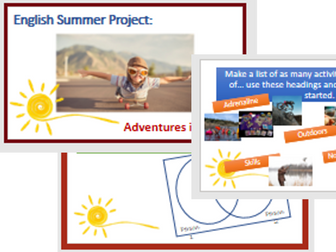
Second lesson in a sequence for Key Stage 3 students designed to develop the topic ‘Inviting Adventure’. In this summer enrichment project, students will cover:
*Reading non fiction texts
*Shaping writing for different audiences
Using rhetorical and argument devices effectively
Creating and planning different text types including media
Widening cultural capital by exploring articles, podcasts and talks
*Speaking and Listening Skills
In this second lessons students will explore board games and read a comment piece. As well as practising their reading skills and encountering high quality journalism, they will get the opportunity to form their own arguments in preperation for their own extended writing.
An engaging opening lesson for Key Stage 3 students designed to introduce the topic ‘Inviting Adventure’. In this summer enrichment project, students will cover:
*Reading non fiction texts
*Shaping writing for different audiences
Using rhetorical and argument devices effectively
Creating and planning different text types including media
Widening cultural capital by exploring articles, podcasts and talks
*Speaking and Listening Skills
In this opening lesson students explore the idea of hobbies and interests by exploring their views in structured discussions and use a TED talk to consider how we try new ideas. Please see the shop for the rest of this unit.
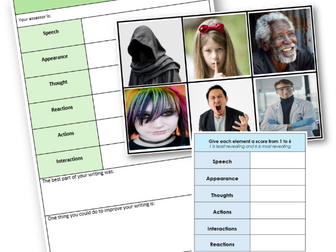
A complete lesson plan, slides and resources for an engaging and practical lesson for AQA GCSE students developing the way they include characters in their writing. Fully differentiated and ideal for mixed ability student, this lesson invites students to explore examples of character introductions and then offers them a framework for developing their own. Resources can be used in this lesson and beyond.
Resources include:
Lesson Plan
Lesson Slides
Character features for ranking
Model writing
Character picture cards
Peer Assessment Table
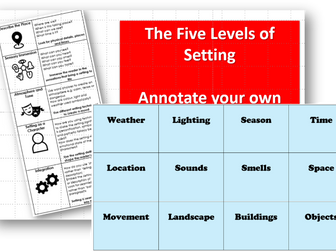
AQA Writing lesson designed to support students in preparing for Section B writing component. In this complete, differentiated lesson suitable for mixed ability students, they explore how to create setting using a model that looks at five levels of integrating and using setting in writing.
This lesson includes:
Lesson plan
Articulate card game
Graphic organiser
Model response
Five Stages of Setting Bookmark
Accompanying slides
Please note that this lesson is part of a unit of seven all of which can be purchased as a bundle. Other lessons include:
Narrative Hooks
Character and Voice
Ambiguity and Gaps
Technical skills: Sentencing and Punctuation
Technical skills: Vocabulary and Devices
Responding to Prompts – Planning
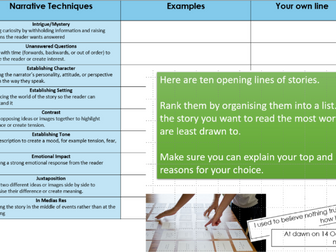
This lesson for AQA English Langauge students explores how to write effective openings by exploring narrative hooks and the methods used to make them effective. Differentiation is built in and this is suitable for students of all abilities.
It includes a detailed lesson plan, opening line card sort, graphic organiser and slides to guide students through activities and reflections. Please note that this is part of a six lesson unit and the complete set of seven lessons are avaiable individually or as a bundle. They cover:
Narrative hooks
Settings and Atmophere
Character and Voice
Ambiguity and Gaps
Technical skills: Sentencing and Punctuation
Technical skills: Vocabulary and Devices
Responding to Prompts – Planning
This versatile resource is useful for revision, introducing AQA GCSE conflict poetry and to support students when exploring comparison skills.
Each of the 15 conflict poems from the AQA Anthology are represented in a set of 5-6 images drawn from the poems and presented in the order they appear in the poem.Best cut up into strips and printed in colour. Some ways you could use them are:
Pre-reading the poems and making predictions about content
Selecting strips to support finding connections and differences
As a visual prompt for quotation learning
To support students in visualising and exploring imagery
For revision activities - e.g. to revise content, plan exam responses etc.
To be cut up and stuck into the anthology
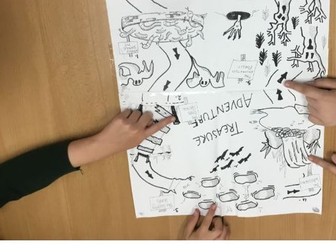
A reliably fun activity tried and tested in the classroom! This lesson is a fun way to see what Year 6 know and explore team work as well as English skills.
This pack comes with:
A lesson plan
A map (to be printed on A3) that needs to be stuck on each groups table
X 6 worksheets - each one is a puzzle related to an obstacle
These should be printed and put into folders so the ‘map master’ can give them out to students as they rech each obstacle.
As teams move around the map, they encounter obstance that correspond to a worksheet they have to ‘solve’. We give a sweet for each completed task and then students move round. They get harder as the adventure continues.
Please note the map is hand drawn.
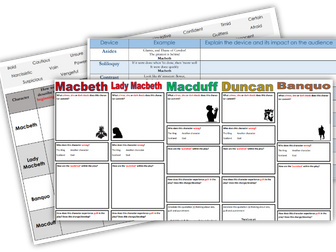
Five revision tasks designed to revise key elements of character, theme, quotations and essay writing skills. These resources are designed for mixed ability GCSE students revising Macbeth.
These could be assigned as home learning tasks or are extensive enough to build lessons around.
Resource 1: Terminology
Students are presented with a table of literary devices and a short memorable quotation that exemplified each one. They must explain th device and its impact for each one.
Resource 2: Revision Clock
An A3 sheet with a ‘clock’ graphic organiser labeled with characters and themes. Students should sent five minutes alone (or in pairs) recording everything they know about each heading. When completed, this can be used as a knowledge organiser for essay writing or quick bursts of revision.
Resource 3: Crimes and Punishments: Exploring Themes
An A3 sheet that invites students to consider the crimes, sins and mistakes characters make, the impact of this and the types of ‘punishments’ characters endure as a result of their actions. As well as exploring Macbeth, Lady Macbeth and Banquo there is a good opportunity to explore Duncan’s naivity and Macduff’s lack of courage as well.
Resource 4: Character Development
This worksheet asks student to select adjectives to describe characters at the beginning of the play and towards the end of their story within the play. The woird bank is designed to support less able students and stretch those aiming for top grades with more nuanced vocabulary choices.
Resource 5: Rehearsing Exam Responses
This worksheet presents students with a thematic question and shares a students plan. Students should read the introduction and first part of the essay and use the shaded box at the bottom to annotate the elements that make this a strong piece of writing. Students should then continue the exam response using either the students planning or their own.
If these resources are used for homelearning - going through them as a class will benefit all.
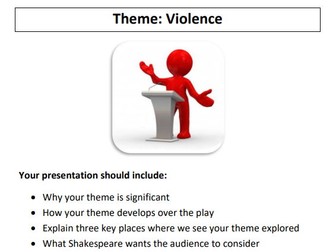
Five worksheet to support students in exploring key themes in Macbeth. Designed to help them structure effective presentations, students benefit from preparing their own focused area and also listening to others.
Perfect for mixed ability Year 10/11 GCSE students who have studied the entire play. Great for exploring themes or as a revision activity.
Suggested Use:
Starter: Discuss what makes an effective presentation and create a checklist e.g. clear structure, supporting evidence etc.
Main:
Divide students into five groups and assign a theme worksheet to each group. Students should explore the initial questions and record their ideas on large sheets of paper.
They should then use the structure suggested on their worksheet to create a clear summary of their findings.
As each group present their area, the rest of the class should create mindmaps/notes to ensure active listening.
Plenary:
Ask students to rank the themes in terms of which they would feel most to least confident writing about in an exam. You can then follow up by exploring a question around the theme they feel least secure about.


 Quick View