Quick Worksheet: Multiples and Lowest Common Multiples (LCM)Quick View
RightAngleResources

Quick Worksheet: Multiples and Lowest Common Multiples (LCM)

(0)
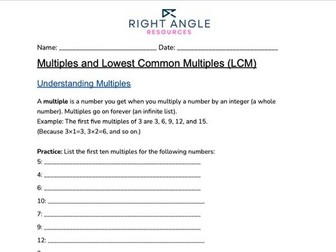
This is a two-page PDF worksheet from Right Angle Resources designed to teach students about multiples and the lowest common multiple (LCM). Content Overview The worksheet is structured with definitions, examples, and practice exercises: Understanding Multiples: This section defines a multiple and provides an example for the number 3. Students are asked to list the first ten multiples for several numbers, including 5, 4, 6, 10, 7, 9, 12, 2, and 8. What is the Lowest Common Multiple (LCM)?: The LCM is defined as the smallest positive number that is a multiple of two or more numbers. How to find the LCM: A three-step method is outlined: list multiples, circle common ones, and identify the smallest . An example demonstrates finding the LCM of 4 and 6, which is 12 . Finding the LCM (Practice): Students use a table format to find the LCM for pairs of numbers: 3 and 5, 8 and 10, 6 and 9, and 12 and 16. LCM of Three Numbers: The final section challenges students to find the LCM for sets of three numbers: 2, 3, and 4; and 5, 6, and 8.
Quick Worksheet: Factors and Highest Common Factors (HCF)Quick View
RightAngleResources

Quick Worksheet: Factors and Highest Common Factors (HCF)

(0)
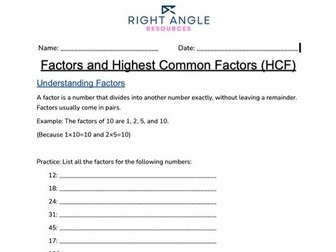
This resource is a two-page PDF worksheet designed to help students understand and practice finding factors and the Highest Common Factor (HCF). Content Overview: The worksheet is structured into several sections: Understanding Factors: Provides a clear definition of a factor, an example using the number 10, and a practice section where students list all factors for various numbers (12, 18, 24, 31, 45, 17, 100, 4, 49) (p. 1). What is the Highest Common Factor (HCF)?: Defines HCF as the largest number that divides into two or more numbers exactly (p. 1). How to find the HCF: Outlines a simple three-step method for finding the HCF: list all factors, circle common factors, and identify the largest one (p. 1). An example is provided for finding the HCF of 12 and 18 (HCF = 6) (p. 1). Finding the HCF (Practice): This section includes a table for students to practice finding the HCF for pairs of numbers (8 and 20; 15 and 25; 21 and 35; 12 and 36), with space provided to show their work (p. 2). HCF of Three Numbers: Challenges students to extend their skills by finding the HCF for sets of three numbers (10, 20, and 30; 16, 24, and 40) (p. 2). This resource is suitable for students learning foundational arithmetic and number theory concepts.