GCSE Biology Cells Lesson Pack | Prokaryotic vs Eukaryotic Cells | Organelles & Functions | Exam QueQuick View
EduProGo

GCSE Biology Cells Lesson Pack | Prokaryotic vs Eukaryotic Cells | Organelles & Functions | Exam Que

(0)
A complete GCSE Biology lesson pack for Year 11 / Key Stage 4 covering prokaryotic and eukaryotic cells, cell organelles and their functions, and common exam-style question types. This resource is designed for clear classroom delivery, retrieval practice, and exam-focused revision. It helps students compare cell types, identify key organelles, and use accurate biological terminology in written answers. Includes: Full lesson PowerPoint Student worksheet Teacher notes Exam-style questions Mark scheme guidance Topics covered: Differences between prokaryotic and eukaryotic cells Cell organelles and their functions Plant, animal, yeast, and bacterial cells Retrieval practice and exam technique Common misconceptions Best suited for: GCSE Biology Key Stage 4 Years 10–11 Revision, core teaching, homework, or cover Files included: PowerPoint PDF worksheet PDF teacher notes If you use this resource, I’d be very grateful if you left a short review.
Percentages Lesson Pack | Year 9 Maths | Increase, Decrease & Reverse PercentagesQuick View
EduProGo

Percentages Lesson Pack | Year 9 Maths | Increase, Decrease & Reverse Percentages

(0)
A clear and well-structured Year 9 maths lesson pack on finding percentages of amounts, percentage increase and decrease, and reverse percentages. This resource is designed for mixed-ability learners and includes non-calculator methods alongside exam-style multi-step questions to build confidence and fluency. Included in this pack: Editable PowerPoint lesson Independent practice worksheet Teacher notes with lesson guidance Mark scheme / answers Students will practise: finding percentages of amounts percentage increase and decrease reverse percentage problems non-calculator percentage strategies multi-step exam-style questions This lesson works well for KS3 maths, Year 9 intervention, or as a bridge into GCSE Foundation percentage work. If this resource saves you time or works well with your class, I’d really appreciate a quick review.
Solving One & Two-Step Equations | Year 8 Maths | KS3 Algebra | GCSE Foundation Prep (PowerPoint + WQuick View
EduProGo

Solving One & Two-Step Equations | Year 8 Maths | KS3 Algebra | GCSE Foundation Prep (PowerPoint + W

(1)
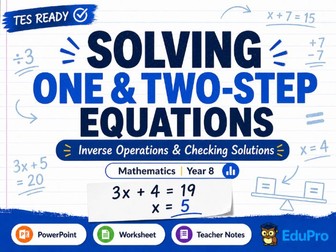
Description Complete Year 8 / KS3 maths lesson on solving one-step and two-step equations using inverse operations, designed for mixed-ability classes and aligned with GCSE (9–1) foundation skills. What’s included: Full lesson PowerPoint (10 slides) Detailed teacher notes with delivery guidance Worksheet with answers (29 marks, exam-style questions) Lesson covers: Inverse operations (addition/subtraction, multiplication/division) Solving one-step and two-step equations Structured solving method Checking solutions using substitution Forming and solving equations from word problems Teaching approach: Gradual release model (I do → We do → You do) Explicit focus on misconceptions Built-in assessment and quick checks Best for: Year 8 maths KS3 algebra lessons GCSE foundation revision If you use this resource, I’d be very grateful if you left a short review.
Battle of the Somme Source Evaluation Lesson | How Useful Is Haig’s Diary? | GCSE History | Year 10Quick View
EduProGo

Battle of the Somme Source Evaluation Lesson | How Useful Is Haig’s Diary? | GCSE History | Year 10

(0)
A ready-to-teach Year 10 GCSE History lesson exploring how useful Douglas Haig’s diary is as evidence of British leadership on the Somme. This lesson helps students build source evaluation skills by analysing Haig’s diary using Nature, Origin and Purpose, then testing its usefulness against contextual knowledge of the Battle of the Somme. It is designed to support students in making balanced historical judgements rather than treating one source as complete proof. Suitable for GCSE History, especially lessons focused on source utility, interpretation, and evaluating leadership in the First World War. What’s included 11-slide teaching PowerPoint source text handout featuring Haig’s diary extract teacher notes with lesson flow, misconceptions, and delivery guidance Lesson focus Students will: identify what Haig’s diary reveals about British leadership analyse the source using Nature, Origin and Purpose consider what the source shows and what it leaves out apply contextual knowledge of the Somme to reach a supported judgement Best for Year 10 GCSE History source evaluation practice Battle of the Somme / First World War units exam skills and written judgement development
Fractions, Decimals and Percentages Lesson + Worksheet | Year 7 MathsQuick View
EduProGo

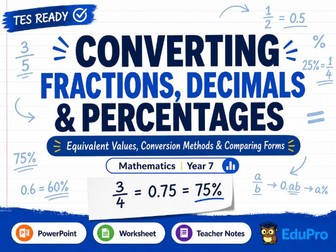
Fractions, Decimals and Percentages Lesson + Worksheet | Year 7 Maths

(0)
A complete Year 7 maths lesson on converting between fractions, decimals and percentages and comparing values. This resource includes a PowerPoint lesson, student worksheet and teacher notes / mark scheme, making it easy to teach as a full lesson or use for revision, cover, homework or intervention. What’s included: Editable PowerPoint presentation Independent practice worksheet Teacher notes with lesson guidance Mark scheme / answers Topics covered: Equivalent fractions, decimals and percentages Converting fractions to decimals Converting decimals to percentages Comparing values in different forms Avoiding common misconceptions Ideal for: Year 7 maths KS3 number skills Mixed-ability classes Revision or catch-up work The lesson is structured with a warm-up, vocabulary, worked examples, guided practice, independent practice and a short check for understanding. A useful classroom-ready resource for teaching or revising fraction, decimal and percentage conversions in a clear step-by-step way.