Found a Cafe | One-Lesson Business Start-Up ChallengeQuick View
TBSakari

Found a Cafe | One-Lesson Business Start-Up Challenge

(0)
A complete one-lesson decision challenge for A-Level Business: students found a fictional London cafe on paper and defend every choice in writing. No tech needed — just this booklet, a calculator and 60–75 minutes. Ten written decisions, every one spec-tagged and AO-tagged: PART 1 — FOUNDING (7 decisions): name and one-line promise (branding/USP), market position (premium, volume, specialist or balanced), choice of eight London sites with rent, footfall and rival data, team size with real wage costs, price and a £1,500 marketing budget split, a full break-even calculation with a worked example, and a synoptic launch pitch that links every choice into one argument. PART 2 — YEAR ONE (1 decision): deal each pair one of six crisis cards (bean price shock, chain rival, transport strike, viral moment, hygiene rumour, wage rise). Students diagnose whether it hits costs, demand or reputation — then respond. PART 3 — BOARDROOM (2 decisions): value the firm with a profit-multiple method and defend the multiple, then one honest reflection. Included: teacher guide with minute-by-minute timings, eight photocopiable site cards, six crisis cards, per-decision AO1–AO4 marking notes, a whole-booklet banding grid and an Edexcel 9BS0 spec map (D1–D10 across 1.3, 1.5, 2.2, 2.4, 2.5, 3.1–3.3). AO3 and AO4 are exercised eight times across the ten decisions. Written for Edexcel 9BS0 but the decisions map directly onto AQA 7132, OCR, WJEC and IB Business Management — the reasoning chain is the same. 13 pages, A4, print-ready. There are no right answers in this lesson — only trade-offs students can defend. The marks live in the reasoning. Found it useful? A star rating helps other teachers find this pack.
AQA A-Level Psychology | Revision & Essay BundleQuick View
TBSakari

AQA A-Level Psychology | Revision & Essay Bundle

(0)
Three full AQA A-Level Psychology 7182 packs in one 30-page PDF: Social Influence revision, Memory exam practice with mark schemes, and 16-mark essay technique. Print-ready. Pack 1 - Social Influence Revision Pack (pages 2-9). Full Paper 1 Section A coverage: conformity (Asch, Zimbardo), obedience (Milgram, situational and dispositional explanations), resistance to social influence, minority influence and social change. Study summary cards, explanation tables, a 16-mark essay scaffold, an annotated exemplar paragraph, an AO3 evidence bank and a key-terms glossary. Pack 2 - Memory Exam Practice Pack (pages 10-19). Exam-style questions at 4, 6, 8 and 16 marks with AQA-banded mark schemes and a Level 4 model essay. Covers the multi-store model, working memory, long-term memory types, interference, retrieval failure and eyewitness testimony - all 24 study citations checked (Loftus & Palmer, Baddeley & Hitch, Gabbert, Godden & Baddeley and more). Pack 3 - 16-Mark Essay Technique Pack (pages 20-29). How the 16-marker is marked, Levels 1-4 decoded, a 22-minute writing method, AO3 elaboration chains, two fully annotated Level 4 model essays and six practice essays with mark-scheme guidance. Works on every topic across Papers 1, 2 and 3. The three packs are designed to be used together: teach or revise the topic, drill the questions, then lift essay marks with the technique method. AO weightings and Levels 1-4 banding follow the published AQA mark schemes throughout. If this bundle saves you planning time, a quick review would mean a lot - it helps other teachers find it.
A-Level & IB Business | Motivation Premium PackQuick View
TBSakari

A-Level & IB Business | Motivation Premium Pack

(0)
Motivation & HRM mapped to CIE 9609, IB Business Management 2.4 and Edexcel IAL Unit 1 — every named theorist, 6 real case studies, 3 board mark schemes. A 22-page premium pack for teachers delivering motivation across more than one board — written for international schools running CIE 9609, IB Business Management (SL & HL) and Pearson Edexcel IAL in parallel, and equally usable on any one of the three. WHAT’S INSIDE Every named theorist across the three boards: Taylor, Mayo, Maslow, Herzberg, McClelland, Vroom, Adams (equity), Deci & Ryan (self-determination — IB-named) A board-by-board command-word table (CIE Analyse/Evaluate; IB Define/Explain/Discuss/Evaluate; Edexcel Analyse/Evaluate) so board-switching students stop losing structure marks 6 real case studies with current, sourced figures: John Lewis Partnership (the unpaid bonus vs employee ownership), Amazon (150% warehouse turnover and the $8bn attrition estimate), Toyota (kaizen and 20 million suggestions), Alphabet/Google (perks vs the 2023 layoffs), Haier (4,000 micro-enterprises, 10,000 middle managers removed), and Gallup’s global engagement data (23% engaged; $8.9tn cost) A worked labour-turnover cost calculation teachers can reuse with their own numbers Exam-style questions for each board with the correct command words and tariffs 3 mark schemes: CIE-style 8/12-mark levels, the IB 10-mark markbands, and an Edexcel IAL 20-mark levels grid 1 fully annotated IB 10-mark model answer showing markband 9-10 moves 26-term glossary in exam-precise language Sources listed for every case figure Three suggested teaching routes included (theory-first, case-first, exam clinic). All figures are the latest published at the time of writing (July 2026) and each source is named on the final page.
A-Level/IB Economics | Inflation Premium PackQuick View
TBSakari

A-Level/IB Economics | Inflation Premium Pack

(0)
Inflation and macroeconomic policy — a complete A-Level and IB Economics revision pack mapped to CIE 9708, IB Economics and Edexcel IAL, built around six real economies. This 20-page premium pack teaches inflation as one connected topic, then applies it to the latest 2025–26 data from the UK, the Eurozone, the USA, Turkey, Argentina and Japan — six contrasting stories: a central bank holding firm, a single rate for a whole currency union, headline versus core, very high inflation under orthodox tightening, dramatic disinflation, and a country exiting deflation. Each case study ends with a framework link so students see the theory in action. What’s inside: Definitions and measurement — inflation, disinflation, deflation, hyperinflation; CPI, RPI, HICP; headline versus core A fully worked CPI and core-inflation calculation, with the method shown step by step Causes of inflation — demand-pull, cost-push and built-in, with clearly labelled AD/AS diagrams Money and policy — the quantity theory (MV=PQ), the monetary transmission mechanism, quantitative tightening and the problem of policy lags The Phillips curve — short-run and long-run, the NAIRU and the role of expectations The costs of inflation and deflation, with a winners-and-losers view Six country case studies with verified 2026 figures and a comparative one-sheet synthesis A 35-term glossary for self-testing Exam practice for all three boards, each followed by its own mark scheme with the correct command words (CIE Assess / To what extent; IB Explain / Evaluate with the required real-world example; Edexcel Assess / Evaluate) Examiner tips, the five mistakes that cost marks, and a student self-mark checklist Ideal for international-school and sixth-form teachers covering inflation, monetary policy and macroeconomic objectives. Works as a teaching sequence, a revision booklet, or timed exam practice. Printable A4, grayscale-friendly, no preparation needed. All figures are the latest available as of May/June 2026 and are sourced on the final page.
AQA A-Level Business | Essay Technique BundleQuick View
TBSakari

AQA A-Level Business | Essay Technique Bundle

(0)
Three full AQA A-Level Business (7132) essay technique packs in one download: 9-mark Analyse, 12-mark Justify and 16-mark Assess - every extended-response tariff below the 25-marker, taught step by step. Each pack follows the same method: see the mark scheme decoded, study Level 3 and Level 4 worked answers built on real UK companies, then practise on fresh questions with full AQA-banded mark schemes. Pack 1 - 9-Mark Analyse Technique Pack (9 pages) AO1/AO2/AO3 split and Levels 1-3 banding decoded 4 Level-3 worked examples + 4 practice questions with mark schemes Chain-of-reasoning template, Level 2 vs Level 3 comparison, self-mark checklist Pack 2 - 12-Mark Justify Technique Pack (11 pages) AO1(2)+AO2(4)+AO3(3)+AO4(3) and Levels 1-4 banding decoded 4 Level-4 worked examples (Costa, Greggs, Aldi, JD Sports) + 4 practice questions 14-minute writing template and self-mark checklist Pack 3 - 16-Mark Assess Technique Pack (11 pages) Full AO1-AO4 evaluation and Levels 1-4 banding decoded 4 Level-4 worked answers + 4 practice questions with mark-scheme guidance 18-minute writing template, Level 3 to Level 4 lift comparison, self-mark checklist Real company contexts throughout: Greggs, Aldi, JD Sports, Costa Coffee, BrewDog, ASOS, Tesco, B&M, Gymshark and Pret a Manger, all with published 2023-24 figures and a sources table in each pack. Covers spec areas 3.4 Marketing, 3.5 Finance, 3.6 HR, 3.7 Operations, 3.9 Strategy and 3.10 Managing Change. Works for Papers 1, 2 and 3. 33 pages total. The three packs cost £3 bought separately - bundled here at £2.
AQA GCSE Business 8132 | 9 & 12 Mark | TechniqueQuick View
TBSakari

AQA GCSE Business 8132 | 9 & 12 Mark | Technique

(0)
The 9-mark and 12-mark questions are where AQA GCSE Business (8132) grades are won or lost — they carry the most marks on both papers and the most analysis and evaluation. Yet most students write everything they know and still never climb past Level 2. This pack fixes exactly that. It teaches the technique for both extended-response questions, step by step, then drills it with ten exam-style questions and full AQA-style banded mark schemes so students learn what the examiner is actually rewarding. What’s included (12 pages, grayscale, print-ready): A clear method for the 9-mark “Recommend / Justify” question — AO2 + AO3, three levels — including how to build a developed chain of analysis and a justified conclusion. A clear method for the 12-mark “Analyse + Evaluate two options” question — AO1 + AO2 + AO3, four levels — including how to reach the integrated Level 4 by linking finance, operations and marketing. 6 × 9-mark and 4 × 12-mark questions covering every spec area: 3.1 ownership, 3.2 influences, 3.3 operations, 3.4 HR, 3.5 marketing, 3.6 finance. A full levels-of-response mark scheme with indicative content for every question. 2 annotated model answers (Level 3 and Level 4) showing precisely how to move up the bands. A command-word bank, connective bank and an examiner “ten mistakes” checklist. Perfect for Year 10 and Year 11 revision, timed exam practice, intervention sessions, cover lessons and homework. The skills transfer to both papers. Zero prep — print and teach. If this saves you time, a quick star rating helps other teachers find it.
OCR J277 GCSE Computer Science | Binary & Hex Drill Pack (46 Qs + Answers)Quick View
TBSakari

OCR J277 GCSE Computer Science | Binary & Hex Drill Pack (46 Qs + Answers)

(0)
A focused drill pack for OCR J277 GCSE Computer Science Section 1.2 Data Representation. Built for revision lessons, low-stakes starters, or end-of-topic consolidation when students need to nail down the conversion skills that appear in every paper. What’s inside: Section 1: Denary to 8-bit Binary (8 questions) Section 2: 8-bit Binary to Denary (8 questions) Section 3: Denary to Hexadecimal (6 questions) Section 4: Hexadecimal to Denary (6 questions) Section 5: Binary to/from Hexadecimal (8 questions) Section 6: Binary Addition including overflow (5 questions) Section 7: Logical Shifts left and right (5 questions) Answers: Worked solutions for every question on the final pages Every section opens with a worked example using the column-value method, divide-by-16 method or nibble-substitution method as appropriate. Challenge questions are marked with a star and stretch students who need full marks on the 8-mark data representation question. Differentiation built in: Sections 1-4 are foundation-friendly, Sections 5-7 stretch to higher-tier students. Each question references the spec section, and a quick-reference nibble-to-hex table is included for students who need scaffolding. Print one copy per student. Keep the answer pages for marking. Works as a homework, lesson starter, intervention pack, or revision station.
AQA A-Level Business 7132 | 16-Mark Assess Technique PackQuick View
TBSakari

AQA A-Level Business 7132 | 16-Mark Assess Technique Pack

(0)
AQA A-Level Business 7132 — full technique pack for the 16-mark Assess question. 4 Level-4 worked answers (JD Sports, Greggs, Aldi, ASOS), 4 practice questions with mark scheme guidance (Pret, BrewDog, Gymshark, Burberry), AQA Levels 1–4 banding, 18-minute writing template, self-mark checklist, and a Level-3 vs Level-4 comparison showing exactly how to lift an answer. Sits naturally between the 9-mark Analyse and 25-mark Evaluate essay packs. Spec areas covered include 3.4 Marketing, 3.5 Finance, 3.6 HR, 3.7 Operations, 3.9 Strategy, 3.10 Managing change. Real UK companies and 2024 published figures throughout. Printable A4 (grayscale-safe). 11 pages. Suitable for in-class teaching, revision homework, or independent A-Level study. RESOURCE TYPE: Revision and assessment SUBJECT: Business Studies AGE: 16-18 CURRICULUM: AQA (+ English if multi-select; + International if multi-select for CIE/IB crossover) TOPIC: Business technique / exam skills PRICE: £1.00 (Paid) Anchor pricing per shop policy until 50 lifetime paid downloads. TAGS (paste exactly, 10–12 max): AQA Business, AQA 7132, A Level Business, 16 mark, Assess question, exam technique, revision, mark scheme, model answer, AO4 evaluation LICENCE: Standard TES licence UPLOAD STEPS REMINDER: tes.com/teaching-resources/shop/upload-resource Step 1 — paste TITLE and DESCRIPTION. After pasting into the SimpleMDE editor field, click inside it once, then Ctrl+A + Delete is NOT needed for a fresh listing — only on edits. Step 2 — attach PDF: AQA-A-Level-Business-16-Mark-Assess-Technique-Pack.pdf (no cover image generated for this listing — Sakari to either skip cover or generate one using the navy/white shop style on TES) Step 3 — Subject Business Studies, Age 16-18, AQA, English curriculum tag. Step 4 — paste the 10 tags above. Step 5 — Licence Standard, Price £1 → Publish. COMPLIANCE NOTES (verified before listing): 0 marketing red flags (no thebusiness.school, no email, no URL, no QR code, no pilot/demo language) 0 AI-slop words on the 28-term banned list AQA banding accurate (L1: 1–4, L2: 5–8, L3: 9–12, L4: 13–16; AO1–AO4 named) Spec section codes accurate (3.4 Marketing, 3.5 Finance, 3.6 HR, 3.7 Operations, 3.9 Strategy, 3.10 Managing change) Real UK companies with realistic 2024 figures (JD Sports, Greggs, Aldi, ASOS, Pret, BrewDog, Gymshark, Burberry) Author attribution ONCE on final page only (corrects 21.5 9-Mark Pack heads-up about per-page footer) One allowed CTA: “A star rating helps other teachers find this pack.” (final page) All 6 tables wrap correctly within column widths (visual QC passed by page-image render of pages 1, 2, 9, 10, 11)
AQA GCSE Business 8132 Paper 2 Exam Practice (9 & 12 marks)Quick View
TBSakari

AQA GCSE Business 8132 Paper 2 Exam Practice (9 & 12 marks)

(0)
A targeted Paper 2 practice pack for AQA GCSE Business 8132 students, built around the 9-mark and 12-mark questions where grade boundaries are decided. The pack contains 10 exam-style questions weighted toward the high-tariff Analyse, Justify and Evaluate command words that students lose marks on in mock exams. Five short real-world contexts run through the pack, all using publicly available 2024 figures. Greggs (revenue £2.01bn, after-4pm trading review) anchors the pricing and marketing-mix decision in question 8. BrewDog supplies the income statement for the gross profit margin calculation in question 7 and the retained-profit vs bank-loan decision in question 2. JD Sports drives the celebrity-endorsement analysis in question 3 and the rights-issue vs secured-loan evaluation in question 10. Aldi (45,000 UK staff, 14 per cent turnover) frames the recruitment-cost analysis in question 6. ASOS (£2.9bn revenue, £331m operating loss, Topshop relaunch) drives the product life-cycle and AI-marketing questions 5 and 9. Full AQA-banded mark schemes follow every question. Nine-mark questions use the three-level banding (Levels 1–3, with descriptors at 1–3, 4–6 and 7–9 marks). Twelve-mark questions use the four-level banding (1–3, 4–6, 7–9, 10–12). Three worked model answers are included for question 5 (9 marks), question 6 (9 marks) and question 10 (12 marks). Each model answer ends with a mark commentary that explains why the response sits at the top of the band. A specification map at the front lists every question with its marks, command word, AQA 8132 sub-section reference and topic. A command-word reference table on page 11 sets out what Identify, Explain, Analyse, Justify and Evaluate each actually demand. A 14-term glossary covers the key Paper 2 vocabulary. Spec coverage: 3.5 Marketing, 3.6 Finance, with one HR question (3.4.2 Recruitment) that is valid in either paper. Printable in grayscale on A4 portrait. 13 pages of dense, no-filler content. Suitable for class exam practice with peer marking, Year 11 mock preparation in the final three weeks before Paper 2, half-term revision homework, or as standalone starter and plenary activities focused on 9- and 12-mark technique.
AQA A-Level Business 7132 — 9-Mark Analyse Technique PackQuick View
TBSakari

AQA A-Level Business 7132 — 9-Mark Analyse Technique Pack

(0)
A focused technique pack for A-Level Business 7132 students aiming for top marks on the 9-mark Analyse question — the question that decides A and A* grades alongside the 25-mark Evaluate. What’s inside (9 pages): Four worked examples using real UK 2024 case studies. Greggs (£2.01bn revenue, third manufacturing site), ASOS (£331m operating loss, Topshop relaunch via TikTok Shop), JD Sports (£10.5bn revenue, £75m training programme) and BrewDog (141 bars, operating profit swing £8m to −£1m). Each worked example shows the full Level 3 response (8 or 9 out of 9) with a mark commentary explaining why the chain of reasoning sits at the top of the band. Four practice questions across Operations, Marketing, Finance and HR, each with a stem rich enough to build a Level 3 response. Full AQA-banded mark schemes (Levels 1–3) follow with indicative content specific enough to mark a student’s response against. The chain-of-reasoning technique broken into four stages — Point, Application, Development, So what — with the connectives that signal analysis to the examiner (this means, as a result, this matters because). Side-by-side comparison of what separates Level 2 (4–6 marks) from Level 3 (7–9 marks) on the five criteria examiners actually use. A printable chain-of-reasoning template students fill in before writing, plus an eight-point self-mark checklist that guarantees a Level 3 response if every box is ticked. Spec coverage: AQA A-Level Business 7132, applicable across Papers 1, 2 and 3. Pairs naturally with the AQA A-Level Business 25-Mark Essay Writing Toolkit for full essay technique preparation. Printable in grayscale on A4 portrait. Suitable for class practice, mock preparation, half-term revision or self-study.
OCR J277 GCSE Trace Tables Practice PackQuick View
TBSakari

OCR J277 GCSE Trace Tables Practice Pack

(0)
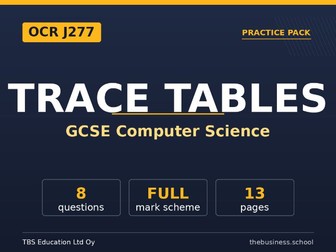
Trace table revision pack for OCR J277 GCSE Computer Science. 8 progressive questions: counter loops, conditional accumulators, WHILE loops, swap algorithms, linear search, two-counter problems, nested loops and a partial bubble sort pass. Every question maps to specific spec points (1.2.3, 2.1.1, 2.1.3) and uses OCR Exam Reference Language pseudocode. What is included: 8 trace table questions with answer space Full mark scheme with completed trace tables and OCR-style mark allocations A rules page covering inclusive vs exclusive loops, zero-based array indexing, and how to record IF/WHILE conditions in a trace Common student mistakes feedback prompts for teachers Spec references on every page 13 pages, A4 portrait, grayscale-safe, printable without colour ink Total marks: 53. Suggested timing: 50 minutes under exam conditions, or use as 6 starters across two weeks before the paper.
AQA A-Level Economics | Macroeconomic Policy | 25-Mark Essay Pack | Paper 2 RevisionQuick View
TBSakari

AQA A-Level Economics | Macroeconomic Policy | 25-Mark Essay Pack | Paper 2 Revision

(0)
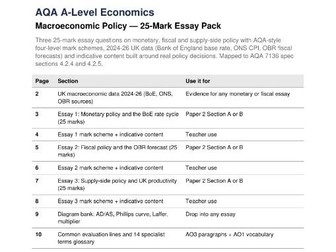
Last-week revision pack for AQA A-Level Economics Paper 2. Built for students sitting the exam in summer 2026. In this pack: UK macroeconomic data 2024-26 reference sheet. Bank of England base rate 3.75% (held 4 Feb 2026, 5-4 vote), ONS CPI 3.4% (Dec 2025), GDP Q4 2025 +0.2% QoQ, PSND about 95.5% of GDP, OBR fiscal headroom about £22 bn at the Autumn Statement 2025, UK productivity 0.4% per year 2010-24. Quotable figures with sources. Essay 1 (Monetary policy): “To what extent is interest-rate policy still the most effective tool for hitting the 2% inflation target?” with AQA-style four-level mark scheme and Level 4 indicative content covering transmission mechanism, time lags, asymmetric effects and cost-push limits. Essay 2 (Fiscal policy): “Evaluate the case for using fiscal policy to stimulate UK growth in 2026” with mark scheme and indicative content covering OBR multipliers, crowding out, Ricardian equivalence and the 2022 mini-budget credibility lesson. Essay 3 (Supply-side policy): “Assess the view that supply-side policy is the only effective way to close the UK productivity gap” with mark scheme and indicative content covering LRAS shifts, hysteresis, R&D intensity and the limits of pure supply-side reasoning. Diagram bank: AD/AS short and long run, Phillips curve (SRPC + LRPC), Laffer curve, multiplier process. What to label and when to use each. Eight common evaluation lines that transfer across all three essays (time lags, crowding out, Ricardian equivalence, credibility, distribution, type of inflation, open-economy effects, hysteresis). 15-term glossary including transmission mechanism, hysteresis, multiplier, output gap, headroom, QE/QT, forward guidance, symmetric target, Ricardian equivalence. Mark schemes follow AQA 7136 25-mark conventions (AO1 4, AO2 6, AO3 6, AO4 9). Sources: Bank of England MPC minutes, ONS CPI/GDP/LFS/productivity series, OBR Economic and Fiscal Outlook November 2025, HM Treasury Autumn Statement 2025, OECD Main Science and Technology Indicators. 11 pages A4 portrait. Grayscale-printable. Spec reference on every page header. Print, photocopy, hand out.
AQA Psychology Memory: 4, 6, 8 & 16 Mark PackQuick View
TBSakari

AQA Psychology Memory: 4, 6, 8 & 16 Mark Pack

(0)
Four AQA-style Paper 1 Memory questions — 4, 6, 8 and 16 marks — with full model answers and AQA-style mark schemes broken down by AO1 and AO3. Spec 4.1.2. Print-and-go. What you get: Q1 (4 marks) Outline the multi-store model — exactly the style of recent AQA papers, with an AO1-only mark scheme. Q2 (6 marks) Explain one limitation of the working memory model — full model answer covering the central executive critique, with banded AO1/AO3 split. Q3 (8 marks) Outline and evaluate interference as an explanation for forgetting — model answer covers proactive, retroactive, McGeoch and McDonald (1931), Underwood (1957) and Baddeley and Hitch (1977). Q4 (16 marks) Discuss research into the effect of misleading information on eyewitness testimony — a full Level-4 essay you can hand straight to students as a WAGOLL, with explicit substitution vs response-bias debate, Bekerian and Bowers (1983) as discriminator, individual differences via Anastasi and Rhodes (2006), and a committed judgement paragraph. Total 34 marks. Run it as a 60-minute mock, or split across four lessons. Every model answer cites real research with year and finding: Atkinson and Shiffrin 1968, Miller 1956, Peterson and Peterson 1959, Baddeley and Hitch 1974 and 1977, Baddeley 2003, Tulving 1985, McGeoch and McDonald 1931, Loftus and Palmer 1974 (verb intensity 31.8 mph to 40.5 mph), Gabbert et al. 2003 (71 percent memory conformity), Bekerian and Bowers 1983, Foster et al. 1994, Geiselman et al. 1985, Anastasi and Rhodes 2006, Schooler and Loftus 1986, and more. Mark schemes follow AQA’s banded style with explicit AO1 and AO3 weightings for every question, plus Level 1 to 4 descriptors for the 16-mark essay. Three student tear-off sheets at the back: a 25-term Memory glossary written in exam-ready language, a side-by-side MSM vs WMM comparison with key supporting studies, and a full reference list. Designed to print cleanly on a school photocopier — grayscale-friendly, no heavy ink coverage, no colour required. Teacher notes after each mark scheme flag the most common student errors: STM capacity vs duration confusion on Q1, students who describe two studies without ever evaluating on Q3, and the single most common reason 16-mark essays drop a level on Q4 (failing to commit to a judgement). Cap-at-level instructions are included for marking consistency across a department. Suitable for Year 12 first teaching, Year 13 mock-prep, exam-clinic homework and revision intervention. Every question has been quality-checked against the AQA 7182 specification and every study citation verified against its original source. From TBS Education. More AQA resources at thebusiness.school.
AQA A-Level Geography | Tectonic Hazards | Nepal 2015 + Eyjafjallajökull 2010 Revision PackQuick View
TBSakari

AQA A-Level Geography | Tectonic Hazards | Nepal 2015 + Eyjafjallajökull 2010 Revision Pack

(0)
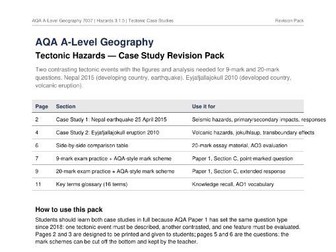
Exam-season revision pack for AQA A-Level Geography Hazards (Paper 1, Section C). Two contrasting case studies most likely to come up in Paper 1: Nepal earthquake 25 April 2015 (M7.8, developing country) and Eyjafjallajökull eruption April–May 2010 (VEI 4, developed country). In this pack: Case Study 1 (Nepal 2015): epicentre, focal depth, plate boundary, convergence rate, primary impacts (Dharahara Tower, Sindhupalchok, UNESCO sites), secondary impacts (Pumori avalanche on Everest Base Camp, Langtang landslide, monsoon health crisis), short and long-term responses (Operation Maitri, DFID £73m, NRA). Case Study 2 (Eyjafjallajökull 2010): plate setting, magma type, phreatomagmatic mechanism, jökulhlaup damage to Ring Road, six-day European airspace closure, US$1.7 billion airline loss, knock-on Kenyan flower export collapse. Side-by-side comparison table with 10 rows including plate boundary, deaths, displacement, predictability, governance and hazard type. Three rows marked for AO3 evaluation. 9-mark exam practice with planning space, lined writing space, AQA-style three-level mark scheme and indicative content. 20-mark exam practice with PEEL paragraph scaffold, AQA-style four-level mark scheme (AO1/AO2/AO3 split) and seven-point indicative content covering both physical and human factors. 16-term glossary with examiner-precise definitions (hazard, vulnerability, capacity to cope, plate boundary types, moment magnitude, VEI, phreatomagmatic, jökulhlaup, pyroclastic flow, hazard management cycle, Park’s model). Design: 12 pages A4 portrait, grayscale-printable, navy and grey accents only. Spec reference on every page header. Sources: USGS, Smithsonian GVP, Met Office VAAC, IATA, World Bank, ICAO Doc 9974. Print, photocopy, hand out.
AQA Business Marketing Mix Flashcards (24)Quick View
TBSakari

AQA Business Marketing Mix Flashcards (24)

(0)
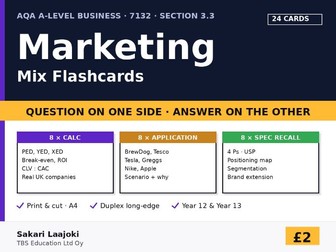
Twenty-four printable revision flashcards for AQA A-Level Business 7132, section 3.3 Marketing. Question on one side, answer on the other. Duplex long-edge printable. Print, cut, hand out. Three card types, eight cards each. Eight calculation cards drill PED, YED, XED, market share, marketing ROI, break-even, click-through and conversion rates, and customer lifetime value — every number from a real UK company so students see Tesco’s milk pricing, Greggs’ £4.2bn market, Innocent’s £8m campaign, Gymshark’s £45 hoodie launch, Brewdog Instagram CPA and Apple iPhone CLV. Eight application cards drop students into a real strategic scenario — BrewDog raising Punk IPA from £6 to £6.50, Aldi forcing Tesco into a positioning decision, Tesla shifting from pure pull to push promotion for the Model 3, Greggs launching the vegan sausage roll, Apple holding price against Samsung, Innocent choosing niche over mass, McDonald’s £8m gluten-free decision, and Nike’s 35-year Just Do It positioning. Eight spec-recall cards lock down the AQA terminology examiners reward: PED formula and strategic read, B2C vs B2B buying behaviour, the four Ps as decision-making framework, positioning maps and gap analysis, niche marketing strengths and limits, behavioural vs geographic segmentation, brand extension success and failure, and Unique Selling Proposition as the heart of positioning. Every card is tagged with its AQA 7132 spec section (3.3.2, 3.3.3 or 3.3.4) in the top-right corner so students can navigate by spec and teachers can pull a subset for a single lesson focus. Format. A4, grayscale-friendly, prints cleanly on a school photocopier. Three front sheets and three back sheets. Print duplex long-edge and the back of each card holds the matching answer. Dashed cut lines mean students or technicians can cut a set in under three minutes. Eight cards per sheet at roughly 95 by 67 millimetres — large enough to read across a classroom, small enough to fit a revision pencil case. Use it as a starter set for first teaching, as a recap pack for a Year 13 cohort revising for Paper 1 or Paper 3, as exam-clinic intervention for students dropping marks on calculation questions, or as a homework pack the week before mocks. Three cards a day for eight days covers the section. The pack has been quality-checked: every calculation has been independently recomputed and every spec tag verified against the AQA 7132 specification. By Sakari Laajoki.
AQA A-Level Business 25-Mark Essay ToolkitQuick View
TBSakari

AQA A-Level Business 25-Mark Essay Toolkit

(0)
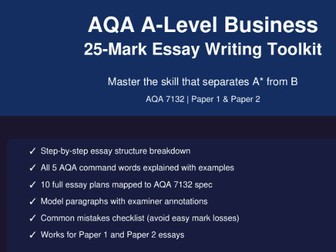
13 pages. 10 full essay plans. Model paragraphs with examiner annotations. All mapped to the AQA 7132 spec. The 25-mark essay is worth more marks than any other question on the AQA A-Level Business paper — and it’s the one students find hardest. Most students know the content but lose marks because they don’t know how to structure an argument, how to hit all four AOs in a single paragraph, or what examiners actually mean by “evaluate” vs “assess”. This toolkit fixes that. It’s 13 pages of practical, ready-to-use material that takes students from “I know the theory but can’t write it under pressure” to “I can plan and write a 25-mark essay in 40 minutes.” The 4-Part Essay Framework A clear, repeatable essay structure broken into four sections: Introduction, Arguments FOR, Arguments AGAINST, and Judgement. Each section shows exactly which AOs are being targeted (AO1 Knowledge, AO2 Application, AO3 Analysis, AO4 Evaluation) and how many marks are available per section. Students stop guessing what goes where and start writing with purpose. AQA Command Word Guide Students often write the same essay regardless of whether the question says “evaluate”, “assess”, “to what extent”, or “discuss”. This page breaks down what each command word actually requires in terms of structure and depth. For example: “To what extent” demands a clear position in the judgement with conditions — not just a vague “it depends”. The difference between a 15-mark and a 21-mark essay often comes down to this. 10 Detailed Essay Plans (AQA Spec Topics 3.1-3.8) Each essay plan gives students a full skeleton they can adapt: a clear question, two or three FOR arguments with real-business evidence, two or three AGAINST arguments, and a reasoned judgement. Every plan uses a named business so students see what genuine application (AO2) looks like — not generic “a business might…” filler.
HSC Business Studies | Marketing Trial HSC Practice Pack | NESA NSW Year 12Quick View
TBSakari

HSC Business Studies | Marketing Trial HSC Practice Pack | NESA NSW Year 12

(0)
A full Trial HSC-format practice paper on the Marketing topic for Year 12 NESA Business Studies (NSW). 10 multiple-choice + 3 short-answer questions (4/6/10 marks) + a 20-mark extended response on Cotton On Group’s global expansion. Includes full marking guide with band descriptors, a Band 6 sample skeleton plan, and complete NESA syllabus mapping to outcomes H1–H10. Real Australian case studies with real data: Aldi Australia (580+ stores, ~9% market share, 1,800-SKU range), Cotton On Group (1,400+ stores across 19 countries, A$2bn+ revenue, founded 1991 in Geelong), Bunnings, Guzman y Gomez. What’s inside (11 pages, A4): Section I — 10 MCQs covering market segmentation, the marketing mix, the marketing process, influences on marketing, and consumer law (ACL). Section II — three short-answer questions: primary vs secondary research with a Guzman y Gomez application; two pricing strategies in a contemporary AU business; a 10-mark Analyse question on Aldi Australia with a detailed stimulus. Section III — 20-mark extended response on Cotton On Group’s global marketing strategies, in business report format. Full marking guide with banded mark schemes for each question. Band 6 skeleton plan (title, executive summary, five body paragraphs, conclusion). Complete NESA syllabus mapping table linking every question to syllabus points and HSC outcomes. Designed for: Year 12 Trial HSC preparation (Term 2 / early Term 3) Half-yearly assessment task with minimal teacher prep Cohort marking moderation — band descriptors are sit-and-go Question paper and marking guide are on separate pages so the question paper can be photocopied for students without revealing answers. Created by TBS Education Ltd Oy (Finland, company number 3614159-3) | thebusiness.school
VCE Psychology Unit 3 Memory Revision PackQuick View
TBSakari

VCE Psychology Unit 3 Memory Revision Pack

(0)
A 15-page exam revision pack for VCE Psychology Unit 3 Area of Study 2, fully aligned to the VCAA Study Design 2023-2027. Covers the Atkinson-Shiffrin multi-store model, all four types of long-term memory, the five named brain regions (hippocampus, amygdala, neocortex, basal ganglia, cerebellum), autobiographical reconstruction with Loftus’s 1974 leading-question study, and mnemonics including Songlines. What’s inside (15 pages): Knowledge Organiser 1: Atkinson-Shiffrin model - function, capacity, duration and encoding for sensory, STM and LTM, plus the key processes between stores and the most common student mistakes flagged in past examiners’ reports. Knowledge Organiser 2: Types of LTM - episodic, semantic, procedural and classically conditioned - with worked examples and the brain region most involved in each. Knowledge Organiser 3: The five named brain regions with location, role in memory and a quick-recall mapping table linking each region to the type of LTM it supports. Knowledge Organiser 4: Autobiographical reconstruction, Loftus’s ‘smashed/hit’ study (1974), the three named mnemonics (acronyms, acrostics, method of loci) and Songlines as an Aboriginal and Torres Strait Islander oral mnemonic system. Practice exam Section A: 15 multiple-choice questions in the four-option VCAA format. Practice exam Section B: 4 short-answer questions (2, 3, 4, 4 marks). Practice exam Section C: 1 ten-mark extended-response question with three required components and stimulus. Marking guide (teacher copy): MC key with examiner notes; short-answer marking with mark-by-mark allocations and common errors; extended-response component table. Why teachers like this pack: Every question references the relevant VCAA Key Knowledge dot point. Examples use real named studies (Atkinson & Shiffrin 1968; Miller 1956; Loftus 1974; case of patient H.M.). Mark schemes follow the structure of recent VCAA examiners’ reports - credit specific psychological reasoning, not generic statements. Clean, print-ready A4 layout. No clip art. Looks like a VCAA publication. Answer key prints separately so students see only the questions. How to use: Print pages 2-5 as a stand-alone revision booklet for students. Print pages 6-7 (questions only) for in-class assessment or homework. Keep pages 8-12 (marking guide) for staff use. Total: 38 marks across the practice exam.
AQA A-Level Business 3.5 Financial Decision Making — Complete Teaching Bundle (7 Resources)Quick View
TBSakari

AQA A-Level Business 3.5 Financial Decision Making — Complete Teaching Bundle (7 Resources)

(0)
A complete teaching bundle covering AQA A-Level Business Topic 3.5: Making Financial Decisions, mapped directly to the 2024 specification across all four subtopics (3.5.1–3.5.4). What’s included (7 resources): 4 × Lesson Slide Decks (PowerPoint, fully editable): Lesson 3.5.1 — Setting Financial Objectives (10 slides): Greggs case study — £1.8bn revenue, 10.4% operating margin, 145 new stores. Covers revenue, cost, and profit objectives with real financial data. Lesson 3.5.2 — Analysing Financial Performance (9 slides): Tesco vs Sainsbury’s ratio comparison — gross profit margin, operating margin, ROCE, gearing, current ratio using 2024 annual report figures. Lesson 3.5.3 — Sources of Finance (9 slides): BrewDog case study — £213m private equity deal, £90m Equity for Punks crowdfunding, £400m debt refinancing. Internal vs external, short vs long-term. Lesson 3.5.4 — Improving Cash Flow and Profits (10 slides): Ryanair case study — €13.4bn revenue, 14.3% net margin, 183.5m passengers. Cash flow forecasting, working capital management, profit improvement strategies. 1 × Worksheet Pack (PDF, 4 pages, printable): One worksheet per subtopic with real company case study context, short-answer questions (Section A), and a 12-mark extended response (Section B). Full AQA-style mark schemes included for every question (Knowledge 1–2, Application 2–4, Analysis 4–6, Evaluation 6–10). 1 × Exam Practice Pack (PDF, printable): Three 25-mark exam-style questions with detailed company extracts (Greggs, BrewDog, Gymshark vs JD Sports). Each question follows AQA’s 2+4+9+10 mark structure with full level descriptors and indicative content. Ideal for timed practice, homework, or mock preparation. 1 × Knowledge Organiser (PDF, landscape A4, printable): Single-page revision resource covering all four subtopics — key definitions, formulae (gross profit margin, operating margin, ROCE, gearing, current ratio, break-even), and real company data points. Colour-coded columns for quick reference during revision. All resources use real companies with real financial data — Greggs, Tesco, Sainsbury’s, BrewDog, Ryanair, Gymshark, JD Sports. No generic examples. Designed for AQA A-Level Business but also suitable for Edexcel/OCR with minor adaptation. Print-ready (grayscale-friendly, A4 layout).
AQA A-Level Business — Complete Knowledge Organiser (Topics 3.1–3.8) | 12 Pages | Print-FriendlyQuick View
TBSakari

AQA A-Level Business — Complete Knowledge Organiser (Topics 3.1–3.8) | 12 Pages | Print-Friendly

(0)
A complete 12-page knowledge organiser covering every topic in the AQA A-Level Business specification (3.1 through 3.8). Each page is a self-contained, single-topic summary designed for A4 printing in black and white — no colour printer needed. Topics covered in full: 3.1 What is business? — Mission, objectives, stakeholders, revenue/cost/profit calculations, supply and demand, PED and YED with worked examples, market structures 3.2 Managers, leadership and decision making — Management vs leadership, Tannenbaum-Schmidt and Blake Mouton models, decision trees with EMV calculations, stakeholder mapping 3.3 Decision making to improve marketing performance — STP, product life cycle with extension strategies, Boston Matrix, Fisher price sensitivity, digital marketing and e-commerce 3.4 Decision making to improve operational performance — Labour productivity formula, capacity utilisation calculations, lean production (JIT, Kaizen, cell), quality management (TQM, benchmarking) 3.5 Decision making to improve financial performance — Gross/operating/net profit margin formulas, ratio analysis (ROCE, current ratio, gearing), sources of finance comparison, breakeven with worked example 3.6 Decision making to improve human resource performance — Labour turnover and retention formulas, Herzberg two-factor theory, Maslow, employee engagement, flexible working 3.7 Analysing the strategic position of a business — SWOT, PESTLE, Porter’s Five Forces, Ansoff Matrix, Bartlett and Ghoshal framework, Elkington Triple Bottom Line 3.8 Choosing strategic direction and managing strategic change — Bowman’s Strategy Clock, mergers and takeovers, organic vs inorganic growth, Kotter and Schlesinger change management model, corporate culture (Handy) Every page includes key definitions in bold, formulas with calculation examples, named theorists and models with short explanations, and real-world business references (Apple, Tesco, Ryanair, JD Sports among others). How to use in your classroom: Print and laminate for classroom wall display — students see key terms daily Issue as a revision booklet at the start of Year 12 or Year 13 Use as a lesson starter: “find three key terms on this page you can’t define yet” Homework: students self-test using the organiser then mark their own answers Exam prep: students highlight areas they’re weakest on before mocks Designed specifically for the AQA 7132 specification (both AS and A-Level). All formulas match the exact wording AQA use in their mark schemes. 12 pages, A4, grayscale, print-ready. No preparation needed — download, print, hand out.