GCSE Biology: Cell Biology Practical's Bundle - AQA & Edexcel (Microscopy & Microbiology)Quick View
SW1996

GCSE Biology: Cell Biology Practical's Bundle - AQA & Edexcel (Microscopy & Microbiology)

(0)
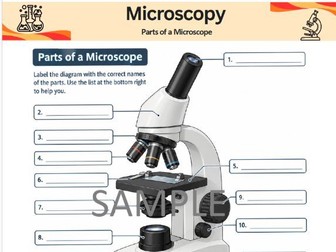
Maximize your students’ exam performance with this premium GCSE Biology Cell Biology Core Practicals worksheet bundle. This high-quality, print-ready resource package is fully aligned with both AQA Required Practicals 1 & 2 and Edexcel Core Practicals 1.6 & 5. Specifically designed for the GCSE 9-1 specification, these sheets cover every essential skill required for mandatory cell biology practical exam questions. The bundle features comprehensive labeling activities, clear step-by-step experiment methods, and dedicated calculation guides. Perfect for classroom lessons, structured homework booklets, cover work, or intensive exam revision sessions, this pack ensures students master key apparatus use, math conversions, safety constraints, and active recall skills. Teachers can utilize the worksheets to build student confidence in technical lab methods, including aseptic preparation, staining techniques, and microscope adjustments, ensuring complete readiness for Paper 1 practical assessments. What is included in this digital download bundle: Resource 1: Microscopy Practical Pack (Onion Cell) • Page 1: Parts of a Microscope Diagram: A beautifully illustrated microscope layout matching standard school laboratory equipment. Includes an built-in word bank detailing parts and functions (eyepiece, objective lenses, focus knobs, stage clips) for student labeling. • Page 2: Step-by-Step Practical Method: Clear instructions divided into Part A (Preparing the Slide using iodine stain) and Part B (Using the Light Microscope). Includes critical examiner hints, such as avoiding trapped air bubbles and keeping lenses safe. • Page 3: Drawing & Calculations Layout: Official GCSE scientific drawing rules alongside the total magnification mathematical formula. Features a dedicated bordered workspace for student observations. Resource 2: Culturing Microorganisms Practical Pack (Microbiology) Page 1: Aseptic Technique & Plate Preparation: A clear guide detailing the mandatory steps to prevent culture contamination. Covers the scientific reasoning behind flaming inoculating loops, workspace disinfection, and creating a convective sterile field using a Bunsen burner flame. Page 2: Testing Antiseptics & Antibiotics Method: Structured instructions for applying paper discs, securing lids correctly using a cross-tape method (to avoid anaerobic conditions), and specific incubation constraints (upside down at a maximum of 25°C). Page 3: Measuring Zones of Inhibition: A data recording table and a targeted math guide helping students calculate the circular area of bacterial death using the A=πr2 formula to mathematically rank chemical effectiveness. Includes an illustrative example diagram with a “not to scale” figure legend. Key features: Fully covers the specification requirements for AQA GCSE Biology (9-1), Combined Science Trilogy, and Edexcel GCSE Biology (9-1).
Diffusion of Potassium Permanganate Practical Worksheet & Markscheme (KS3 Science)Quick View
SW1996

Diffusion of Potassium Permanganate Practical Worksheet & Markscheme (KS3 Science)

(0)
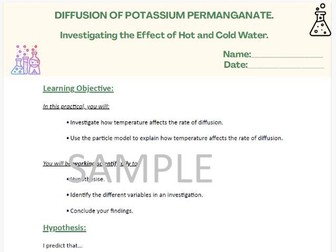
Master diffusion with this complete KS3/KS4 Potassium Permanganate practical pack! Includes a 4-page student worksheet and full teacher mark scheme. This ready-to-print resource guides students through investigating the effect of hot and cold water temperature on the rate of diffusion using the particle model. Designed to build core Working Scientifically skills, this lesson pack helps students structure a hypothesis, identify independent, dependent, and control variables, record data, and draw a particle-based conclusion. What’s Included in this Download: • Page 1: Learning Objectives & Hypothesis – Sets clear goals and scaffolded prediction lines. • Pages 1–2: Identifying Variables – Focused sections for Independent, Dependent, and Control variables to secure easy marks. • Page 2–3: Step-by-Step Practical Method – A clear, foolproof student checklist including safety/accuracy rules (such as a strict “no stirring” directive). • Page 3: Results Table & Observations – Clear layout for temperature (°C) and time taken (s) data collection. • Page 3: Conclusion & Particle Theory – Scaffolding to explain why hot water increases kinetic energy and speeds up particle movement. • Page 4: Extension Activity – A high-tier challenge exploring the definition and mechanics of a concentration gradient. • Complete Teacher Mark Scheme / Answer Key – Perfect for quick grading, peer assessment, or display on the board. Perfect For: • Key Stage 3 Science (Years 7–9) – States of Matter and Particles topics. • GCSE Physics / Chemistry / Biology revision – A great refresher on transport over cell membranes or basic kinetic theory. • Cover Lessons – Easy to follow, self-contained layout requiring minimal teacher input.
Antibiotic Resistance & Selection Pressures: Advanced Biology PackQuick View
SW1996

Antibiotic Resistance & Selection Pressures: Advanced Biology Pack

(0)
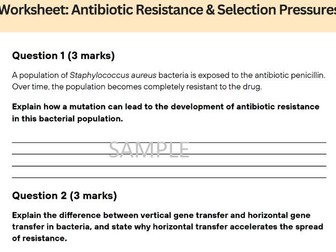
Advanced Biology Antibiotic Resistance & Selection Pressures worksheet with a comprehensive mark scheme. Perfect exam prep for A-Level. What’s Included? • 2-Page Student Worksheet: 5 structured, exam-style questions totaling 20 marks. • 2-Page Mark Scheme: A point-by-point teacher marking guide with precise scientific vocabulary for fast grading. Topics Covered: • Selection Pressures: How continuous penicillin use acts as a selection pressure, driving directional selection. • Gene Pool Changes: How selection pressures alter allele frequencies over generations. • Bacterial Genetics: Spontaneous mutations and vertical vs. horizontal gene transfer. • Practical Methodology: Describing the disc diffusion method, outlining how to calculate the zone of inhibition area (π r²), and ensuring experimental reliability. • Superbugs: Cellular defenses (β-lactamase and efflux pumps) alongside human antibiotic misuse. Perfect For: • Homework assignments, end-of-unit diagnostic tests, or structured lesson revision.
Bacterial Cell Walls: Gram-Positive vs Gram-Negative BundleQuick View
SW1996

Bacterial Cell Walls: Gram-Positive vs Gram-Negative Bundle

(0)
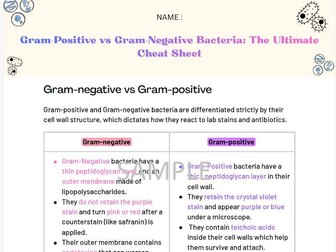
Gram-positive and Gram-negative bacteria are differentiated strictly by their cell wall structures, dictating how they react to lab stains and antibiotics. This premium, classroom-ready educational bundle is designed to take students from foundational understanding to absolute exam mastery. It is optimized for high school biology, AP Biology, A-Level Biology, or introductory microbiology courses. What’s Included in the Download: The Ultimate Cheat Sheet (Page 1): A high-impact, side-by-side visual comparison guide. It contrasts peptidoglycan thickness, outer membrane composition, teichoic acids, staining color mechanics, and clinical antibiotic pathways. The Student Worksheet (Pages 2–3): A 4-question, 13-mark mock exam template. It transitions from basic structural recall to high-tier, application-based diagnostic questions. The Official Mark Scheme (Pages 4–5): A comprehensive, examiner-style grading guide detailing exactly where incremental points are awarded.