WWI AlliancesQuick View
StotzEdu

WWI Alliances

(0)
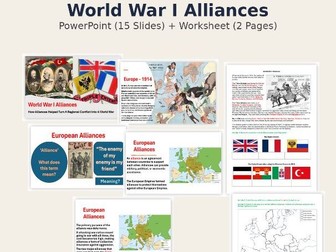
Bring the causes of World War I to life with this engaging and ready-to-use World War I Alliances Resource Pack. Designed to help students clearly understand how alliances transformed a regional conflict into a global war, this resource combines visual learning with meaningful analysis activities. What’s Included: 15-slide PowerPoint presentation Introduction & Context What Are Alliances? The Triple Entente The Triple Alliance & Central Powers Rising Tensions in the Balkans The Chain Reaction Source Analysis / Reflection Tasks 2-Page Worksheet Informational text on the Triple Entente, Triple Alliance, and Neutral Nations Activity 1: Identify countries from their WWI-era flags Activity 2: Label a blank map of Europe with alliance countries Activity 3: Colour-code the map using the alliance key Activity 4: Analyse a primary source (political cartoon, 1914) and explain how the alliance system caused WW1 Answer sheet included Key words: WW1, World War One, WWI, alliances, Triple Entente, Triple Alliance, causes of WW1, map activity, primary source, year 8, year 9, year 10, grades 7-9, history worksheet File type: PPT & PDF
Battles of the Western Front: Verdun, the Somme, Passchendaele + Strategy Board GameQuick View
StotzEdu

Battles of the Western Front: Verdun, the Somme, Passchendaele + Strategy Board Game

(0)
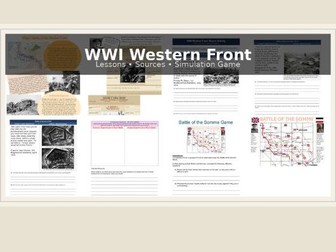
Major Battles of the Western Front: Complete Resource Pack (Junior High School) Bring WWI to life with this engaging, multi-activity resource pack covering the three major battles of the Western Front: Verdun, the Somme, and Passchendaele. Designed for junior high school, this pack moves students through a carefully scaffolded sequence of tasks: from reading and research, to source analysis, to a hands-on strategy board game, building both historical knowledge and critical thinking skills along the way. What’s included: Resource 1 Page 1: Visually rich reading covering the Western Front, Verdun, the Somme, and Passchendaele Page 2: Two Soldier’s Field Reports (battle research task: Somme and Passchendaele) in an authentic military document style Page 3-6: Source analysis worksheet comparing soldier accounts with historical photographs across all three battles + a reflection of the battles Page 7: Game reflection worksheet with structured historical thinking questions Resource 2 Battle of the Somme board game (Risk style strategy game) **Resource 3 ** Battle of the Somme board game rules (with visuals) Curriculum connections: Historical sources and evidence, historical significance, cause and effect, empathy and perspective. No prep needed! just print and go!
Battle of the Somme Board Game (Risk Style Strategy Game)Quick View
StotzEdu

Battle of the Somme Board Game (Risk Style Strategy Game)

(0)
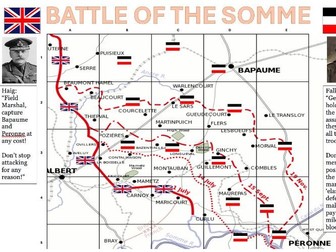
Battle of the Somme Battle of the Somme is a two-player (or two-team) strategy board game that recreates the challenges of trench warfare during World War I. One side plays as Britain, launching an all-out offensive, while the other plays as Germany, using defensive tactics to hold their ground. The game is played on a grid-based map representing the Western Front, with each space controlled by armies (represented by tokens). Players take turns attacking, defending, and manoeuvring their forces to achieve their objectives. Gameplay Overview Britain begins with a larger attacking force and must push forward across the battlefield, capturing key enemy positions, including the cities of Bapaume and Peronne, while taking control of all German-held territories. The British player must carefully manage their troops, as losses are permanent. Germany, on the other hand, focuses on defence. Using an “elastic defence” strategy, German forces retreat rather than being destroyed, trying to wear down the British through repeated attacks and attrition. Combat System Battles are resolved using dice rolls. When Britain attacks an adjacent German position, both sides roll a die: The higher roll wins the battle. If Britain wins, German troops retreat and Britain advances. If Germany wins, Britain loses a unit. This simple system creates tension, as even strong attacks can fail, reflecting the unpredictability of real warfare. Key Features Asymmetrical gameplay: Britain attacks; Germany defends. Permanent losses for Britain vs. retreating German forces, highlighting different military strategies. Tactical movement rules, including adjacency and restrictions on diagonal attacks for Britain. Strategic decision-making, as players must choose where to concentrate forces and when to risk attacking. Winning the Game Britain wins by capturing Bapaume, Peronne, and all German positions. Germany wins by reducing British forces so they can no longer effectively attack while still holding key locations. Educational Purpose The game illustrates key concepts of World War I trench warfare, including: Attrition and heavy losses Defensive advantages The difficulty of advancing across enemy lines
Why Men Enlisted in World War One (WWI) - Includes  Differentiated Lesson!Quick View
StotzEdu

Why Men Enlisted in World War One (WWI) - Includes Differentiated Lesson!

(0)
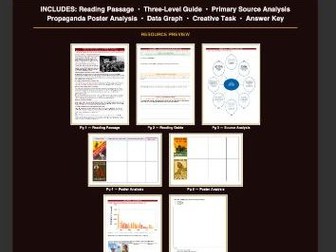
This fully resourced, 7-page student worksheet explores the eight major reasons men enlisted and fought in World War One. Designed for Years 9-10 History, it combines structured reading, historical thinking, primary source analysis, and creative tasks into a single engaging lesson or two-lesson sequence. What is included: Reading passage: covering 8 causes of enlistment with an accompanying photograph Three-level reading guide: (on the lines, between the lines, beyond the lines) Primary source concept map: students match 8 verified soldier quotes to the 8 causes WWI propaganda poster analysis: 4 real posters with observation and inference tasks Extension section: Recruitment graph analysis and modern vs WWI poster comparison Creative task: Students design their own recruitment poster and explain their choices Differentiated version included: covers 4 causes with simplified text, bracketed definitions, word bank, and scaffolded questions Full teacher answer sheet included + Teacher instruction sheet (PDF) This resource is ideal for: -Australian, British, US, Canadian and New Zealand curriculum units on World War One -Self Paced Student Lessons -Mixed-ability classrooms, both standard and differentiated versions included All primary sources are attributed to verified collections including the Imperial War Museum Oral History Archive and the Smithsonian National Postal Museum. All posters are public domain and fully attributed. No prep required! print and go. Key words WWI, World War One, enlistment, propaganda, patriotism, peer pressure, conscription, British Empire, mateship, KS3 history, Year 9 history, GCSE history, worksheet, differentiated lesson
Leaders & Commanders of WWIIQuick View
StotzEdu

Leaders & Commanders of WWII

(0)
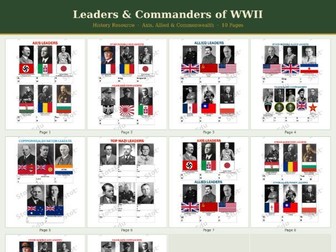
Leaders and Commanders of World War Two 10-Page Worksheet Pack with Answer Key PDF included. Suitable for Grades 8-10 This comprehensive 10-page worksheet pack challenges students to identify the major political leaders and military commanders of World War Two from both the Axis and Allied powers. Using photograph-based identification activities supported by national flags and name initials as clues, it is ideal as a student paced full lesson resource, revision activity, homework task, or end-of-unit task What’s included: Page 1: Axis Leaders: Identify the leaders of Nazi Germany, the Kingdom of Italy, the Empire of Japan, the Kingdom of Hungary, the Kingdom of Romania, and the Tsardom of Bulgaria Page 2: Other Notable Axis Leaders (Vichy France, Romania, Japan) and Major Axis Commanders from the German Army, Imperial Japanese Navy, and Royal Italian Army Page 3: Allied Leaders: identify the “Big Three” (UK, USSR, USA) plus Free France, the Republic of China, and Poland in exile Page 4: Other Notable Allied Leaders and Major Allied Commanders across US, British, and Soviet forces Page 5: Commonwealth Nation Leaders - Canada, British India, South Africa, Australia, and New Zealand Page 6: Top Nazi Leaders extended activity - students identify six key figures in Nazi party and complete Name, Role, and Fate fields Pages 7–10: Teacher variation pages offering alternative layouts combining Axis and Allied sections on the same page Answer key included (separate Word document) Key words: WW2, World War Two, WWII, Axis leaders, Allied leaders, Hitler, Churchill, Stalin, Roosevelt, military commanders, political leaders, identification activity, Year 8, Year 9, Year 10, Grades 7–9, history worksheet, Nazi Germany, Empire of Japan, Soviet Union, Commonwealth nations File type: PDF
M.A.I.N (MAIN) Causes of World War I (WW1 WWI)Quick View
StotzEdu

M.A.I.N (MAIN) Causes of World War I (WW1 WWI)

(0)
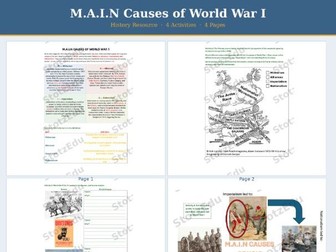
M.A.I.N Causes of World War One — 4-Page Worksheet with Primary Source Activities. PDF included. Suitable for Years 8–10 / Grades 7–9. This engaging 4-page worksheet introduces students to the long-term causes of World War One using the M.A.I.N acronym (Militarism, Alliances, Imperialism, Nationalism). Packed with primary source analysis and creative activities, it is ideal as a full lesson resource, homework task, or assessment activity. What’s included (PDF): Clear, accessible reading text explaining each M.A.I.N cause, with key vocabulary highlighted for students to define Activity 1: Match each M.A.I.N term to its correct definition Activity 2: Analyse a Punch magazine cartoon (1912–1914) and colour-code the causes of tension shown in the source Activity 3: Match four primary sources to the correct M.A.I.N cause and justify your answer in writing Activity 4: Annotate a cause-and-effect diagram explaining how each M.A.I.N factor led to WW1 Answer sheet included Key words: WW1, World War One, WWI, M.A.I.N, causes of WW1, Militarism, Alliances, Imperialism, Nationalism, primary source analysis, Year 8, Year 9, Year 10, Grades 7-9, history worksheet, arms race, nationalism Balkans File type: PDF
Leaders & Commanders of WWIQuick View
StotzEdu

Leaders & Commanders of WWI

(0)
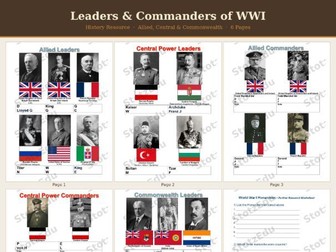
Leaders & Commanders of WWI — 6‑Page Worksheet with Visual and Research Activities PDF included. Suitable for Years 8–10 / Grades 7–9. This comprehensive 6‑page worksheet introduces students to the key political leaders, monarchs, and military commanders of World War I. Through photos, flags, and clues, students explore who led the major powers, and who led armies. The resource supports content knowledge, comparison skills, and historical reasoning with further research questions on the last page Ideal for use as a student paced full lesson, revision task, or homework activity. What’s included (PDF): Page 1: Allied Leaders Identifies political leaders and monarchs of the United Kingdom, France, Russia, the United States, and Italy. Page 2: Central Power Leaders Identifies rulers of the German Empire, Austria‑Hungary, the Ottoman Empire, and Bulgaria. Page 3: Allied Commanders Identifies senior military commanders from the United Kingdom and France, with space to define their roles. Page 4: Central Power Commanders Identifies key military commanders from Germany, Austria‑Hungary, and the Ottoman Empire. Page 5: Commonwealth Leaders Identifies leaders from the Dominion of Canada, British India, Union of South Africa, Australia, and New Zealand, highlighting the global reach of the British Empire. Page 6: Further Research Worksheet Explores World War I monarchies, including family connections between rulers, which monarchies survived beyond 1922, and a short written explanation on why many monarchies collapsed after the war. Answer sheet included Key words WWI, World War One, World War I, leaders of WWI, commanders of WWI, monarchies, Allied Powers, Central Powers, British Empire, Commonwealth, Kaiser Wilhelm II, Tsar Nicholas II, King George V, Austria‑Hungary, military leadership, Year 8 history, Year 9 history, Year 10 history, Grades 7–9, history worksheet
World War I AlliancesQuick View
StotzEdu

World War I Alliances

(0)
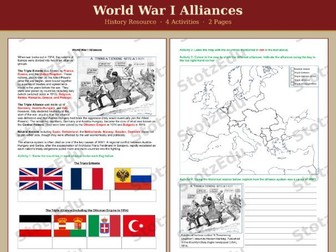
World War I Alliances worksheet with map activities and primary source analysis. PDF included. Suitable for Years 8–10 / Grades 7–9. This engaging 2-page worksheet introduces students to the alliance system in World War One, covering the Triple Entente, Triple Alliance, and Neutral Nations. It combines reading, map work, and primary source analysis, making it ideal as a lesson activity, homework, or assessment task. What’s included (PDF): Informational text on the Triple Entente, Triple Alliance, and Neutral Nations Activity 1: Identify countries from their WWI-era flags Activity 2: Label a blank map of Europe with alliance countries Activity 3: Colour-code the map using the alliance key Activity 4: Analyse a primary source (political cartoon, 1914) and explain how the alliance system caused WW1 Answer sheet included Key words: WW1, World War One, WWI, alliances, Triple Entente, Triple Alliance, causes of WW1, map activity, primary source, year 8, year 9, year 10, grades 7-9, history worksheet File type: PDF