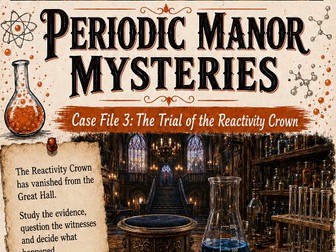
The Reactivity Crown
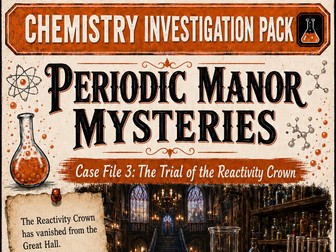
A KS3 chemistry mystery in which pupils investigate what happened to a mysterious crown at Periodic Manor using clues linked to metals, reactions and the reactivity series. Students examine evidence, compare possible explanations and use their understanding of how different metals react to decide which material or reaction best explains the case.
The activity supports key ideas in chemical reactions, metals, displacement and reactivity, while encouraging pupils to use evidence carefully rather than relying on guesses. It works well as a consolidation task after teaching the reactivity series or as an engaging practical-style investigation.
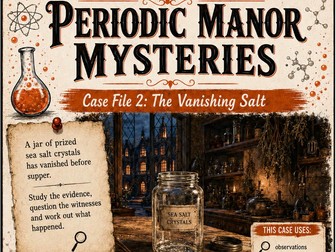
The Vanishing Salt
A KS3 chemistry mystery in which pupils investigate the disappearance of a salt sample at Periodic Manor. Using witness statements, scene evidence and practical clues, students identify useful information, rule out misleading evidence and explain what happened using chemical reasoning.
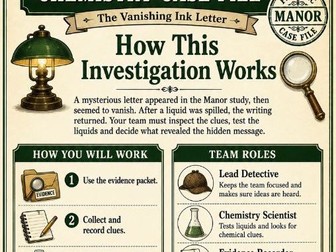
The Vanishing Ink Letter
A KS3 chemistry mystery in which a hidden or disappearing message causes confusion at Periodic Manor. Pupils investigate the evidence using ideas linked to acids, alkalis, pH and indicators. They examine witness statements, chemical clues and possible explanations before deciding how the message appeared, disappeared or changed.
This case supports the acids and alkalis topic by helping pupils apply their knowledge of pH, colour change and indicator reactions in a memorable context. It is particularly useful as a practical investigation, topic hook or consolidation lesson.
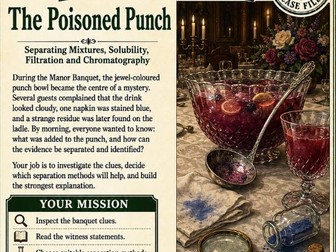
The Poisoned Punch
A KS3 chemistry mystery in which something unusual has been added to the punch at a Periodic Manor banquet. Pupils investigate clues such as colour, solubility, residue, cloudiness and possible contamination before deciding which substance is most likely responsible.
The activity links strongly to separating mixtures, solubility, filtration, evaporation and chromatography. It encourages students to choose appropriate separation techniques, interpret evidence and explain how different substances can be identified or removed from a mixture.
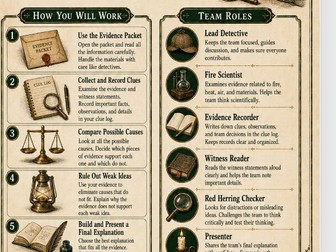
The Murdered Candle Flame
A KS3 science mystery in which a candle flame suddenly goes out during an event at Periodic Manor. Pupils compare possible explanations including lack of oxygen, carbon dioxide, draughts, fuel problems and heat loss before deciding what “killed” the flame.
This mystery supports work on combustion, oxygen, carbon dioxide, chemical reactions and the fire triangle. It works well as a demonstration-based lesson or as a consolidation task after teaching combustion and gases.
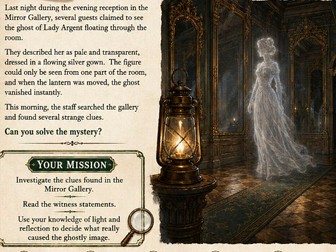
The Ghost in the Glass
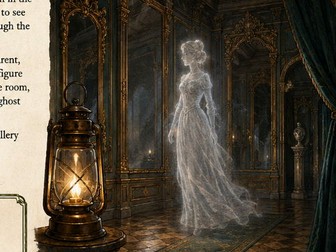
A KS3 physics mystery in which guests at Periodic Manor claim to have seen a ghostly figure in the glass. Pupils investigate whether the sighting can be explained scientifically using reflection, viewing angles, light paths and evidence from the scene.
This case supports the light topic, especially reflection and how images are seen. It encourages pupils to move beyond supernatural explanations and use ray diagrams, observation and logical reasoning to explain an optical illusion.
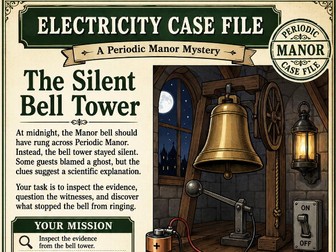
The Silent Bell Tower
A KS3 physics mystery in which the bell tower at Periodic Manor fails to ring. Pupils investigate whether the problem was caused by a broken wire, dead cell, faulty switch, insulating material or another electrical fault.
The case links to circuits, conductors, insulators, switches, cells and complete circuits. It is a clear and accessible physics mystery that works well with practical circuit-building or as a structured evidence-based reasoning task.
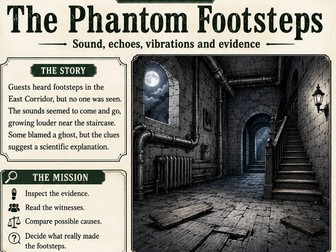
The Phantom Footsteps
A KS3 physics mystery in which footsteps are heard in a corridor at Periodic Manor, but no one is seen. Pupils investigate possible explanations including echoes, vibrations, sound travelling through solids, loose floorboards and sound from another room.
The activity links to sound, vibrations, echoes and how sound travels through different materials. It is useful for developing pupils’ understanding that sound can travel, reflect and be transmitted in ways that are not always immediately obvious.
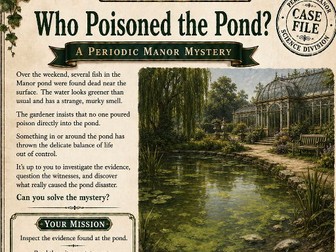
Who Poisoned the Pond?
A KS3 biology/environmental science mystery in which the pond at Periodic Manor has been affected and pupils must determine what caused the problem. Students examine evidence linked to algae, fertiliser, oxygen levels, pH, food webs and human impact.
This case supports ecology, ecosystems, pollution, food chains, eutrophication and environmental change. It is particularly strong for helping pupils build a cause-and-effect explanation using several connected pieces of evidence.
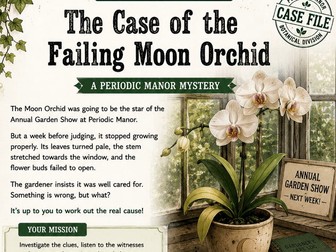
The Case of the Failing Moon Orchid
A KS3 biology mystery in which a prized orchid at Periodic Manor is failing before an important display. Pupils investigate greenhouse evidence, witness statements and plant-growth clues to work out which factor is limiting the plant’s growth.
The case links to photosynthesis, plant growth, limiting factors, light, water, temperature and minerals. It works well as a plant science enquiry and encourages pupils to connect visible plant symptoms with scientific explanations.
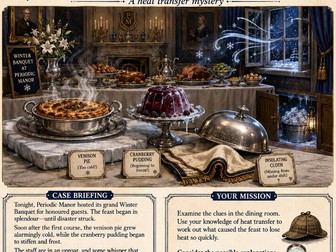
The Frozen Feast
A KS3 physics mystery in which food at Periodic Manor’s winter feast loses heat unusually quickly. Pupils investigate clues linked to cold surfaces, open windows, missing insulation, radiation from heat sources and possible hidden ice.
The case supports energy transfer, conduction, convection, radiation, insulation and temperature change. It works well as a heat-transfer consolidation task because pupils must compare several possible causes and decide which best fits the evidence.
The Stolen Silver Spoon
A KS3 physics/chemistry mystery in which Lady Argent’s silver spoon may have been replaced with a fake. Pupils use evidence linked to mass, volume, water displacement and density to decide whether the spoon is genuine and what material the replacement might be made from.
This activity supports particles and properties of matter, density, measurement and scientific calculation. It is a strong maths-in-science investigation because pupils must use measurements rather than appearance to justify their conclusion.
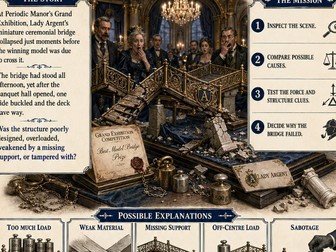
The Collapsing Bridge
A KS3 physics mystery in which a model bridge at Periodic Manor collapses just before judging. Pupils investigate whether the failure was caused by too much load, an off-centre load, a missing support, weak material, damaged joints or possible sabotage.
The case links to forces, loads, structures, supports, stability and moments or turning effects. It is particularly useful for engineering-style reasoning, as pupils must explain how forces act through a structure and why certain parts fail.
Periodic Manor Biology Mysteries Bundle
KS3 Science Mystery Lessons | Biology Case Files | Evidence-Based Enquiry
Bring KS3 biology to life with the Periodic Manor Biology Mysteries Bundle — a collection of story-led science investigation lessons where pupils become biology detectives.
Each mystery begins with a strange event at Periodic Manor or the nearby village of Bacillia Beck. Students must examine evidence, read witness statements, interpret maps and records, identify patterns, rule out red herrings and build a final scientific explanation.
This bundle is designed to help pupils apply biology knowledge in memorable, purposeful contexts while developing enquiry, teamwork, evidence handling and scientific reasoning.
This bundle is ideal for:
KS3 biology lessons
topic hooks
consolidation and revision
enquiry-based lessons
STEM enrichment
science club activities
cover lessons with structure
group problem-solving tasks
What is included?
The Case of the Failing Moon Orchid
A plant science mystery in which a prized orchid at Periodic Manor is failing before an important display. Pupils investigate greenhouse evidence, witness statements and plant-growth clues to decide which factor is limiting the plant’s growth.
KS3 links: photosynthesis, plant growth, limiting factors, light, water, minerals and temperature.
Who Poisoned the Pond?
An ecology mystery in which the pond at Periodic Manor has been affected and pupils must determine what caused the problem. Students examine evidence linked to algae, fertiliser, oxygen levels, pH, food webs and human impact.
KS3 links: ecosystems, food webs, pollution, eutrophication, human impact and environmental change.
The Mould in the Pantry
A microbes mystery in which food stored in the manor pantry has spoiled unexpectedly. Pupils investigate clues linked to warmth, moisture, uncovered food, damaged packaging and food preservation to work out why mould has grown.
KS3 links: microorganisms, fungi, decomposition, food spoilage, food preservation and conditions for microbial growth.
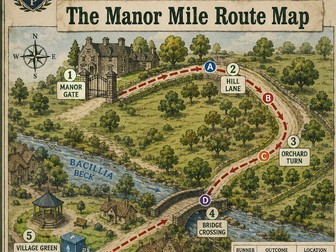
The Manor Mile Mystery: The Case of the Fainting Finish Line
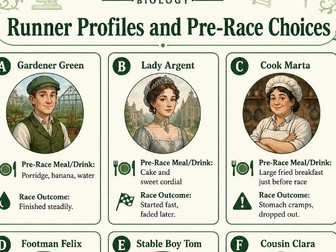
A digestion and nutrition mystery based around the annual Bacillia Beck village race. Pupils compare runner profiles, pre-race food choices, hydration, race results and witness statements to work out why some runners performed well while others faded, dropped out or became lightheaded.
KS3 links: digestion, nutrients, carbohydrates, protein, fats, hydration, balanced diet, exercise and energy from food.
The Fever at Bacillia Beck
A disease transmission mystery in which villagers and manor staff become ill after the village fair. Pupils use maps, illness records, witness statements and evidence cards to identify the most likely source of infection and explain how microbes spread.
KS3 links: microorganisms, pathogens, disease transmission, contaminated water, hygiene, sanitation and preventing infection.
Skills developed
Across the bundle, pupils practise:
using evidence to support a conclusion
identifying patterns in data and observations
comparing possible explanations
ruling out red herrings
applying biology knowledge in context
interpreting maps, records and witness statements
using correct scientific vocabulary
working collaboratively
writing or presenting a justified final verdict
How the lessons work
Most mysteries include:
a case briefing or story hook
evidence board or scene clues
maps, records or witness statements
student evidence logs
comparison tables
final verdict / case closed task
teacher notes or answer guidance
Pupils work best in small groups as scientific detectives. They gather clues, discuss possible explanations, compare evidence and then present or write a final theory using claim, evidence and reasoning.
Recommended starting point
Start with Who Poisoned the Pond? or The Mould in the Pantry. Both have clear evidence chains and accessible biology links, making them strong introductions to the Periodic Manor biology format.
Teacher note
These resources are designed to support enquiry, discussion and scientific reasoning. They work best when pupils are encouraged to explain why they think something happened, rather than simply trying to guess the answer.
Periodic Manor Physics Mysteries Bundle
KS3 Science Mystery Lessons | Physics Case Files | Evidence-Based Enquiry
Bring KS3 physics to life with the Periodic Manor Physics Mysteries Bundle — a collection of story-led science investigation lessons where pupils become physics detectives.
Each mystery begins with an unusual event at Periodic Manor. Students must inspect evidence, examine maps and diagrams, interpret clues, compare explanations, rule out red herrings and use physics knowledge to solve the case.
This bundle is designed to make physics feel purposeful, memorable and investigative. It is especially useful for helping pupils apply ideas such as circuits, light, sound, density, forces and heat transfer in real contexts.
This bundle is ideal for:
KS3 physics lessons
topic hooks
consolidation and revision
practical investigation lessons
cover lessons with structure
STEM enrichment
science club activities
group problem-solving tasks
What is included?
The Silent Bell Tower
A circuits mystery in which the bell tower at Periodic Manor fails to ring. Pupils investigate whether the fault was caused by a broken wire, dead cell, faulty switch, insulating material or another electrical issue.
KS3 links: circuits, cells, switches, conductors, insulators, complete circuits and electrical faults.
The Ghost in the Glass
A light mystery in which guests claim to have seen a ghostly figure in the glass. Pupils investigate whether the sighting can be explained using reflection, viewing angles, light paths and evidence from the scene.
KS3 links: light, reflection, ray paths, mirrors, viewing angles and optical illusions.
The Phantom Footsteps
A sound mystery in which footsteps are heard in a corridor at Periodic Manor, but no one is seen. Pupils compare possible explanations involving echoes, vibrations, sound travelling through solids and hidden sound sources.
KS3 links: sound, vibrations, echoes, sound transmission and sound through different materials.
The Stolen Silver Spoon
A density mystery in which Lady Argent’s silver spoon may have been replaced with a fake. Pupils use evidence linked to mass, volume, displacement and density to decide whether the spoon is genuine.
KS3 links: density, mass, volume, displacement, properties of materials and measurement.
The Collapsing Bridge
A forces and structures mystery in which a model bridge at Periodic Manor collapses just before judging. Pupils investigate whether the collapse was caused by too much load, an off-centre force, weak material, missing supports or possible sabotage.
KS3 links: forces, loads, structures, stability, supports, moments and engineering design.
The Frozen Feast
A heat transfer mystery in which food at Periodic Manor’s winter feast cools or freezes unexpectedly. Pupils investigate clues linked to open windows, cold surfaces, missing insulation, radiation, conduction and convection.
KS3 links: energy transfer, conduction, convection, radiation, insulation and temperature change.
Skills developed
Across the bundle, pupils practise:
applying physics knowledge to unfamiliar situations
using evidence to support a conclusion
interpreting diagrams, maps and practical clues
comparing possible explanations
identifying red herrings
using correct physics vocabulary
discussing and justifying ideas
building claim-evidence-reasoning explanations
presenting a final verdict clearly
How the lessons work
Most mysteries include:
a case briefing or story hook
evidence board or scene clues
maps, diagrams or practical evidence
witness statements
student recording sheets
comparison or theory-building tasks
final verdict / case closed page
teacher notes or answer guidance
Pupils work best in small groups as physics detectives. They examine evidence, test possible explanations and use scientific reasoning to decide which explanation best fits the case.
Teacher note
These resources are designed to make physics more investigative and discussion-based. They work best when pupils are encouraged to compare explanations and justify their final answer using evidence, not guesswork.
Periodic Manor Chemistry Mysteries Bundle
KS3 Science Mystery Lessons | Chemistry Case Files | Evidence-Based Enquiry
Bring KS3 chemistry to life with the Periodic Manor Chemistry Mysteries Bundle — a collection of story-led science investigation lessons where pupils become chemistry detectives.
Each mystery begins with a strange event at Periodic Manor. Students must examine evidence, read witness statements, interpret practical clues, rule out red herrings and build a final scientific explanation. These lessons are designed to make chemistry feel purposeful, memorable and investigative, while supporting key KS3 curriculum content.
This bundle is ideal for:
KS3 chemistry lessons
topic hooks
consolidation and revision
practical investigation lessons
cover lessons with structure
STEM enrichment or science club activities
group problem-solving tasks
What is included?
The Vanishing Salt
A chemistry mystery where pupils investigate the disappearance of a salt sample using scene evidence, witness statements, practical clues and chemical reasoning.
KS3 links: chemical reactions, salts, practical investigation, evidence handling.
The Reactivity Crown
Students investigate a mysterious crown using evidence linked to metals, reactions and the reactivity series. They must decide which material or reaction best explains the case.
KS3 links: metals, reactivity series, displacement, chemical reactions.
The Vanishing Ink Letter
A hidden or disappearing message causes confusion at Periodic Manor. Pupils use pH, acids, alkalis and indicator clues to explain what happened.
KS3 links: acids and alkalis, pH, indicators, neutralisation, colour change.
The Poisoned Punch
Something unusual has been added to the punch at the manor banquet. Students investigate solubility, residue, colour and separation evidence to identify the most likely substance.
KS3 links: separating mixtures, solubility, filtration, evaporation, chromatography.
The Murdered Candle Flame
A candle flame mysteriously goes out during an event at the manor. Pupils compare possible explanations including oxygen loss, carbon dioxide, draughts, fuel problems and heat loss.
KS3 links: combustion, oxygen, carbon dioxide, gases, chemical reactions, fire triangle.
Skills developed
Across the bundle, pupils practise:
using evidence to support a conclusion
comparing possible explanations
identifying red herrings
applying chemistry knowledge in context
interpreting practical observations
working collaboratively
explaining ideas using scientific vocabulary
presenting a justified final verdict
How the lessons work
Most mysteries include:
a case briefing or story hook
evidence board or scene clues
witness statements
student recording sheets
comparison or evidence-sorting tasks
final verdict / case closed page
teacher notes or answer guidance
Pupils work best in small groups as scientific detectives. They gather evidence, discuss possible explanations and then present or write a final theory using claim, evidence and reasoning.
Teacher note
These resources are designed to support enquiry, discussion and scientific reasoning. They work best when pupils are encouraged to explain why they think something happened, rather than simply trying to guess the answer.


 Quick View