How Would I Feel? – Feelings & Emotions Assessment WorksheetsQuick View
C_hall26

How Would I Feel? – Feelings & Emotions Assessment Worksheets

(0)
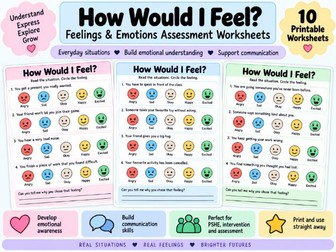
Help pupils develop and demonstrate their understanding of feelings and emotions with this set of 10 printable assessment worksheets. Each worksheet presents pupils with four everyday situations and asks them to think about how they might feel. Pupils choose the emotion that best matches each situation, providing an accessible way to explore emotional awareness and understanding. What is included? ✔ 10 printable worksheets ✔ 40 different everyday situations ✔ Visual emotion choices ✔ Simple, pupil-friendly language ✔ A mixture of school, home and social situations ✔ Suitable for individual or small-group work ✔ Useful for assessment, intervention and PSHE activities Skills assessed The activities can be used to explore pupils’ ability to: • Recognise and identify emotions • Connect situations with feelings • Understand how different experiences can affect emotions • Develop emotional vocabulary • Talk about their own feelings • Consider how they might feel in different situations • Communicate their emotional responses How can the resource be used? These worksheets can be used as: • Baseline assessments • Individual assessments • PSHE activities • Social and emotional learning activities • Pastoral support activities • Intervention work • Evidence of progress • Discussion starters • One-to-one activities The worksheets are designed to be simple, visual and accessible, making them suitable for pupils who may benefit from reduced written demands and visual prompts. Teacher use The worksheets can also be used as a starting point for discussion. After a pupil chooses an emotion, adults can ask: “Why would you feel that way?” This provides an opportunity to assess not only emotion recognition but also the pupil’s ability to explain and communicate their thinking. 10 printable PDF worksheets included. Please note: This resource is designed as an assessment/activity resource and is not a diagnostic assessment.
Welsh Numbers 1-10 | Rhifau WorksheetsQuick View
C_hall26

Welsh Numbers 1-10 | Rhifau Worksheets

(0)
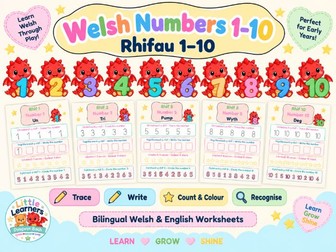
Help young learners practice Welsh numbers 1–10 with these fun bilingual Welsh and English number worksheets. Children trace, write, recognise and practice each number alongside the Welsh number word. What’s included? This resource contains 10 printable A4 worksheets, covering Welsh numbers 1–10. Each worksheet includes: • The Welsh number and English number • The Welsh number word, e.g. Un, Dau, Tri • Number tracing practice • Number writing practice • A counting and colouring activity • Number recognition and circling activity • Cute, child-friendly Little Learners illustrations Perfect for: • Early Years • Nursery • Reception • Foundation Phase • Welsh-medium classrooms • Bilingual Welsh/English classrooms • Welsh as a second language • Maths and numeracy activities • Home learning The simple, consistent layout makes the worksheets easy for young children to follow independently or with adult support. Numbers included: 1 – Un 2 – Dau 3 – Tri 4 – Pedwar 5 – Pump 6 – Chwech 7 – Saith 8 – Wyth 9 – Naw 10 – Deg Format: A4 printable worksheets Language: Welsh and English Number range: 1–10
What Could I Say? – Communication Skills WorksheetsQuick View
C_hall26

What Could I Say? – Communication Skills Worksheets

(0)
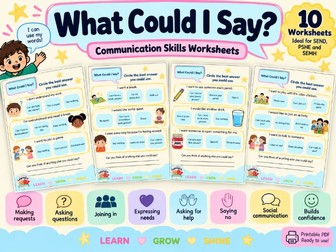
What Could I Say? – Communication Skills Worksheets Help pupils develop their functional communication and social communication skills with this set of 10 colourful, accessible worksheets. Each worksheet presents everyday situations and asks pupils to circle the best response they could use. The activities encourage pupils to think about what they want or need and how they can communicate this appropriately. The worksheets include situations such as asking for help, requesting a turn, joining an activity, asking questions, expressing worries and communicating personal boundaries. What’s included? ✔ 10 printable worksheets ✔ 30 everyday communication scenarios ✔ Simple, pupil-friendly language ✔ Visual prompts and colourful illustrations ✔ Multiple-choice communication responses ✔ Opportunity for pupils to suggest their own response ✔ Suitable for individual work, intervention or small-group activities Skills covered Asking for help Making requests Asking questions Expressing needs Joining in with activities Taking turns Communicating feelings Saying no appropriately Setting personal boundaries Seeking support when worried Responding appropriately when something goes wrong The pack includes activities where pupils practise communicating needs such as wanting a break, needing somewhere quiet or wanting to talk to someone. It also includes situations involving personal boundaries and saying no appropriately. How can it be used? These worksheets are ideal for: SEND provision Communication and language intervention PSHE SEMH activities Social skills work Pastoral support Individual pupil assessment Small-group intervention One-to-one discussion Each page finishes with “Can you think of anything else you could say?”, giving pupils an opportunity to generate their own language rather than simply selecting an answer.